PhysicsTest
- 256
- 27
- TL;DR
- I want to understand the difference between the line and phase voltages.
When i study the 3 phase systems, this is want i understand for a Star connection Line voltage is ##\sqrt 3 V_\phi## and leads the phase voltage by 30Degrees.
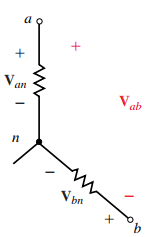
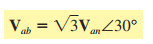 ----> eq1
So, from above we can conclude that both Line voltages and phase voltages are sine waves with phase difference.
But in case of Inverter design in place of the 3 phase system, if i refer the application note i attached, the Line to Ground or phase voltage is different from line voltages as shown below. The line voltages are sine waves with 120 degrees apart which is as expected.
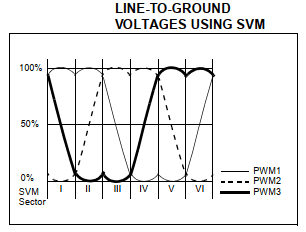
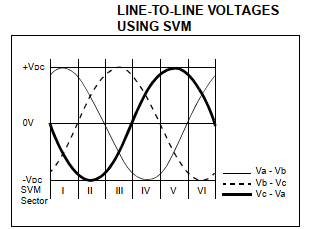
Fig1 Fig2
a. Is the eq1 still applicable?
b. If the terminals coming out of the inverter let us say are R1, Y1, B1, and if i observe the waveform of R1,Y1,B1 on an oscilloscope, will i see the waveform of Fig1? and I can see the waveform of Fig2 only with differential probe?
The topic i read for 3 phase AC systems may not be directly applicable to motors alone, it is applicable to house hold supply as well. I am confused if i can compare them ?
So, from above we can conclude that both Line voltages and phase voltages are sine waves with phase difference.
But in case of Inverter design in place of the 3 phase system, if i refer the application note i attached, the Line to Ground or phase voltage is different from line voltages as shown below. The line voltages are sine waves with 120 degrees apart which is as expected.
Fig1 Fig2
a. Is the eq1 still applicable?
b. If the terminals coming out of the inverter let us say are R1, Y1, B1, and if i observe the waveform of R1,Y1,B1 on an oscilloscope, will i see the waveform of Fig1? and I can see the waveform of Fig2 only with differential probe?
The topic i read for 3 phase AC systems may not be directly applicable to motors alone, it is applicable to house hold supply as well. I am confused if i can compare them ?