Hypercube
- 62
- 36
This isn't really a homework question, I just need help understanding the example:
=====================
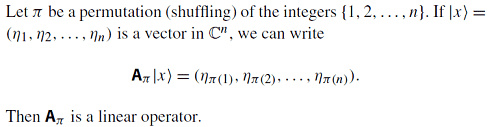
====================
So transformation takes complex n-tuple as input, and it seems output is also a complex n-tuple (which is what makes it "operator"). But permutations of n entries is not n. I'm confused! Let's use the simple example, let x = (1, 2, 3). Permutations of this vector would be a set of 3! entries:
{(1, 2, 3),(1, 3, 2),(2, 1, 3),(2, 3, 1),(3, 1, 2),(3, 2, 1)}
But the transformation seems to produce one single ordered n-tuple, rather than a whole set.
Alternative interpretation would be that entries in the range of T: eta1, eta2, eta3, ..., etan are the number of permutations of the first n elements. But that also makes no sense, I would end up with a sequence of natural numbers that do not depend on the input vector.
I must be misunderstanding something, and I have a feeling it's obvious. Any help would be appreciated, thanks in advance.
(Note to moderator: I have not used the template since it is not applicable; no questions nor relevant equations. My thoughts and effort on the example have been included though. Also, apologies if I am posting in the wrong place.)
=====================
====================
So transformation takes complex n-tuple as input, and it seems output is also a complex n-tuple (which is what makes it "operator"). But permutations of n entries is not n. I'm confused! Let's use the simple example, let x = (1, 2, 3). Permutations of this vector would be a set of 3! entries:
{(1, 2, 3),(1, 3, 2),(2, 1, 3),(2, 3, 1),(3, 1, 2),(3, 2, 1)}
But the transformation seems to produce one single ordered n-tuple, rather than a whole set.
Alternative interpretation would be that entries in the range of T: eta1, eta2, eta3, ..., etan are the number of permutations of the first n elements. But that also makes no sense, I would end up with a sequence of natural numbers that do not depend on the input vector.
I must be misunderstanding something, and I have a feeling it's obvious. Any help would be appreciated, thanks in advance.
(Note to moderator: I have not used the template since it is not applicable; no questions nor relevant equations. My thoughts and effort on the example have been included though. Also, apologies if I am posting in the wrong place.)