Magnetic field lines around electron and wire seem to contradict

Click For Summary

Discussion Overview

The discussion revolves around the interpretation of magnetic field lines in relation to electron movement and conventional current flow. Participants explore the implications of the right-hand rule, the depiction of electron behavior, and the historical context of charge flow conventions.

Discussion Character

  • Conceptual clarification
  • Debate/contested
  • Technical explanation

Main Points Raised

  • One participant notes that using the right-hand rule for determining magnetic field direction may yield results that contradict the expected behavior of electrons, suggesting a potential misunderstanding of electron spin and angular momentum.
  • Another participant questions the charge of the electron and the convention for current direction, indicating a need for clarity on these foundational concepts.
  • It is pointed out that while the current is depicted as flowing upwards, the actual movement of electrons is downwards, highlighting the difference between conventional current and electron flow.
  • A participant references a comic to illustrate the confusion surrounding current direction and electron movement, while also suggesting that thinking about electron motion is beneficial for understanding electrical phenomena.
  • Another participant argues that considering the motion of conduction electrons relative to the positive ion lattice is crucial for comprehending concepts like Faraday's Law and the behavior of current-carrying wires.

Areas of Agreement / Disagreement

Participants express differing views on the utility of considering electron movement in discussions of current. There is no consensus on the best approach to understanding the relationship between magnetic fields and electron behavior.

Contextual Notes

Participants reference historical conventions in charge flow and the implications of these conventions on understanding magnetic fields, suggesting that there may be limitations in how these concepts are traditionally taught or understood.

SamRoss
Gold Member
Messages
256
Reaction score
36
In the picture below, the direction of the magnetic field lines can be determined by using the right-hand rule with the thumb pointing in the direction of the current.
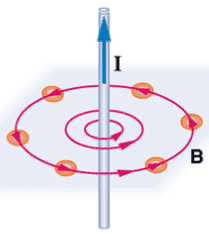
1604436073035.png


If we use the right hand rule in the picture below, thinking of the yellow arrow as the current, we would not get the correct direction for the magnetic field.
1604436057040.png


I'm aware that electrons do not literally spin around like little tops, but they are often depicted as spinning around because they have magnetic fields around them as if they were spinning. I'm curious as to why the electrons would be depicted as spinning around in a direction which would contradict the right-hand rule. Is it because their angular momentum is in this direction (that is, in a direction such that the relationship between it and the magnetic field can be found with a left-hand rule instead)?
 
Physics news on Phys.org
What is the charge of the electron, and what is the convention for the direction of charge flow in an electric current?
 
  • Like
Likes   Reactions: SamRoss
Nugatory said:
What is the charge of the electron, and what is the convention for the direction of charge flow in an electric current?

I see. So in the first picture I posted, the current is pointing up but the electrons would actually be flowing down. Is that it?
 
https://xkcd.com/567/
Yes, the direction of positive current flow is opposite to the direction of electron movement.
(And in practice it is almost never helpful or necessary to think about an electric current in terms of moving electrons)
 
  • Haha
  • Like
Likes   Reactions: berkeman and SamRoss
SamRoss said:
I see. So in the first picture I posted, the current is pointing up but the electrons would actually be flowing down. Is that it?
You can blame it all on Benjamin Franklin apparently.
 
  • Like
Likes   Reactions: SamRoss
Nugatory said:
https://xkcd.com/567/
Yes, the direction of positive current flow is opposite to the direction of electron movement.
(And in practice it is almost never helpful or necessary to think about an electric current in terms of moving electrons)
The cartoon is great, but I tend to the opposite opinion concerning the statement. To the contrary I think it's always of great advantage to think about the motion of the conduction electrons relative to the positive ion lattice in a metal when it comes to currents in usual conductors. With this in mind there's almost no more trouble with Faraday's Law of induction in connection with problems like the homopolar generator or the correct relativistic treatment of the current-carrying wire:

https://www.physicsforums.com/insights/homopolar-generator-analytical-example/
https://www.physicsforums.com/insights/relativistic-treatment-of-the-dc-conducting-straight-wire/
 

Similar threads

  • · Replies 5 ·
Replies
5
Views
2K
  • · Replies 22 ·
Replies
22
Views
2K
  • · Replies 2 ·
Replies
2
Views
2K
  • · Replies 22 ·
Replies
22
Views
2K
  • · Replies 1 ·
Replies
1
Views
2K
  • · Replies 1 ·
Replies
1
Views
1K
  • · Replies 12 ·
Replies
12
Views
1K
  • · Replies 23 ·
Replies
23
Views
5K
  • · Replies 27 ·
Replies
27
Views
3K
  • · Replies 1 ·
Replies
1
Views
2K