Magnetism as a Relativistic Phenomenon

Click For Summary
SUMMARY

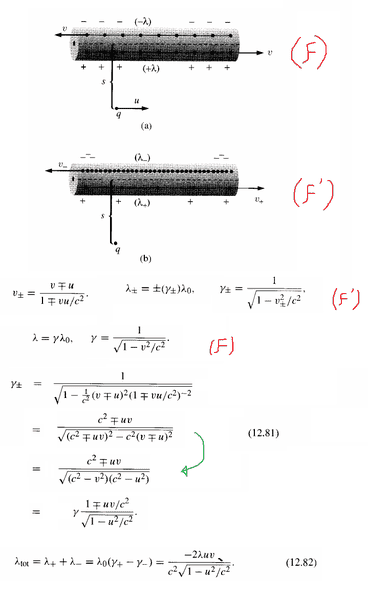
The discussion centers on the relativistic treatment of magnetism, specifically addressing the transformation of charges in different frames of reference. In frame F, charges move at speeds 'v' and '-v', while in frame F', the charge q is stationary, leading to modified speeds v+ and v-. The confusion arises in steps 12.81 and 12.82 regarding the treatment of the ± signs in the denominator, where the participants clarify that both positive and negative gamma yield the same denominator, thus simplifying the expression. This highlights the importance of understanding relativistic effects on charge motion.

PREREQUISITES
  • Relativity theory fundamentals
  • Understanding of electromagnetic theory
  • Familiarity with Lorentz transformations
  • Basic algebraic manipulation techniques
NEXT STEPS
  • Study the Lorentz force law in detail
  • Explore the derivation of the electromagnetic field tensor
  • Learn about the implications of charge motion in relativistic contexts
  • Investigate the mathematical treatment of relativistic velocity addition
USEFUL FOR

Physics students, educators, and researchers interested in advanced electromagnetism and the implications of relativity on magnetic phenomena.

unscientific
Messages
1,728
Reaction score
13
Consider a wire with charges moving with speed 'v'and '-v' in frame F (with charge q at distance s away moving at speed u).

In frame F', the charge q is stationary, and so the speeds of the charges in the wire are v+ and v-, where v- > v+

Hi guys, I have trouble following through the proof in step 12.81 and 12.82:

How did they get rid of the ± in the denominator? I tried using a2 - b2 = (a+b)(a-b) but it doesn't match the expression:
345n03k.png
 

Attachments

  • 345n03k.png
    345n03k.png
    17.6 KB · Views: 820
Last edited:
Physics news on Phys.org
The plus and minus on top of each other are different solutions to the equation. Whether you choose to solve for positive or negative gamma in equation 12.81, the denominator comes out the same. Then, if you factor the denominator, you get the equation after 12.81.
 

Similar threads

  • · Replies 20 ·
Replies
20
Views
3K
  • · Replies 5 ·
Replies
5
Views
1K
  • · Replies 4 ·
Replies
4
Views
2K
  • · Replies 28 ·
Replies
28
Views
5K
  • · Replies 14 ·
Replies
14
Views
4K
  • · Replies 1 ·
Replies
1
Views
2K
  • · Replies 27 ·
Replies
27
Views
3K
  • · Replies 4 ·
Replies
4
Views
2K
  • · Replies 15 ·
Replies
15
Views
1K
  • · Replies 5 ·
Replies
5
Views
2K