Devs
- 5
- 1
- Homework Statement
- It has no statement
- Relevant Equations
- mx''+bx'+kx=p(t)
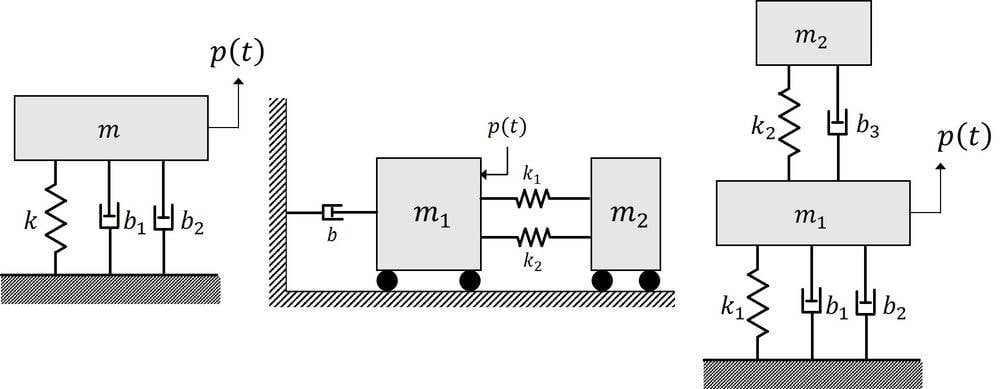
Summary:: How can I get mathematics modeling for these tree systems?
First of all, my mother tongue is not English, so my expression could be ambiguous.
I want to get mathematics modeling for these three system above, like this form.

First one is b -> (b1+b2), right? but I'm not sure about second and third figures.
After that, do I have to do Laplace Transform?
+Can I get Damping ratio and Natural frequency for all these systems? These are not necessary. Only mathematics modelings are also thank you.
I wanted to ask questions on Korean sites before, but I couldn't find appropriate site. Please help me.
Thank you all for your help.[Moderator's note: Moved from a technical forum and thus no template.]
First of all, my mother tongue is not English, so my expression could be ambiguous.
I want to get mathematics modeling for these three system above, like this form.
First one is b -> (b1+b2), right? but I'm not sure about second and third figures.
After that, do I have to do Laplace Transform?
+Can I get Damping ratio and Natural frequency for all these systems? These are not necessary. Only mathematics modelings are also thank you.
I wanted to ask questions on Korean sites before, but I couldn't find appropriate site. Please help me.
Thank you all for your help.[Moderator's note: Moved from a technical forum and thus no template.]
Last edited by a moderator: