Mesh Analysis for AC RLC Circuits: Finding Vo and Io

Click For Summary

Discussion Overview

The discussion revolves around using mesh analysis to find the output voltage (Vo) and output current (Io) in an AC RLC circuit. Participants are examining the formulation of mesh equations and addressing potential errors in their calculations.

Discussion Character

  • Technical explanation
  • Debate/contested
  • Mathematical reasoning

Main Points Raised

  • One participant presents initial mesh equations but expresses uncertainty about their correctness.
  • Another participant identifies a sign error in the voltage source in the mesh equations and suggests corrections.
  • A question is raised regarding the polarity of the voltage source and its effect on the mesh analysis.
  • Further clarification is provided on the application of Kirchhoff's Voltage Law (KVL) and the concept of conventional current in relation to the voltage source.
  • A later post explores a new formulation for loop 2 and seeks validation for the subsequent steps in the analysis.

Areas of Agreement / Disagreement

Participants do not reach a consensus on the correctness of the initial mesh equations, and multiple views on the interpretation of voltage polarity and mesh analysis remain present.

Contextual Notes

There are unresolved issues regarding the assumptions made in the mesh equations, particularly concerning the signs of voltage sources and the interpretation of current directions.

jess_88
Messages
6
Reaction score
0
hi guys

I am trying to fined Vo and Io using mesh analysis for the following cct
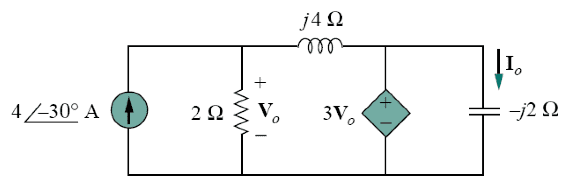
IGAdf.png


The formulas I made from the cct using mesh analysis don't seem right

here is what I have-
loop1
2(I1 - I2) = 0
loop2
2(I2 - I1) + I2(j4) - 3Vo = 0
loop3
3Vo + I3(-2j) = 0

and
I1 = 4<-30
vo = 2(I1 - I2)

loop1
2(4<-30 - I2) = 0
I2 = 4<-30

loop 2
2(4<-30 - 4<-30) + I2(j4) - 6(4<-30 - 4<-30)

loop 3
6(4<-30 - 4<-30) + I3(-2j) = 0

I must have done something wrong... I just don't know where
 
Physics news on Phys.org
here is what I have-
loop1
2(I1 - I2) = 0
loop2
2(I2 - I1) + I2(j4) - 3Vo = 0
loop3
3Vo + I3(-2j) = 0

For loop1 no mesh equation is needed, by inspection,

I_{1} = 4 \angle -30^{o}

Let's just keep that in mind because we will apply it later on.

For loop 2, you are mixing up the sign on the voltage source, it should be +3Vo. (You've mixed this up before in one of your previous problems.)

You have the same type of error in loop 3, -3Vo not +3Vo.

Fix those are you should be ready to solve!
 
ah great thanks!
just to clarify my mistake with 3Vo.
is the polarity reversed due to the polarity of the vo resister?
 
jess_88 said:
ah great thanks!
just to clarify my mistake with 3Vo.
is the polarity reversed due to the polarity of the vo resister?

I'm not sure what you mean.

You have to remember all you are doing with mesh analysis is KVL combined with Ohm's Law. (It's a little more complex than that because the mesh currents don't always model the physical currents but that's extra details)

If you apply KVL in a clockwise fashion you should find that you are running a "positive" current through the voltage source as per conventional current.

By conventional current, I mean that a positive current is defined as one that flows form positive to negative.

You can read more about it here, http://www.asmcommunity.net/board/index.php?topic=12847.0;wap2

"It all boils down to always ASSUMING that a external flow of positive charges from the pos to the neg terminal of a voltage source always produces a positive current. This causes electron flow to have a MATHEMATICALLY opposite direction with respect its real direction, but it is consistent and correct with respect to positively charged particles. In cases where knowing the real physical particle direction is important, that can be handled on a case by case basis. Most of the time in circuit analysis, the real direction does not matter."

Hopefully this clears things up!
 
Last edited by a moderator:
ah geez.
I get it now!
thank you so much :)
 
quick question.
I have for loop2
2(I2 - I1) + I2(j4) + 3Vo = 0
= -4I2 + j4(I2) = -I1(4)
can I do this next part??
-I2 + j4(I2) = -I1
-I2(1 - j) = -(4<-30)
I2 = (4<-30)/(sqrt(2)<-45)

... is this ok?
 

Similar threads

  • · Replies 7 ·
Replies
7
Views
3K
Replies
9
Views
2K
  • · Replies 7 ·
Replies
7
Views
2K
  • · Replies 187 ·
7
Replies
187
Views
59K
  • · Replies 7 ·
Replies
7
Views
2K
Replies
2
Views
3K
  • · Replies 4 ·
Replies
4
Views
2K
Replies
18
Views
2K
  • · Replies 4 ·
Replies
4
Views
3K
  • · Replies 6 ·
Replies
6
Views
2K