Engineering Mesh Analysis for time domains?

Click For Summary
The discussion focuses on solving a circuit using mesh analysis, where the user initially presents their mesh equations but finds discrepancies with the expected answers. It is clarified that the direction of the currents I1 and I2 is crucial, as I1 is clockwise and I2 is anticlockwise. The correct approach involves using I1 + I2 in the equations due to their opposing directions at the junction. The user realizes that if both currents are drawn in the same direction, their original equations would be valid. The final consensus is that the mesh equations can be correct if both currents are considered to flow anticlockwise.
jisbon
Messages
475
Reaction score
30
Homework Statement
Solve the following mesh circuit.
Relevant Equations
-
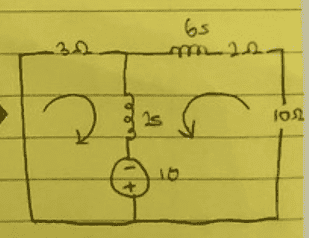
I've tried to solve the following circuit using mesh equation, but the solution seems to differ from my attempted answer.

Mesh circuit as follows:
1589772153530.png

My mesh equation is:

-10+3(i1)+2s(i1-i2)=0 (for the mesh on the left)
and
-10+12(i2)+6s(i2)+2s(i2-i1)=0 (right mesh)

However the answer seems to be different and claims that the equation are as follows:
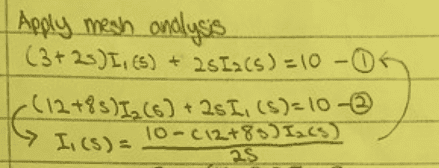
1589772263290.png


Am I missing something here?
Thanks
 
  • Like
Likes Delta2
Physics news on Phys.org
You have to show us how you took the directions of currents ##I_1,I_2## to be

And why you say in time domain since it seems you doing it in the s-domain (Laplace transformed currents)?
 
Sorry, what I meant was s domain.
As shown in the diagram, I1 is in the clockwise direction, while I2 (the one on the right) is in anticlockwise.
 
Then in your equations you should put ##I_1+I_2## where you have ##I_1-I_2## (or ##I_2-I_1##) and then your answer is the same with the book answer.
You should put ##I_1+I_2## because that's what we get -given the current directions as you say -if we apply KCL at the junction with the 3##\Omega## resistor the 6s coil and the 2s coil ,
 
  • Like
Likes Jody
Sorry I now understood you use mesh currents, but still the total mesh current in the branch that has the source and the 2s coil is ##I_1+I_2## because one is clockwise and the other counterclockwise.
 
  • Like
Likes Jody
Delta2 said:
Sorry I now understood you use mesh currents, but still the total mesh current in the branch that has the source and the 2s coil is ##I_1+I_2## because one is clockwise and the other counterclockwise.
Oh I see. So if they are in the same direction, my old equations will then be correct?
This:
10+3(i1)+2s(i1-i2)=0 (for the mesh on the left)
and
-10+12(i2)+6s(i2)+2s(i2-i1)=0 (right mesh)
 
jisbon said:
Oh I see. So if they are in the same direction, my old equations will then be correct?
This:
10+3(i1)+2s(i1-i2)=0 (for the mesh on the left)
and
-10+12(i2)+6s(i2)+2s(i2-i1)=0 (right mesh)
Yes I believe the above equations are correct if both are anticlockwise.
 
  • Like
Likes jisbon
I agree with Delta. You draw both of the currents in the same direction and so their sign should not flip.
 
  • Like
Likes Delta2

Similar threads

  • · Replies 7 ·
Replies
7
Views
2K
  • · Replies 7 ·
Replies
7
Views
3K
Replies
18
Views
2K
  • · Replies 4 ·
Replies
4
Views
7K
  • · Replies 7 ·
Replies
7
Views
2K
Replies
2
Views
3K
  • · Replies 6 ·
Replies
6
Views
2K
Replies
9
Views
2K
  • · Replies 6 ·
Replies
6
Views
2K
  • · Replies 17 ·
Replies
17
Views
3K