Mirau White Light Interferometer. Light Source?

Click For Summary

Discussion Overview

The discussion centers around the selection of a suitable white light source for a Mirau white light interferometer setup. Participants explore various options and considerations regarding the light source, including power requirements, the necessity of collimation, and the appropriateness of white light for specific applications.

Discussion Character

  • Exploratory
  • Technical explanation
  • Debate/contested

Main Points Raised

  • One participant seeks a white light source that is pre-collimated and integrated with necessary optical components, expressing a preference for a high-power option (100-200 Watts).
  • Another participant questions the need for such high power, suggesting that white lasers are rare and not typically used in interferometry.
  • Some participants note that white light interferometry is common and suitable for rough surfaces, which aligns with the original poster's application.
  • There is a suggestion that white light interferometry does not typically involve lasers, and that the setup may be more complex than anticipated.
  • Participants discuss the possibility of using optical fibers and LEDs as alternatives for generating white light.
  • A specific product (MCWHL5-C2) is proposed as a potential light source, with a suggestion that an aperture stop may be necessary.
  • A Product Support Engineer from Edmund Optics offers assistance and suggests that the original poster is on the right track with their setup.
  • Another participant points out that the referenced document shows a setup using a white light LED, indicating a practical example of a light source used in similar applications.

Areas of Agreement / Disagreement

Participants express differing views on the necessity and feasibility of using high-power white lasers for interferometry. While some agree on the suitability of white light for rough surfaces, there is no consensus on the best approach or specific light source to use.

Contextual Notes

Participants mention various assumptions regarding the complexity of setups and the characteristics of light sources, but these remain unresolved. The discussion reflects a range of experiences and knowledge levels regarding white light interferometry.

Who May Find This Useful

Individuals interested in optical engineering, interferometry, and those seeking practical advice on selecting light sources for experimental setups may find this discussion beneficial.

adamjts
Messages
24
Reaction score
0
Hi everyone,
I'm building a white light interferometer and need help choosing and finding a white light source.

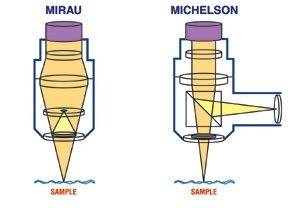
I'm using this mirau objective:
http://www.edmundoptics.com/microsc...ectives/nikon-interferometry-objectives/59312
Interferometry%201.jpg


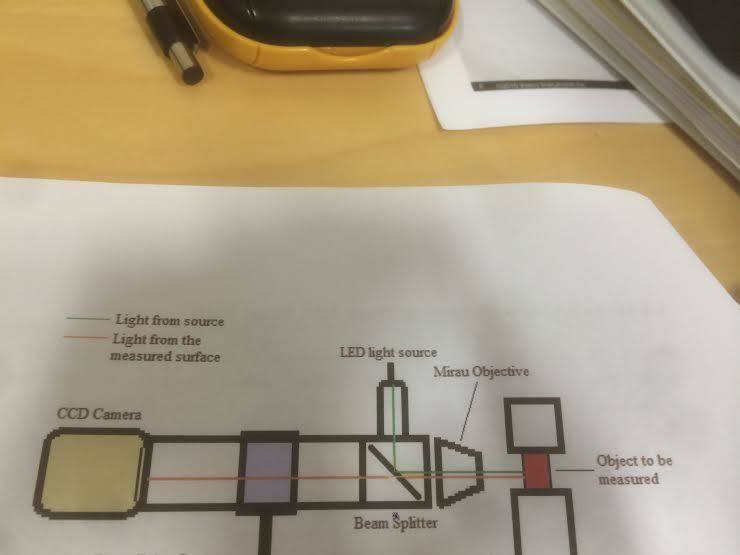
Here is the setup:

unnamed.jpg


I know that the light source will have to be collimated and go through an aperture stop, field stop, bandpass, etc. I was hoping that there was a white light laser that does these steps already so that I don't have to work with several different lenses and build a setup for them. Such a laser must exist, no? Does anyone know where I can find one? Ideally one that is 100-200 Watts? I've looked all over but am having trouble finding an manufacturer that makes what I'm looking for.

Are there any important steps that I'm missing? Should a collimated white light beam do the job?

THANKS!
 
Engineering news on Phys.org
200 Watts? (!) are you doing interferometry on the moon? That level of power on a laser is used to cut steel. Further, white lasers are a special purpose rarity. I've not heard of anyone using them for interferometry. Its not necessary. Why do you want to use white?
 
I'm not sure about the wattage but i know that white light interferometry is a common practice.

http://fp.optics.arizona.edu/jcwyan.../Optical_Testing/WhiteLightInterferometry.pdf
http://www.micromanufacturing.com/content/understanding-scanning-white-light-interferometry
http://www.laserfocusworld.com/articles/print/volume-37/issue-9/features/interferometry/interferometric-approaches-each-have-advantages.html

White light is more suited to rougher surfaces which would be appropriate for my purpose because the surface I'm looking at will have µm variations.
 
Last edited by a moderator:
oh and yes I was totally off with the power of the laser
 
from what I've seen, white light interferometry is not done with a laser. And that includes your sources that you posted. reread the first page of your document from fp.optics. White lasers are a relatively recent invention. And I believe it is a much more complicated solution.
 
Last edited:
I was under the impression that the steps described in the diagram (before the light even reaches the beam splitter) were steps that were typical of those carried out in a laser before it exits the laser.
photo.jpg
 
adamjts said:
I was under the impression that the steps described in the diagram (before the light even reaches the beam splitter) were steps that were typical of those carried out in a laser before it exits the laser.
View attachment 70494

most of that is totally unnecessary if your light starts out monochromatic and coherent. For laser interferometry, all you need is the laser, a beam splitter, a lens, and a mirror.
 
  • Like
Likes   Reactions: 1 person
  • #10
  • #11
White Light Interferometry

Hi adamjts,

I'm a Product Support Engineer who works at Edmund Optics. I've been following your posts above and noticed that you're interested in White Light Interferometry. In terms of the setup that would go with the interferometry objective above, you're definitely on the right track. You would need an illumination source and a way to mount it inline. We have suggested parts for the illumination, inline mechanics, and the mounting. This would make sure that you don't have to build everything from scratch. If you're interested to discuss this further, please feel free to email me at this address. I look forward to working with you on your application.

Thanks,
PD
 
  • #12
hi adamjts

on pages 18 and 19 of that document in your post #6

its shows their setup, they are using a white light LED ( Light Emitting Diode)

Dave
 

Similar threads

  • · Replies 6 ·
Replies
6
Views
2K
  • · Replies 33 ·
2
Replies
33
Views
4K
  • · Replies 1 ·
Replies
1
Views
1K
  • · Replies 4 ·
Replies
4
Views
6K
  • · Replies 19 ·
Replies
19
Views
5K
  • · Replies 2 ·
Replies
2
Views
1K
  • · Replies 5 ·
Replies
5
Views
6K
  • · Replies 14 ·
Replies
14
Views
3K
  • · Replies 3 ·
Replies
3
Views
8K
  • · Replies 152 ·
6
Replies
152
Views
11K