Multivariable Arc Length Problem: Weird Form with Parameterization

Click For Summary
The discussion centers on a multivariable arc length problem where the user is confused about the parameterization and simplification of the arc length formula. They correctly parameterized the curve and derived the derivative, but are uncertain about the simplification of the expression for ds. Another participant emphasizes the importance of using the correct formula for ds, which involves summing the squares of the derivatives of each coordinate. The user acknowledges the formula but struggles to identify their mistake in the simplification process. The conversation highlights the need for careful application of the arc length formula in multivariable calculus.
The Head
Messages
137
Reaction score
2
Homework Statement
See Attachment
Relevant Equations
ds=sqrt(dx^2+dy^2+dz^2)
Arc Length = integral on C of ds
Problem: See Attachment. Parts (a) & (b) are clear, but my confusion arises in (c)-- I feel like there is a much simpler form. While technically my answer is correct, there must be something I'm missing.

I parameterized the curve C=(t, e^2t, e^2t) and got c'(t)=(1,2e^2t,2e^2t), which should be correct since I got the answer for (b). I said ds=sqrt(||c'(t)||)

So ds=sqrt(1+4e^2t+4e^4t) =sqrt((1+2e^2t)^2)=1 + 2e^2t. The limits are from t=0 to t=x_0.

Integral(1+2e^2t) dt = t+e^2t, and I'll evaluate at the limits to get:

x_0 + e^(2x_0) - 1. So if x_0=ln(W+1)^(1/3), then e^(2x_0)= (W+1)^2/3. But still, why ask for it in this crazy form? Or is it just a silly excuse to
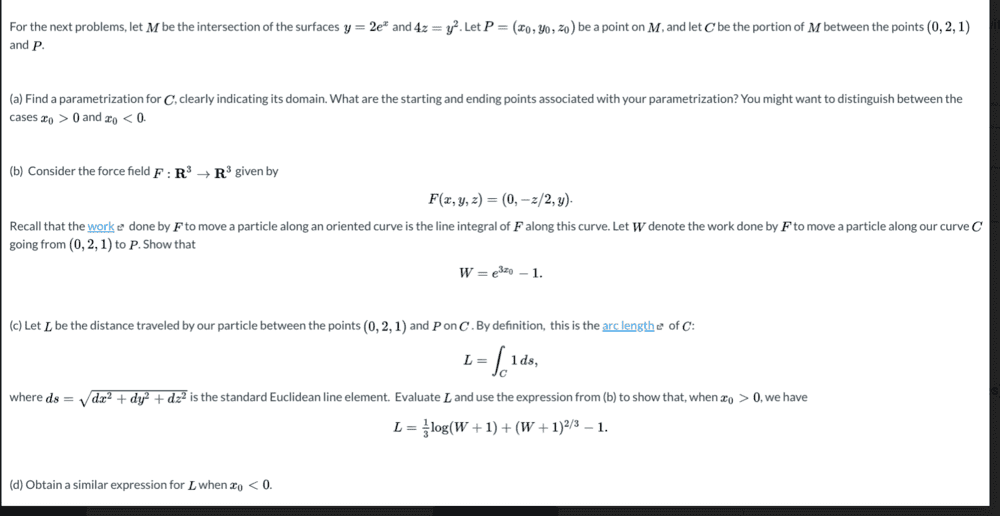
Screen Shot 2020-08-02 at 8.30.07 PM.png
 
Physics news on Phys.org
The Head said:
So ds=sqrt(1+4e^2t+4e^4t) =sqrt((1+2e^2t)^2)=1 + 2e^2t.
Stop right there, check your formula, my clac book says that

$$ds = \sqrt{\left( \tfrac{dx}{dt}\right) ^2 +\left( \tfrac{dy}{dt}\right) ^2 +\left( \tfrac{dz}{dt}\right) ^2 } \, dt$$
 
  • Like
Likes etotheipi
benorin said:
Stop right there, check your formula, my clac book says that

$$ds = \sqrt{\left( \tfrac{dx}{dt}\right) ^2 +\left( \tfrac{dy}{dt}\right) ^2 +\left( \tfrac{dz}{dt}\right) ^2 } \, dt$$

I agree on the formula, but not sure where I went wrong. Since it's arc length and the path is parameterized as c(t)= (t, 2e^t, e^(2t)) and c'(t)= (1, 2e^(t), 2e^(2t)) = (dx/dt, dy/dt, dz/dt). So squaring all terms and summing up gives: 1 + 4e^(2t) + 4e^(4t). So then I took the square root, simplified to 1+2e^2t, and then tacked on the dt. Where did I go wrong?
 
benorin said:
Stop right there, check your formula, my clac book says that

##ds = \sqrt{\left( \tfrac{dx}{dt}\right) ^2 +\left( \tfrac{dy}{dt}\right) ^2 +\left( \tfrac{dz}{dt}\right) ^2 } \, dt##
The above is equivalent to ##ds = \sqrt{dx^2 + dy^2 + dz^2}##
 
Question: A clock's minute hand has length 4 and its hour hand has length 3. What is the distance between the tips at the moment when it is increasing most rapidly?(Putnam Exam Question) Answer: Making assumption that both the hands moves at constant angular velocities, the answer is ## \sqrt{7} .## But don't you think this assumption is somewhat doubtful and wrong?

Similar threads

Replies
5
Views
2K
  • · Replies 2 ·
Replies
2
Views
1K
  • · Replies 9 ·
Replies
9
Views
2K
Replies
6
Views
1K
  • · Replies 5 ·
Replies
5
Views
2K
  • · Replies 6 ·
Replies
6
Views
2K
  • · Replies 8 ·
Replies
8
Views
6K
  • · Replies 2 ·
Replies
2
Views
1K
Replies
12
Views
2K
Replies
2
Views
2K