Twins Paradox: Nature Cheats but B Gets Fooled

Click For Summary

Discussion Overview

The discussion revolves around the Twins Paradox, specifically focusing on the implications of the Doppler effect and the perception of motion between two observers, Green and Blue, during their respective journeys. Participants explore the mechanics of signal transmission, the timing of events, and the resulting implications for understanding the paradox in a relativistic context.

Discussion Character

  • Exploratory
  • Technical explanation
  • Debate/contested
  • Mathematical reasoning

Main Points Raised

  • Some participants propose that Blue's understanding of Green's position is influenced by the Doppler effect and the timing of signals received, suggesting that Blue cannot accurately determine Green's position until he receives confirmation of Green's change in direction.
  • Others argue that Blue's model of Green's motion is not the same as Green's actual motion, leading to potential misunderstandings about events and their labels.
  • There is a discussion about the relevance of specific clock readings at various events and how they relate to the calculations of speed and position.
  • Some participants question how Blue can know whether Green has changed direction, emphasizing the delayed nature of information due to the finite speed of light.
  • Participants discuss the limitations of using Doppler shifts to infer distance, noting that additional information is required to make accurate calculations about Green's position after a certain point.

Areas of Agreement / Disagreement

Participants generally disagree on the interpretation of events and the implications of the Doppler effect, with multiple competing views on how accurately Blue can determine Green's position and the nature of their respective motions. The discussion remains unresolved with various conceptual errors identified by some participants.

Contextual Notes

Limitations include the dependence on the labeling of events, the assumptions made about the motion of Green after certain observations, and the unresolved nature of how Doppler shifts relate to distance calculations.

Stephanus
Messages
1,316
Reaction score
104
Dear PF Forum,
After all these post'. I want to know that my understanding of twins paradox is close enough.
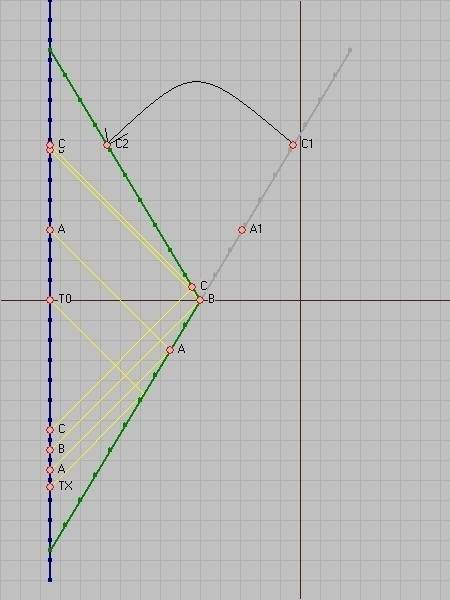
ST-01.jpg

So, Green travels, Blue stays.
Blue keeps sending signal, Green bounces the signal.
Doppler factor = 1/4, so ##\frac{1}{4} = \frac{1-v}{1+v}; v = 0.6##
And at event T0 (from B), Green changes direction. Blue can calculate the doppler effect and position, and know that G is at B.
At event A (above) Blue thinks that Green is at A1. Blue never knows that Green has changed frame.
And at event C (above) while Blue thinks that Green is at C1, suddenly the Doppler factor changes. From 0.25 to 4. Then Blue realize that Green is not at C1 but at C2. That Green has suddenly jump from a distance to a spot at C2.
So it mustn't be Green. It's something else who looks like Green whose time is dilated, and now Green's clock is speeding up from event C (above) until they meet. But the speeding up can catch up Blue's clock.
So, nature cannot be fooled, but nature fools B.
And for Green, at event T0, Green will see that Blue whose time is dilated, but now Blue's clock is speeding up and catches up Green's clock and still going on until they meet.
Is this how Twins Paradox work?
 
Physics news on Phys.org
Stephanus said:
at event T0 (from B), Green changes direction

No. At event B, Green changes direction. As you go on to point out, Blue does not know about Green's change in direction until he receives a light signal from event B and sees Green's Doppler shift change, which is at event C (or one of them--your event labeling is not very good since multiple events have a "C" next to them).

Stephanus said:
at event C (above) while Blue thinks that Green is at C1, suddenly the Doppler factor changes. From 0.25 to 4. Then Blue realize that Green is not at C1 but at C2. That Green has suddenly jump from a distance to a spot at C2.

No. Green doesn't "jump" at all; Green already changed direction, at event B. Event C is when Blue finds out about Green's change in direction and updates his model of Green's motion. Blue's model of Green's motion is not the same as Green's motion.

Stephanus said:
So it mustn't be Green. It's something else who looks like Green whose time is dilated, and now Green's clock is speeding up from event C (above) until they meet.

No. As above, Blue's model of Green's motion is not the same as Green's motion. Here you are confusing the two.

Stephanus said:
for Green, at event T0, Green will see that Blue whose time is dilated, but now Blue's clock is speeding up

No. At event B, Green sees Blue's Doppler shift change. But at event B, Green is not seeing light signals from event T0; he's seeing light signals from an event on Blue's worldline that you've labeled "B", but which should have some different label to avoid confusion. Green does not see light from event T0 until later.

Stephanus said:
Is this how Twins Paradox work?

Not really; you have made several conceptual errors. See above.
 
  • Like
Likes   Reactions: HallsofIvy
PeterDonis said:
No. At event B, Green changes direction. As you go on to point out, Blue does not know about Green's change in direction until he receives a light signal from event B and sees Green's Doppler shift change, which is at event C (or one of them--your event labeling is not very good since multiple events have a "C" next to them).
No. Green doesn't "jump" at all; Green already changed direction, at event B. Event C is when Blue finds out about Green's change in direction and updates his model of Green's motion. Blue's model of Green's motion is not the same as Green's motion.
No. As above, Blue's model of Green's motion is not the same as Green's motion. Here you are confusing the two.
No. At event B, Green sees Blue's Doppler shift change. But at event B, Green is not seeing light signals from event T0; he's seeing light signals from an event on Blue's worldline that you've labeled "B", but which should have some different label to avoid confusion. Green does not see light from event T0 until later.
Not really; you have made several conceptual errors. See above.
Okay...
ST-01.jpg

Okay,... there are three section (A)Above, (G)Green, (B)Below. So the events labeled as CB, BB, AB for below. CG, BG, AG and CA,BA,AA.
I prefer to use 1 letter event so the picture won't be crowded.
First before I response to your post. I would like to ask a simple question:
Rule of the game:
AB sends signal to AG containing his own clock. AG bounces back the signal to AA with AB clock and AG clock.
BB sends signal to BG containing... ( the same rule).
So, at
Event AA:
AA clock: 3200
AG clock: 2000 (is this relevant to our calculation?)
AB clock: 800

Event BA
BA clock: 4000
BG clock: 2500 (is this relevant?)
BB clock: 1000,

So (BA-AA) = 800; (BB-AB) = 200; Doppler factor is 4. What V, ##4 = \frac{1+V}{1-V}; V = 0.6##So speed is 0.6c.
Direction: Green is receding.
-----------------------------
Question: Can Blue calculate where Green is?
Thanks.
 
Stephanus said:
Can Blue calculate where Green is?

Based on what information? If you mean, based on the information he receives prior to event BA, no, he can't, because he hasn't yet seen Green change direction. Based on information he receives after event BA, yes, he can, because he has now seen Green change direction.
 
PeterDonis said:
Based on what information? If you mean, based on the information he receives prior to event BA, no, he can't, because he hasn't yet seen Green change direction. Based on information he receives after event BA, yes, he can, because he has now seen Green change direction.
What if we shift BA, BG, BG 1 milisecond below. Just before Green changes direction.
Can Blue determine Green position?
But how do Blue knows that Blue can/cannot determine Green direction?
And how do Blue knows that Green has/hasn't changed direction.
I just want to know about particular answer.
We see something blue-shifted. We substract it with doppler factor, and we "know" it's not violet, it's somewhat "orange"
We see a clock's speeding toward us, we subtract it with doppler factor, actually it's a little bit slower than our clocks.
We see a clock's runs slow, we subtract it with doppler factor, actually it's not that slow. It moves away from us.
Speed? We know at once from dopper factor.
What about distance?
 
Stephanus said:
What if we shift BA, BG, BG 1 milisecond below. Just before Green changes direction.
Can Blue determine Green position?

Same answer as before: if Blue doesn't yet have the information that Green changed direction, then Blue's calculation of Green's position might be incorrect.

Stephanus said:
how do Blue knows that Green has/hasn't changed direction.

He doesn't, if he hasn't yet seen Green change direction. Blue's information about Green is always "delayed", because it takes light time to travel from Green to Blue. That's always going to be true. I don't see why it's a problem.
 
Stephanus said:
Speed? We know at once from dopper factor.
What about distance?

The Doppler shift alone can't tell you about distance. You need some other information. For example, in your scenario, Green starts out co-located with Blue, so Blue knows where Green was at that instant; and if Blue has continuous observations of Green's Doppler shift, he can calculate where Green is up to the point when Green emitted the light Blue is receiving at a given instant. To calculate anything about Green after that point, Blue must make some assumption about how Green moves after the last point Blue actually observed him. Again, this is always going to be true, and I don't see why it's a problem.
 

Similar threads

  • · Replies 13 ·
Replies
13
Views
3K
  • · Replies 115 ·
4
Replies
115
Views
9K
  • · Replies 11 ·
Replies
11
Views
2K
  • · Replies 14 ·
Replies
14
Views
2K
  • · Replies 24 ·
Replies
24
Views
5K
  • · Replies 9 ·
Replies
9
Views
2K
  • · Replies 20 ·
Replies
20
Views
3K
  • · Replies 37 ·
2
Replies
37
Views
5K
  • · Replies 35 ·
2
Replies
35
Views
4K
  • · Replies 48 ·
2
Replies
48
Views
7K