Need help in understand the Markers on electronic chips

  • Thread starter Thread starter null void
  • Start date Start date
  • Tags Tags
    Electronic
Click For Summary

Discussion Overview

The discussion revolves around understanding the "Markers" on electronic chips, specifically in relation to flip-flops and their reset mechanisms. Participants explore the implications of labeling inputs as active-high or active-low and the significance of bubble markers in circuit diagrams.

Discussion Character

  • Technical explanation
  • Conceptual clarification
  • Debate/contested

Main Points Raised

  • One participant questions how to interpret markers like CLR and CLR' (bar-CLR) in relation to resetting flip-flops, particularly the role of bubble markers.
  • Another participant provides a link to a diagram and states that if the CLR port is active-low, supplying a high state will be inverted by the bubble, resulting in a low state that resets the flip-flop.
  • A participant clarifies that the bubble indicates active-low inputs, meaning the CLR~ input clears the flip-flop when driven low.
  • There is a question about the existence of CLR~ without a bubble marker, which is confirmed to be non-existent by another participant.
  • Additional resources are shared by a participant to provide further context on the use of symbols in circuit design and their relation to DeMorgan's Theorem.

Areas of Agreement / Disagreement

Participants generally agree on the interpretation of bubble markers indicating active-low signals, but there is some uncertainty regarding the application of these markers in different configurations and the implications for resetting flip-flops.

Contextual Notes

Participants express varying levels of familiarity with the topic, and some assumptions about the configurations and their implications remain unexamined. The discussion does not resolve all uncertainties regarding the application of markers in different contexts.

null void
Messages
102
Reaction score
1
Need help in understand the "Markers" on electronic chips
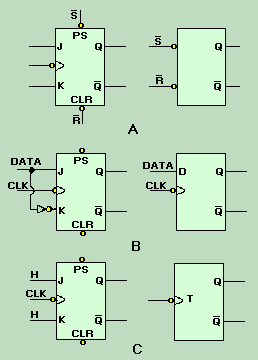
34NVJ060.GIF


I am just wondering what is the markers telling us, like what has shown in the diagram, the CLR is telling us if we apply active-high state input to that port, the flip flop will be reset right? But there is some case where the Markers is labeled as CLR' (bar-CLR) and there is a bubble attached at the port it should be something like "NOT gate". So in this case how do i determine whether should i apply high or low state to reset my flip flop?

If CLR is labeled without bar, does it mean when the port receive high state, ff is reset;
and if CLR is labeled with bar, does it mean when the port receive low state, ff is reset?

Do the bubble determine anything?
 
Engineering news on Phys.org
https://www.filesanywhere.com/Viewplay/getCanvasImageElink.aspx?PATH=\SELENIUM\delete.png&IMAGETYPE=O&MODELPARAM=&H=768&W=1366&r=574777

This is the type of flip flop i see in my note, if the CLR port is active-Low, so supplying high state into the port will get inverted by the bubble b4 the port then become low, so can i say the flip flop is reset in this configuration?


But my note keep using this kind of configuration to avoid the flip flop from getting reset...
 
Last edited:
No, the bubble is a marker, not an active thing. The bubble indicates active low for inputs, so the CLR~ input clears the FF when it is driven low. And the bubble and > markings on the clock input indicate that the clock causes the data to propagate on the negative-going edge of the clock input.
 
Last edited:
oh, is that mean there is no such things like a CLR~ without bubble marker?
 
null void said:
oh, is that mean there is no such things like a CLR~ without bubble marker?

Correct. No bubble means you use the active high signal CLR. A bubble means that the active low signal CLR~ is used to clear the FF. :smile:
 
  • Like
Likes   Reactions: 1 person
Ah I see, thank you very much :)
 
Take a look at this, which explains a little about why designers use certain symbols:
http://www.eetimes.com/document.asp?doc_id=1274541

This page also explains some of it about halfway down, under "DeMorgan's Theorem":
http://www.physics.mcmaster.ca/phys4db3/Lab/chapter5.htm

Also
http://hyperphysics.phy-astr.gsu.edu/hbase/electronic/gate.html#c2

and this slide show isn't bad
http://webdocs.cs.uAlberta.ca/~amaral/courses/329/webslides/Topic8-DocTimeDiagrams/sld011.htm

I couldn't find any pages that do a fantastic job of explaining this...
 
  • Like
Likes   Reactions: 1 person

Similar threads

  • · Replies 28 ·
Replies
28
Views
4K
Replies
2
Views
2K
  • · Replies 2 ·
Replies
2
Views
18K
  • · Replies 11 ·
Replies
11
Views
3K
Replies
20
Views
4K
Replies
1
Views
3K
  • · Replies 5 ·
Replies
5
Views
6K
Replies
56
Views
14K
  • · Replies 1 ·
Replies
1
Views
2K
  • · Replies 2 ·
Replies
2
Views
4K