Newton's law of viscosity in 3D, used to derive Navier-Stoke

Click For Summary
SUMMARY

The discussion focuses on the derivation of the Navier-Stokes equations and the relationship between strain rates and shear stresses in three dimensions, specifically referencing the 'Stokes relations'. The participants highlight the complexity of these relations compared to the simpler one-dimensional case of stress equating to viscosity times velocity gradient. Key insights include the clarification that normal components in the viscous shear stress tensor (τxx, τyy, τzz) represent normal stresses due to tensile and compressive deformations, not shear stresses. The book "Transport Phenomena" by Bird, Stewart, and Lightfoot is recommended for a detailed outline of the derivation.

PREREQUISITES
  • Understanding of Navier-Stokes equations
  • Familiarity with continuum mechanics
  • Knowledge of tensor calculus
  • Basic principles of fluid mechanics
NEXT STEPS
  • Study the derivation of the Navier-Stokes equations in "Transport Phenomena" by Bird, R.B., Stewart, W.E., and Lightfoot, E.N.
  • Learn about the 3D version of Hooke's law and its application to fluids.
  • Explore the concepts of normal and shear stresses in fluid mechanics.
  • Investigate the principles of Newtonian fluids and their behavior under strain.
USEFUL FOR

Students and professionals in fluid mechanics, mechanical engineers, and researchers interested in the mathematical foundations of fluid dynamics and the behavior of viscous fluids.

cantgetaname
Messages
41
Reaction score
0
I'm trying to understand how the Navier-Stokes equations are derived and having trouble understanding how the strain rates are related to shear stresses in three dimensions, what a lot of texts refer to as the 'Stokes relations'.

http://soliton.ae.gatech.edu/labs/windtunl/classes/hispd/hispd06/ns_eqns.html
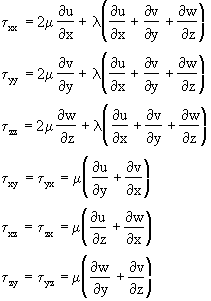
Image466.gif


It's no longer the simple stress=viscosity*velocity gradient of the 1d case, but more complicated than that and none of the books I could get my hands on or the internet could show me how these relations are derived. They are just mentioned there as if they are obvious but I can't see how.

And what does the normal components in viscous shear stress tensor (τxx, τyy, τzz) even mean? How can you have viscous shear stress normal to a surface.
 
Physics news on Phys.org
cantgetaname said:
I'm trying to understand how the Navier-Stokes equations are derived and having trouble understanding how the strain rates are related to shear stresses in three dimensions, what a lot of texts refer to as the 'Stokes relations'.

http://soliton.ae.gatech.edu/labs/windtunl/classes/hispd/hispd06/ns_eqns.html

Image466.gif


It's no longer the simple stress=viscosity*velocity gradient of the 1d case, but more complicated than that and none of the books I could get my hands on or the internet could show me how these relations are derived. They are just mentioned there as if they are obvious but I can't see how.

And what does the normal components in viscous shear stress tensor (τxx, τyy, τzz) even mean? How can you have viscous shear stress normal to a surface.
An outline of the derivation you are looking for is presented in Section 1.2 of Bird, R.B., Stewart, W.E., and Lightfoot, E.N., Transport Phenomena.

In terms of your question regarding viscous "shear" stresses normal to a surface, the answer is that these are not shear stresses (at least not in the a coordinate system aligned with the surface). These are normal stresses resulting from the tensile and compressive deformations that are occurring along the coordinate directions. Are you familiar with the 3D version of Hooke's law for solids? There you have tensile normal strains, and you have corresponding tensile normal stresses. This is the analogous thing for a fluid. For example, if you have a rod of a very viscous fluid and you apply tension to the rod, it will experience a rate of deformation in the axial direction. The force you are applying divided by the cross section area of the rod is the normal stress. For an incompressible viscous fluid, the stress is 3 times the viscosity times the rate of extension.

Chet
 
Are you familiar with continuum mechanics? A Newtonian fluid is actually one where the viscous stresses are directly proportional to the rate of strain. If you are familiar with continuum mechanics and tensors, the above equations are easily derived.
 
Chestermiller said:
An outline of the derivation you are looking for is presented in Section 1.2 of Bird, R.B., Stewart, W.E., and Lightfoot, E.N., Transport Phenomena.

In terms of your question regarding viscous "shear" stresses normal to a surface, the answer is that these are not shear stresses (at least not in the a coordinate system aligned with the surface). These are normal stresses resulting from the tensile and compressive deformations that are occurring along the coordinate directions. Are you familiar with the 3D version of Hooke's law for solids? There you have tensile normal strains, and you have corresponding tensile normal stresses. This is the analogous thing for a fluid. For example, if you have a rod of a very viscous fluid and you apply tension to the rod, it will experience a rate of deformation in the axial direction. The force you are applying divided by the cross section area of the rod is the normal stress. For an incompressible viscous fluid, the stress is 3 times the viscosity times the rate of extension.

Chet
That book does answer my question (although at present a lot of it goes over my head). Thanks!
 

Similar threads

  • · Replies 8 ·
Replies
8
Views
3K
  • · Replies 2 ·
Replies
2
Views
2K
  • · Replies 18 ·
Replies
18
Views
2K
  • · Replies 4 ·
Replies
4
Views
2K
  • · Replies 1 ·
Replies
1
Views
5K
  • · Replies 7 ·
Replies
7
Views
4K
  • · Replies 1 ·
Replies
1
Views
1K
  • · Replies 4 ·
Replies
4
Views
3K
  • · Replies 7 ·
Replies
7
Views
2K
  • · Replies 2 ·
Replies
2
Views
5K