Nodal Analysis of a circuit with 3 sources and 3 resistors

Click For Summary

Discussion Overview

The discussion revolves around the nodal analysis of a circuit containing three sources and three resistors. Participants explore the identification of circuit elements, the formulation of nodal equations, and the implications of specific component values on the analysis. The conversation includes technical reasoning, potential errors in equations, and the challenges of homework problems in circuit analysis.

Discussion Character

  • Technical explanation
  • Debate/contested
  • Homework-related
  • Mathematical reasoning

Main Points Raised

  • Some participants identify the nodes in the circuit as Va, Vb, and Vc, while others question the definitions of the sources.
  • There is a suggestion that the 10V source is indeed a voltage source, but some participants express uncertainty about the nature of the middle source, debating whether it is a voltage or current source.
  • Participants point out potential errors in the equations presented, with one participant noting that their equations matched a solution manual except for a specific term.
  • One participant emphasizes the importance of understanding general solutions over specific tricks that may not apply in all cases.
  • There is a discussion about the implications of changing resistor values, particularly how it affects the analysis and whether certain solutions remain valid.
  • Some participants express frustration with the clarity of homework problems and the potential for typos leading to confusion.
  • One participant shares their equations for nodal analysis, but another questions the validity of one of the equations, asking for clarification and proper formulation.

Areas of Agreement / Disagreement

Participants express differing views on the correctness of the equations and the nature of the sources. There is no consensus on the resolution of the circuit analysis, and multiple competing interpretations of the problem remain.

Contextual Notes

Participants note potential errors in the formulation of nodal equations and the ambiguity surrounding the types of sources in the circuit. The discussion highlights the challenges of accurately interpreting homework problems and the importance of clear definitions in circuit analysis.

Who May Find This Useful

This discussion may be useful for students and practitioners in electrical engineering or circuit analysis, particularly those interested in nodal analysis and the challenges of interpreting circuit problems.
Xiao Xiao
Messages
30
Reaction score
3
Homework Statement
Determine the current i2 as labeled in the circuit with the assistance of Nodal Analysis.
Relevant Equations
V1=(Vc-Vb), V3=(Vc-Va)
--> 0.0(Vc-Vb)+(Vc-Va)/5=(Va-Vb)/3
--> (Va-Vb) /3+10=(Vb-Vc)/2
--> 0.02(Vc-Va)+(Vb-Vc)/2=(Vc-Va)/5

No solution for the system of equations.
Are my equations wrong or is soemthing incorrect in the Question itself, because it has 10V on a current source.
Screenshot_20220103_135401.jpg
 
Physics news on Phys.org
Can you say which elements are a, b and c.
 
tech99 said:
Can you say which elements are a, b and c.
Oh yes, starting from left, first node is Va, second is Vb, third is Vc.
 
That must be a 10V voltage source, since the "V" isn't defined otherwise.

Also, some of your equations are incorrect, I think.
 
DaveE said:
That must be a 10V voltage source, since the "V" isn't defined otherwise.

Also, some of your equations are incorrect, I think.
Yeah, I guess I was tired when I wrote them and didn't copy some stuff correctly.

I got my hands on the solution manual and their equations are the same as me, except they didn't include 0.2*V3. But they considered 10V as 10A. I'll just send it to my professor and ask.
 
Look carefully at KCL at the left most node. The current source ##0.2v_3 = \frac{v_3}{5} = i_2## that means there is no current through the ##2 \ohm## resistor, and no current in the right most source. The problem is trivial given these specific component values.
 
DaveE said:
Look carefully at KCL at the left most node. The current source ##0.2v_3 = \frac{v_3}{5} = i_2## that means there is no current through the ##2 \ohm## resistor, and no current in the right most source. The problem is trivial given these specific component values.
Ooooh, yes you're right, I completely missed that, thank you.
 
Not my favorite HW problem.

First, IMO, there's a typo. Which is really bad in HW problems, legal contracts, resumes, etc. Other places, like your PhD dissertation or your NYT editorial, not so much. Students lack the experience and confidence to say that the question is wrong, they think they are wrong, they get confused instead of educated, and waste a lot of time.

Second, the easy solution relies on noticing a particular trick; a special case. Much better to learn general solutions than special tricks that only work rarely. This is especially important when you are being paid to design circuits and the problem is often to choose component values, not just analyse what someone else chose.
 
  • Like
Likes   Reactions: Xiao Xiao
DaveE said:
Look carefully at KCL at the left most node. The current source ##0.2v_3 = \frac{v_3}{5} = i_2## that means there is no current through the ##2 \ohm## resistor, and no current in the right most source. The problem is trivial given these specific component values.
You mean the right most node, don't you?

What if the 5 ohm resistor is 4 ohms? Then your trick doesn't work. What would be the solution of the circuit in case the 5 ohm resistor is 4 ohms?
 
  • #10
The Electrician said:
You mean the right most node, don't you?
Oops! No, I meant the leftmost source ##0.02v_1 = 0 ##, since ##v_1=0## . This is because the rightmost source equals the current across the top.

The Electrician said:
What if the 5 ohm resistor is 4 ohms? Then your trick doesn't work.
Yes, exactly, that's why I wouldn't choose this as a HW problem. It's not great learning for working in the real world, where tricks rarely work this well.

The Electrician said:
What would be the solution of the circuit in case the 5 ohm resistor is 4 ohms?
Are you asking me to solve this for you? You first; then I'll help if you get stuck.

You can start by telling me what the middle source is, voltage or current? You may notice I didn't actually finish the original problem.
 
  • Like
Likes   Reactions: BvU
  • #11
DaveE said:
Oops! No, I meant the leftmost source ##0.02v_1 = 0 ##, since ##v_1=0## . This is because the rightmost source equals the current across the top.Yes, exactly, that's why I wouldn't choose this as a HW problem. It's not great learning for working in the real world, where tricks rarely work this well.Are you asking me to solve this for you? You first; then I'll help if you get stuck.

You can start by telling me what the middle source is, voltage or current? You may notice I didn't actually finish the original problem.
The middle source has to be a voltage because if it's a current source there would be 3 current sources feeding a floating object (3 resistors in a delta configuration) from which there is no return path to ground, and the voltage of that object would be indeterminate. If the middle source is a voltage source, then at least the voltage(s) of the floating object won't be indeterminate.

Of course I'm not asking you to solve it for me. Solve it for yourself; I know you, like me, solve problems like this to keep in good (mental) shape.

And we want the TS to be able to solve it.
 
  • Like
Likes   Reactions: BvU and DaveE
  • #12
The Electrician said:
The middle source has to be a voltage because if it's a current source there would be 3 current sources feeding a floating object (3 resistors in a delta configuration) from which there is no return path to ground, and the voltage of that object would be indeterminate. If the middle source is a voltage source, then at least the voltage(s) of the floating object won't be indeterminate.
Yes. Although since they only asked about ##i_2##, the question is solvable. It's a case of infinite vs. a single solution.

I have also been flippant about the typo. There are people (on the other side of the Atlantic) that draw their voltage sources exactly the same as their current sources. WHICH DRIVES ME CRAZY; I HATE IT, I HATE IT, I HATE IT! I pretend, as much as possible, that those people don't actually exist. Although they would tell you everything is in order here. Let's just celebrate that they don't draw their inductors like capacitors with a negative value.

The Electrician said:
I know you, like me, solve problems like this to keep in good (mental) shape.
Actually, no I don't. Perhaps I should. But I've done enough in the past and, honestly, it's a pretty rote application of network analysis. Something has to make me interested first, then I'll solve it, right up until the point that I lose interest. *

* PS: For this I can thank the antiquated EE department head where I did my MS. His thing was linear network analysis. He wrote a book and made it a requirement that every grad student take his class. It was a (nearly) complete waste of effort, I instantly forgot at least 90% of it. Great if your the guy that has to code the first SPICE algorithms, which had already been done long ago. He taught me to hate this stuff. I mean, how much time do you want to spend constructing and solving simple linear algebra problems? It's exactly contrary to the approach I learned as an undergrad; "design oriented analysis" as named by my guy, R.D. Middlebrook. Where the answer isn't as important as understanding why you get that answer.
 
Last edited:
  • Like
Likes   Reactions: BvU
  • #13
Xiao Xiao said:
Yeah, I guess I was tired when I wrote them and didn't copy some stuff correctly.

I got my hands on the solution manual and their equations are the same as me, except they didn't include 0.2*V3. But they considered 10V as 10A. I'll just send it to my professor and ask.
Xaio Xaio, DaveE showed you a trick that gets you the right answer, but the problem requires you to find the solution using nodal analysis. Your nodal equations have errors. Will you be working on this problem's nodal analysis any more?
 
  • #14
The Electrician said:
Xaio Xaio, DaveE showed you a trick that gets you the right answer, but the problem requires you to find the solution using nodal analysis. Your nodal equations have errors. Will you be working on this problem's nodal analysis any more?
Yes, these are my equations so far.
1. ##0.02v_1+i_2=(v_a-v_b)/3##
2. ##(v_a-v_b) /3+10=(v_b-v_c)/2##
3. ##(v_b-v_c)/2+i_2=i_2##

I do use this ##0.2v_3=i_2## and through equation 3 I find that ##v_b-v_c=v_1=0##
and solve the rest of the equation using that.
 
  • Like
Likes   Reactions: BvU
  • #15
Xiao Xiao said:
Yes, these are my equations so far.
1. ##0.02v_1+i_2=(v_a-v_b)/3##
2. ##(v_a-v_b) /3+10=(v_b-v_c)/2##
3. ##(v_b-v_c)/2+i_2=i_2##

I do use this ##0.2v_3=i_2## and through equation 3 I find that ##v_b-v_c=v_1=0##
and solve the rest of the equation using that.
Your 3rd equation doesn't look like a proper nodal equation. Can you write in the proper form? If you do, do they have a solution?

Did you find out if the middle source labeled 10V is supposed to be a current or voltage source?

Does the solution manual explain its solution?
 
  • #16
The Electrician said:
Your 3rd equation doesn't look like a proper nodal equation. Can you write in the proper form? If you do, do they have a solution?

Did you find out if the middle source labeled 10V is supposed to be a current or voltage source?

Does the solution manual explain its solution?
The third one should be ##(v_b-v_c)/2+0.2v_3=(v_c-v_a)/2##

##(v_c-v_a) /2= i_2## and ##0.2v_3=i_2##
That's why I wrote it that way. I solved it by hand and got an answer for it, but I'm not sure if it's correct. I couldn't find out if it's 10V or 10A but I decided to count is a current source, idk why I didn't ask the professor in the end.

The solution manual answer is weird, they put a resistor instead of the left current source, but didn't include it in the equations, I'll just attach it.
 

Attachments

  • Screenshot_20220103_222311.jpg
    Screenshot_20220103_222311.jpg
    39.4 KB · Views: 187
  • #17
So we have an exercise with a picture that has a current source ##0.2\, v_2## instead of a resistor of ##7\, \Omega## and a current source that says ##10 \,V## ? Anything else ?

##\ ##
 
  • #18
BvU said:
So we have an exercise with a picture that has a current source ##0.2\, v_2## instead of a resistor of ##7\, \Omega## and a current source that says ##10 \,V## ? Anything else ?

##\ ##
Nothing else
 
  • Like
Likes   Reactions: BvU
  • #19
The answer in the solution manual is totally messed up!

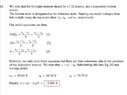
First of all, without some path to ground (which the 7 ohm resistor provides), the original problem from post #1 of this thread has no solution for the voltages at the nodes, although I suppose one could say that I2 = 0 anyway.

The addition of a 7 ohm resistor makes a solution possible, but the equations they show are incomplete; they haven't included the 7 ohm resistor in the equations! The equations they show have no solution so where did they get those numerical values? I have no idea. The third equation needs a term +Vc/7 at the end. If that is added, then we have a solution:

Messedup.png
 
  • #20
Xiao Xiao said:
The solution manual answer is weird, they put a resistor instead of the left current source, but didn't include it in the equations, I'll just attach it.
The resistor is in place of the right current source.
 
  • Like
Likes   Reactions: Xiao Xiao
  • #21
The Electrician said:
The answer in the solution manual is totally messed up!

First of all, without some path to ground (which the 7 ohm resistor provides), the original problem from post #1 of this thread has no solution for the voltages at the nodes, although I suppose one could say that I2 = 0 anyway.

The addition of a 7 ohm resistor makes a solution possible, but the equations they show are incomplete; they haven't included the 7 ohm resistor in the equations! The equations they show have no solution so where did they get those numerical values? I have no idea. The third equation needs a term +Vc/7 at the end. If that is added, then we have a solution:

View attachment 295151
Yeah it's completely messed up, and I couldn't figure on what basis they changed the question. So I'm sticking with the solution that I ended up with in my previous reply.

I did end up asking my professor about if there's an error in the Question or not but he hasn't responded yet.
 
  • #22
Xiao Xiao said:
Yeah it's completely messed up, and I couldn't figure on what basis they changed the question. So I'm sticking with the solution that I ended up with in my previous reply.

I did end up asking my professor about if there's an error in the Question or not but he hasn't responded yet.
Has your professor responded yet? What did he say?
 
  • #23
The Electrician said:
Has your professor responded yet? What did he say?
No he did not, unfortunately. So I asked him about the solution in hope he respond, if he uploads the solution for the question later (because this was in our assignment) or answers my question, I'll update with the righ question or method to use here.
 

Similar threads

Replies
2
Views
2K
  • · Replies 7 ·
Replies
7
Views
2K
  • · Replies 1 ·
Replies
1
Views
2K
  • · Replies 2 ·
Replies
2
Views
2K
  • · Replies 4 ·
Replies
4
Views
4K
  • · Replies 4 ·
Replies
4
Views
2K
  • · Replies 1 ·
Replies
1
Views
2K
Replies
15
Views
2K
  • · Replies 5 ·
Replies
5
Views
3K
  • · Replies 37 ·
2
Replies
37
Views
5K