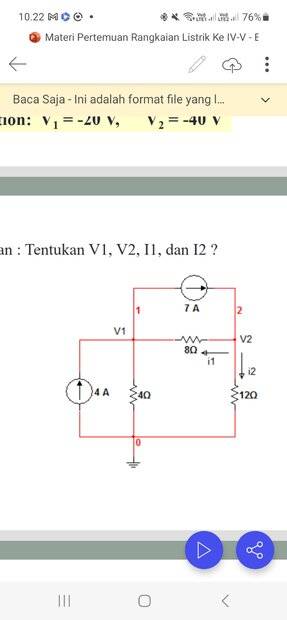
Node analysis problem: 2 Current Sources and 3 Resistors

Click For Summary

Discussion Overview

The discussion revolves around a node analysis problem involving two current sources and three resistors, focusing on confirming the correctness of answers related to a homework assignment. Participants engage in clarifying their approaches and solutions within the context of electrical engineering.

Discussion Character

  • Homework-related
  • Technical explanation

Main Points Raised

  • One participant expresses uncertainty about their answers and seeks confirmation.
  • Multiple participants emphasize the need for showing work to facilitate assistance.
  • Another participant notes that the initial equations appear correct and that the final values satisfy the equations, suggesting the answers may be valid.
  • A different participant mentions that while the answers are correct, they did not review the method used to arrive at them.
  • One participant introduces the concepts of Norton and Thevenin transformations as potential simplifications for similar problems in future studies.
  • There is a reminder about the importance of verifying one's own solutions in engineering practice.

Areas of Agreement / Disagreement

Participants generally agree on the importance of showing work and verifying solutions, but there is no consensus on the specific methods used or the correctness of the approaches taken by the original poster.

Contextual Notes

Some participants mention the need for clearer presentation of work, particularly using LaTeX for mathematical expressions, which may indicate limitations in the clarity of the original post's content.

Who May Find This Useful

This discussion may be useful for students studying electrical engineering, particularly those learning about node analysis and verification of solutions in homework contexts.
Gunther_Guss
Messages
4
Reaction score
0
Homework Statement
Please, help me to find the value of V1, V2, I1 and I2.
Relevant Equations
i have my own answers but i need to confirm wether my answers are correct or not. Thanks.
-
Screenshot_20230924_102246_Microsoft 365 (Office).jpg
 
Last edited by a moderator:
Physics news on Phys.org
Gunther_Guss said:
i have my own answers but i need to confirm wether my answers are correct or not. Thanks.
On the homework forum, before we can help, you need to show your work and the answers you got.
 
renormalize said:
On the homework forum, before we can help, you need to show your work and the answers you got.
Alright, how about this ? is this correct ?
1695529449086832652457236195769.jpg
 
Last edited by a moderator:
Welcome to PF.

Gunther_Guss said:
Alright, how about this ? is this correct ?
In future posts, please type your work into the forum so that it is easier to read. I'll try to check your work later today unless somebody else beats me to it.

I will also send you a private message (PM) with some tips on how to use LaTeX to type math into PF. That is the best way to show your work. :smile:
 
  • Like
Likes   Reactions: DeBangis21
Gunther_Guss said:
Alright, how about this ? is this correct ?View attachment 332471
Haven't checked the detailed working but the initial equations look correct and your final values satisfy the equations. So it looks good.

If you haven't already done so, remember you can (should!) check your working by seeing if the final values satisfy the original equations.
 
  • Like
Likes   Reactions: DeBangis21, renormalize, FactChecker and 1 other person
Your answers are correct, but I didn't review your method.

If you continue to study EE, you will learn about the Norton and Thevenin source transformations which make this kind of problem really pretty simple. Below is a picture of my solution notes which don't require any equations beyond simple arithmetic. They aren't meant to be understandable, just an example of how practicing analog EEs would solve this (realtime unedited notes).

PXL_20230924_235110888~2[1].jpg
 
BTW, you'll need to get used to routinely verifying your own solutions at the end of each engineering problem you solve. That is part of the job. Out in the real world you will get fired if you constantly ask your boss to check your calculations, that's why he hired you, he has his own work to do. You will also get fired if your products don't work because you made mistakes you didn't correct. All of us make mistakes, it's not realistic to expect not to. But when you do make a mistake, you need to be the one that spots it and fixes it.
 

Similar threads

Replies
15
Views
2K
  • · Replies 37 ·
2
Replies
37
Views
5K
  • · Replies 10 ·
Replies
10
Views
4K
  • · Replies 7 ·
Replies
7
Views
3K
  • · Replies 8 ·
Replies
8
Views
2K
  • · Replies 5 ·
Replies
5
Views
2K
  • · Replies 5 ·
Replies
5
Views
2K
  • · Replies 6 ·
Replies
6
Views
2K
  • · Replies 2 ·
Replies
2
Views
1K
  • · Replies 5 ·
Replies
5
Views
3K