Number of fringes in a 2-slit diffraction pattern

Click For Summary

Discussion Overview

The discussion revolves around the calculation of the number of fringes in a two-slit diffraction pattern, particularly in the context of setting up a lab for high school physics. Participants explore how to define and count fringes, the implications of slit width and separation, and the necessary parameters for calculating wavelength.

Discussion Character

  • Exploratory, Technical explanation, Homework-related

Main Points Raised

  • One participant questions how to count fringes in a diffraction pattern, suggesting that every bright point should be considered a fringe, but seeks confirmation.
  • Another participant notes the effects of slit width and spacing on the diffraction pattern, indicating that the slit spacing must be larger than the slit width.
  • Some participants assert that all bright points are fringes but emphasize that additional details about the experimental setup are necessary to calculate wavelength accurately.
  • There is a discussion about the correct measurement of slit separation, with one participant suggesting it is about 4-5 widths apart, while another initially proposed a larger distance of 8-10 widths.
  • Participants clarify the definition of the variable "m" in the context of two-slit and single-slit formulas, indicating different interpretations based on the type of diffraction pattern being analyzed.
  • One participant shares their experience with lab setups, indicating that consistent results can be achieved if the correct parameters are used in the respective formulas.

Areas of Agreement / Disagreement

Participants generally agree that all bright points can be considered fringes, but there is no consensus on the exact method for counting them or the implications of different slit configurations. The discussion remains unresolved regarding the specific details needed for accurate wavelength calculations.

Contextual Notes

Participants express uncertainty about the definitions and measurements involved, particularly regarding the slit separation and the variable "m" in different contexts. There are also unresolved mathematical steps related to the calculations of wavelength.

nmsurobert
Messages
288
Reaction score
36
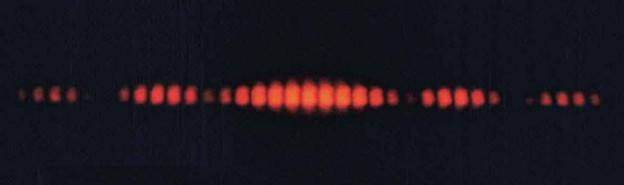
When looking at a diffraction pattern made by two slits, and trying to calculate wavelength, what do we count as fringes? For example, in this picture are there five total fringes or, like, 25?
I've been trying to set up a lab for my high school physics 2 class and the math says that every bright point should be considered a fringe, but I am having a hard time finding anything in writing that confirms what my math is telling me. Thanks!
double-slit-interference-624x185.jpeg
 
Science news on Phys.org
There are two diffraction effects here: the finite width of each slit and the spacing distance between each subsequent slit center. Obviously the slit spacing must be larger than the slit width. The smaller distance in real space produces larger diffraction spacings. I would guess the two slits are perhaps 8-10 widths apart
In x-ray crystalography these are known as the form factor (each scatterer) and the structure factor (from the lattice). The result is their product
 
  • Like
Likes   Reactions: vanhees71 and Dale
They are all fringes. But in addition, you cannot calculate the wavelength from the pattern only. You need more details about the setup, like slit widths, slit separation, and distance of the screen from the slits.

Actually, for the pattern above the slit separation is about 4-5 widths, not 8-10. You have to look at the multiplicity of the first-order peaks, not the 0-th order.
 
lodbrok said:
Actually, for the pattern above the slit separation is about 4-5 widths, not 8-10. You have to look at the multiplicity of the first-order peaks, not the 0-th order.
Yes. I always get that wrong!Thanks
 
lodbrok said:
They are all fringes. But in addition, you cannot calculate the wavelength from the pattern only. You need more details about the setup, like slit widths, slit separation, and distance of the screen from the slits.

Actually, for the pattern above the slit separation is about 4-5 widths, not 8-10. You have to look at the multiplicity of the first-order peaks, not the 0-th order.
Awesome. Thanks. I have all that information. I intend on using the equation λ = (yd)/(mR). The only value I was unsure of was "m".
 
If you're using a two-slit interference formula, the ##m## that you want is the number of small spots from the center (0), including "missing" spots at or near the minima of the overall pattern. In your example photo, at the first overall minimum from the center, this would be ##m=6##.

If you're using a single-slit diffraction formula, the ##m## that you want is the number of overall minima from the center. In your example photo, at the first overall minimum from the center, this would be ##m=1##.

You should get consistent results for the two cases, provided you use the "slit spacing" in the two-slit formula, and the "slit width" in the single-slit formula.

(I did this lab many times, using a He-Ne laser and slides with single/double slits from Pasco Scientific.)
 
Last edited:
  • Informative
Likes   Reactions: berkeman
jtbell said:
If you're using a two-slit interference formula, the ##m## that you want is the number of small spots from the center (0), including "missing" spots at or near the minima of the overall pattern. In your example photo, at the first overall minimum from the center, this would be ##m=6##.

If you're using a single-slit diffraction formula, the #m# that you want is the number of overall minima from the center. In your example photo, at the first overall minimum from the center, this would be ##m=1##.

You should get consistent results for the two cases, provided you use the "slit spacing" in the two-slit formula, and the "slit width" in the single-slit formula.

(I did this lab many times, using a He-Ne laser and slides with single/double slits from Pasco Scientific.)
Perfect. Thank you. Like I said, my math was telling me what to do, but when I'm not sure you guys always point my in the right direction.
 
  • Like
Likes   Reactions: berkeman

Similar threads

  • · Replies 4 ·
Replies
4
Views
2K
  • · Replies 34 ·
2
Replies
34
Views
4K
  • · Replies 1 ·
Replies
1
Views
3K
  • · Replies 4 ·
Replies
4
Views
5K
  • · Replies 4 ·
Replies
4
Views
9K
Replies
6
Views
3K
  • · Replies 6 ·
Replies
6
Views
8K
  • · Replies 12 ·
Replies
12
Views
2K
  • · Replies 17 ·
Replies
17
Views
4K
Replies
14
Views
4K