Diffraction and intensity of fringes

Click For Summary

Discussion Overview

The discussion revolves around the concepts of diffraction and intensity of fringes in single and double slit experiments, including interpretations of textbook diagrams and the relationships between different patterns of light intensity. Participants explore theoretical aspects and clarify their understanding of the phenomena involved.

Discussion Character

  • Exploratory
  • Technical explanation
  • Debate/contested

Main Points Raised

  • Some participants assert that in single slit diffraction, the central fringe is wider than the outer fringes, while in double slit diffraction, fringes appear within the area of the central fringe.
  • There are conflicting interpretations of a textbook diagram, with some participants questioning the accuracy of the representation of the intensity distribution for single and double slit patterns.
  • One participant suggests that the red dotted line in the diagram represents a two-source pattern without diffraction effects, while others challenge this interpretation based on the absence of a central fringe and the sharpness of the bright fringes.
  • Participants discuss the implications of slit width and separation on the observed patterns, with some noting that the widths must be appropriately defined to avoid merging slits.
  • Clarifications are made regarding the modulation of the two-source pattern by the single slit diffraction pattern, with some participants expressing confusion over the relationships depicted in the diagrams.
  • Questions arise about the reasons for intensity peaks at the center of fringes and the distinction between diagrams showing only diffraction versus those showing both diffraction and interference effects.

Areas of Agreement / Disagreement

Participants generally agree on some foundational aspects of diffraction and interference but express differing interpretations of the textbook diagram and its implications. The discussion remains unresolved regarding the accuracy of the representations and the relationships between the patterns.

Contextual Notes

Participants note limitations in the textbook's diagram, including potential omissions and inaccuracies in the representation of intensity distributions. There is also uncertainty regarding the conditions under which certain patterns are observed, particularly concerning slit dimensions and their effects on diffraction.

question dude
Messages
80
Reaction score
0
I'm not sure if I've understood my textbook correctly. Can you tell me if my current understanding is correct:

- in a single slit diffraction there's a wide central fringe which is twice as wide as all the other outer fringes

- if we had a double slit diffraction instead of a single slit, we would see fringes within the area that would've been occupied by the wide central fringe


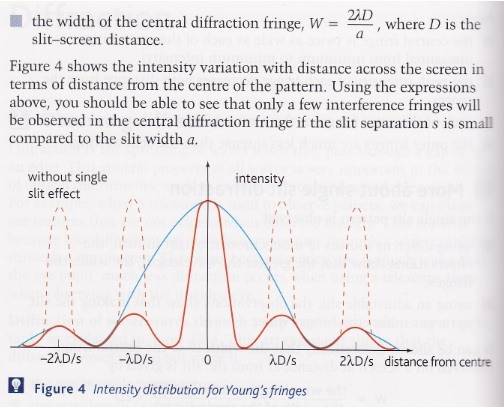
Below is a diagram in my textbook showing intensity distribution of young's fringes, I don't really understand it. Is the blue line supposed to represent the fringes of a single slit diffraction, and the solid red line is representing the fringes of a double slit? I also don't understand at all what the dashed lines in the background are about :confused:
attachment.php?attachmentid=199818.jpg


(btw this is all high school level physics)
 
Science news on Phys.org
Your understanding is correct. I think your textbook diagram is confusing, and partly wrong. I'll explain.

I think the dotted red line is supposed to represent a two source pattern with no superimposed diffraction effects. It is wrong because (1) it omits the central fringe (2) it makes the bright fringes too sharp. The intensity should follow a 'cos squared' graph, which is sinusoidal in shape. This implies that at mid-intensity (halfway up the vertical axis) the widths of bright and dark fringes should be equal. They don't seem to be.

The red solid line is the single slit diffraction pattern for a slit with a width of 2s, in which s is the distance between the slit centres used for the two slit graph. I find this confusing, because slits of this width couldn't have a separation s between their centres without merging into one wide slit. I suppose that the diagram makes no claim that the red dotted line and the red solid line should apply to the same set-up, but I'd rather they did.

The blue line is the single slit diffraction pattern for a slit with a width of (2/3)s. I've no quarrel with this: two slits of this width, with centres separated by s, would not merge, and could be used to produce Young's fringes, but there seems to be no graph which shows the 'modulation' of the Young's fringes by the diffraction 'envelope'.
 
Philip Wood said:
Your understanding is correct. I think your textbook diagram is confusing, and partly wrong. I'll explain.

I think the dotted red line is supposed to represent a two source pattern with no superimposed diffraction effects. It is wrong because (1) it omits the central fringe (2) it makes the bright fringes too sharp. The intensity should follow a 'cos squared' graph, which is sinusoidal in shape. This implies that at mid-intensity (halfway up the vertical axis) the widths of bright and dark fringes should be equal. They don't seem to be.

sorry I don't quite understand what this is

Philip Wood said:
The red solid line is the single slit diffraction pattern for a slit with a width of 2s, in which s is the distance between the slit centres used for the two slit graph.

how comes the solid red line is not a double slit diffraction pattern?

because that's what it appears me. There are three fringes from that solid red line occupying the space inside a wide central fringe (from the blue line)

Philip Wood said:
I find this confusing, because slits of this width couldn't have a separation s between their centres without merging into one wide slit.

I didn't notice this until you've point it out here. Yeah that is impossible, the distance between the two slit centre must to be greater than the slit width. It makes no sense.
 
What I said about the red solid line in my earlier post was wrong. It is supposed to represent the two source (red dotted) pattern 'modulated' by the blue single slit pattern. Sorry.

"a two source pattern with no superimposed diffraction effects": this is what you'd get if the slits were much smaller than a wavelength in width, and so radiated equally in all 'forward' directions, up to 90° either side of the normal.
 
Philip Wood said:
What I said about the red solid line in my earlier post was wrong. It is supposed to represent the two source (red dotted) pattern 'modulated' by the blue single slit pattern. Sorry.

thats okay, so this would explain the thing about the slit width appearing to not make sense

Philip Wood said:
"a two source pattern with no superimposed diffraction effects": this is what you'd get if the slits were much smaller than a wavelength in width, and so radiated equally in all 'forward' directions, up to 90° either side of the normal

there's no diffraction for this?

so what is the reason why the intensity of fringes normally peak at the centre and then decrease further outwards?
and also I've just found these two diagrams on the web:http://www.colorado.edu/physics/phys2020/phys2020_f98/lab_manual/Lab5/Image2106.gif

http://www.colorado.edu/physics/phys2020/phys2020_f98/lab_manual/Lab5/Image2109.gif

is this correct:

the first diagram shows diffraction fringes

the second diagram shows both diffraction AND interference fringes
 
Last edited by a moderator:

Similar threads

  • · Replies 4 ·
Replies
4
Views
2K
  • · Replies 8 ·
Replies
8
Views
21K
  • · Replies 4 ·
Replies
4
Views
4K
  • · Replies 1 ·
Replies
1
Views
3K
  • · Replies 17 ·
Replies
17
Views
3K
  • · Replies 4 ·
Replies
4
Views
5K
  • · Replies 3 ·
Replies
3
Views
1K
Replies
6
Views
3K
  • · Replies 17 ·
Replies
17
Views
4K
  • · Replies 6 ·
Replies
6
Views
3K