On a conceptual level, what's happening in this equation?

  • Context: Graduate 
  • Thread starter Thread starter cmkluza
  • Start date Start date
  • Tags Tags
    Conceptual
Click For Summary
SUMMARY

This discussion focuses on the mathematical modeling of traffic flow using the equation that relates car density, velocity, and flow rate. The key equation presented is the conservation of vehicles, expressed as d/dt ∫^b_a ρ(t, x) dx = Q_a - Q_b, where ρ(t, x) represents the density of cars, v(ρ) is the velocity, and Q is the flow rate. Participants clarify that the integral of density over a segment gives the total number of vehicles, while the time derivative indicates the change in vehicle count over time, linking density changes to flow dynamics. This relationship is crucial for understanding phenomena like the accordion effect in traffic.

PREREQUISITES
  • Understanding of calculus, specifically integrals and derivatives.
  • Familiarity with traffic flow concepts, such as density and flow rate.
  • Knowledge of mathematical modeling in physics.
  • Basic understanding of continuous functions and their applications in real-world scenarios.
NEXT STEPS
  • Explore the concept of traffic flow models, focusing on the Lighthill-Whitham model.
  • Learn about the mathematical representation of the accordion effect in traffic dynamics.
  • Investigate the implications of density and flow rate in urban traffic management systems.
  • Study the application of partial differential equations in modeling traffic flow.
USEFUL FOR

Traffic engineers, mathematicians, physicists, and anyone interested in the dynamics of vehicle flow and traffic management strategies.

cmkluza
Messages
118
Reaction score
1
I'm trying to read up on some traffic flow models and I've encountered the following equation (source [pdf]):

Variables are ##t =## time, ##x =## space variable along road, ##\rho (t, x) =## density of cars, ##v(\rho ) =## velocity, ##Q = \rho \times v##

Following graphic is used to show situation:
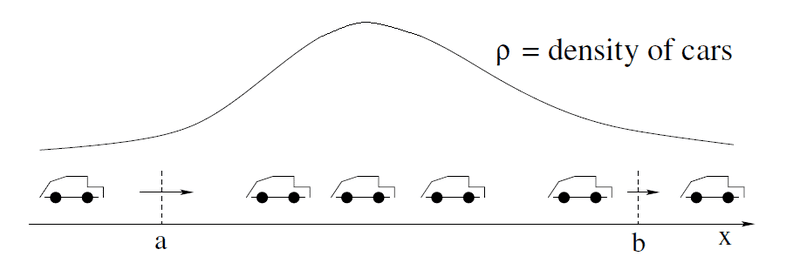
upload_2016-2-8_23-10-13.png


If total number of vehicles is conserved:
\frac{d}{dt} \int^b_a \rho (t, x) dx = Q_a - Q_b
\frac{d}{dt} \int^b_a \rho (t, x) dx = \rho (t,a)v(\rho (t,a)) - \rho (t,b)v(\rho (t,b))
What are these equations actually showing, namely the first bit (derivative of integral of density)? I'm a bit confused since I'm not too familiar with the math behind it. Ignoring numbers and math right now, what are the physical interactions described by this? That might not be worded to clearly, so what does the integral of the density with respect to distance show? What, then, does the derivative with respect to time show?

Sorry if this is asking a lot, but any help understanding this will be appreciated!
 
Physics news on Phys.org
That looks to me like a mathematical description of the accordion effect in traffic: one person in a line of traffic taps their brakes and before you know it, you have a backwards propagating wave of people slamming on their brakes and barely avoiding rear-ender accidents.
https://en.wikipedia.org/wiki/Accordion_effect
 
  • Like
Likes   Reactions: cmkluza
cmkluza said:
What are these equations actually showing, namely the first bit (derivative of integral of density)? I'm a bit confused since I'm not too familiar with the math behind it. Ignoring numbers and math right now, what are the physical interactions described by this? That might not be worded to clearly, so what does the integral of the density with respect to distance show? What, then, does the derivative with respect to time show?
Hi
Well to start with, the density in linear density, example: cars/meter
Q is the flow rate of cars in cars/sec . that easily can be seen from Q = ρ x v, Example : Q = cars/meter x meters/sec ==cars/sec.

Density is some function of time and position.
For any section ab, the integral of the density function yields the value of the density between ab.
The derivative yields the rate of density change per time.

That last part is not worded quite correctly, but maybe you (or someone else) can correct it.

cherios
 
  • Like
Likes   Reactions: cmkluza
russ_watters said:
That looks to me like a mathematical description of the accordion effect in traffic: one person in a line of traffic taps their brakes and before you know it, you have a backwards propagating wave of people slamming on their brakes and barely avoiding rear-ender accidents.
https://en.wikipedia.org/wiki/Accordion_effect

Ah, perfect, that's what I'm hoping to develop in my investigation! Thanks for the link, I keep learning new things about traffic flow; it's a much larger subject area than I'd originally thought.

256bits said:
Hi
Well to start with, the density in linear density, example: cars/meter
Q is the flow rate of cars in cars/sec . that easily can be seen from Q = ρ x v, Example : Q = cars/meter x meters/sec ==cars/sec.

Density is some function of time and position.
For any section ab, the integral of the density function yields the value of the density between ab.
The derivative yields the rate of density change per time.

That last part is not worded quite correctly, but maybe you (or someone else) can correct it.

cherios

As far as I know, that last part is worded correctly; at least it's helped me gain a better understanding of this equation. Thanks for your input!
 
@russ_watters and @256bits
I hate to bother you guys with too many questions, but could you explain why exactly the change in flux is equivalent to the derivative of the integral of density? I believe I understand what the derivative and integral term is saying for the most part now, it's showing the rate of density change per time, but how does this relate to change in flux? Change in density per time should be
\frac{\frac{cars}{distance}}{time}
while change in flux should just be
\frac{cars}{time}

Do you guys know how/why they are equating the two?

Edit: Is it possible that the initial integral of density yielded only the number of vehicles within the segment over which it was integrated?
 
Last edited:
Try drawing it! Get a pen and a piece of paper. Make different scenarios for traffic flow rate, density etc. and see empirically how the equations describe what you are drawing.

All equations ultimately describe systems which you can visualise, so by turning this on its head you can make a visual representation of the traffic flow and gain an intuitive understanding of the equations. There's really nothing abstract about it at all.
 
  • Like
Likes   Reactions: cmkluza
cmkluza said:
@russ_watters and @256bitsEdit: Is it possible that the initial integral of density yielded only the number of vehicles within the segment over which it was integrated?
Yes that is what it means. Hence the needed correction I mentioned, which you have now solved.
congrats. Give yourself credit.
 
Last edited:
  • Like
Likes   Reactions: cmkluza
cmkluza said:
I'm trying to read up on some traffic flow models and I've encountered the following equation (source [pdf]):

If total number of vehicles is conserved:
\frac{d}{dt} \int^b_a \rho (t, x) dx = Q_a - Q_b
\frac{d}{dt} \int^b_a \rho (t, x) dx = \rho (t,a)v(\rho (t,a)) - \rho (t,b)v(\rho (t,b))

The integral from point A to point B over the density of cars is just the number of cars between these two points.

The time derivative of the number of cars is the difference between the number of cars going in on one side and coming out on the other side.

In all of this the traffic is simulated as a continuous medium. Rather than having a car at one point, then nothing for a few meters, and then another car, there is a continuous density of cars, say 0.1 cars/meter or 1 car per 10 meters. This makes the simulation a lot easier, and it makes no difference to the result if you are only interested in trends of what happens if there are many cars.

The number of cars passing through a point A (Q(x=A, t) is then the density of cars at that point and at the time t when you are looking, rho(x=A,t), times the velocity of cars at that point and time, v(x=A, t).

If somewhere between point A and point B Godzilla was snacking on cars, then the equation would no longer be valid.
 
  • Like
Likes   Reactions: cmkluza and Chestermiller

Similar threads

  • · Replies 11 ·
Replies
11
Views
2K
  • · Replies 18 ·
Replies
18
Views
2K
  • · Replies 67 ·
3
Replies
67
Views
6K
  • · Replies 1 ·
Replies
1
Views
2K
  • · Replies 6 ·
Replies
6
Views
2K
Replies
9
Views
1K
  • · Replies 4 ·
Replies
4
Views
2K
  • · Replies 8 ·
Replies
8
Views
3K
  • · Replies 18 ·
Replies
18
Views
922
  • · Replies 1 ·
Replies
1
Views
2K