Opamp oscillator with amplitude stabilization

Click For Summary
SUMMARY

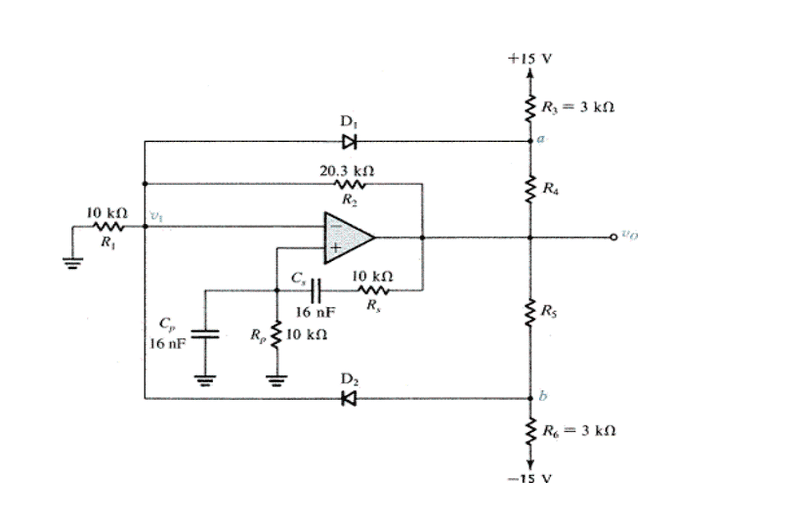
The discussion focuses on an op-amp oscillator circuit with amplitude stabilization using ideal diodes. The circuit analysis revealed an oscillation frequency, but the role of diodes in stabilizing amplitude was unclear. The simulation in Multisim indicated an amplitude of 8.954*sqrt(2)V, with a noted anomaly of 3.409V across the diode, which contradicts typical diode behavior. It was concluded that diodes provide negative feedback by conducting during opposite half-cycles, thus stabilizing the oscillation amplitude by reducing gain when the amplitude exceeds a certain threshold.

PREREQUISITES
  • Understanding of op-amp circuit design
  • Familiarity with diode characteristics and behavior
  • Experience with Multisim simulation software
  • Knowledge of feedback mechanisms in oscillators
NEXT STEPS
  • Explore op-amp oscillator design principles
  • Learn about diode clipping and its effects on signal processing
  • Investigate the use of negative feedback in electronic circuits
  • Study advanced simulation techniques in Multisim for circuit analysis
USEFUL FOR

Electronics engineers, circuit designers, and students interested in oscillator design and amplitude stabilization techniques using op-amps and diodes.

etf
Messages
179
Reaction score
2
It is known R4=R5=1.2k. My task is to calculate amplitude of oscillations at v0:
limmm.png


Opamps and diodes are ideal.

I did analysis of circuit without amplitude stabilization and I got oscillation frequency, but I can't figure out how diodes stabilize amplitude in this circuit.
Any sugestion?
Thanks in advance.

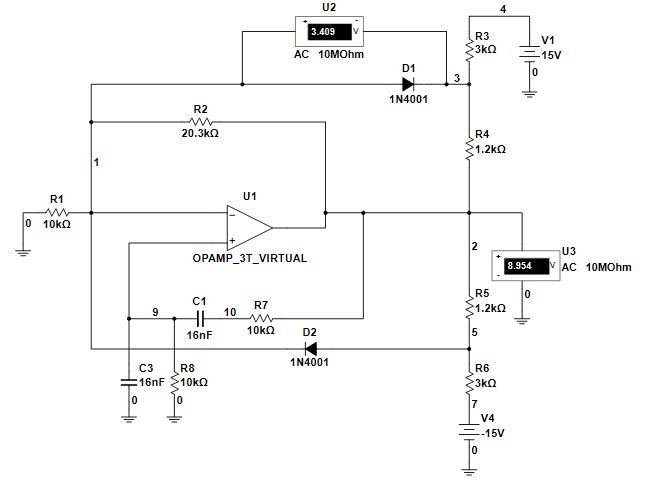
Edit: I simulated this circuit in Multisim:
sim.png


It looks like amplitude is 8.954*sqrt(2)V.
One strange thing: how can voltage on diode be 3.409V ??
I was thought that when diode is direct biased, voltage drop on it is about 0.7V.
 
Last edited:
Physics news on Phys.org
In your simulation, V4 and V5 should have opposite polarities.

One diode conducts during part of vo's positive half-cycle, and the other diode conducts during part of vo's negative half-cycle. When conducting they supply additional heavy negative feedback (an additional path for signal vo to feed back to the OP-AMP's inverting input).

A diode has 0.7V across it when conducting, but can have any voltage at all when reverse-biased.
 
  • Like
Likes etf
Because the gain is only slightly larger than the critical value (3.03>3) we can assume that the diodes will start to conduct (and to reduce the gain) for values smaller than 0.7 volts (perhaps 0.4...0.5 V).
Without oscillation and for small oscillation amplituts both diodes are biased in reverse direction.
Only amplitudes above a certain value will slightly open the diodes - thereby reducing the gain (increasing feedback).
 
Last edited:
  • Like
Likes etf
I think the diodes are shown in backwards. Your reading of U2 is impossible with the circuit as shown.
If the diodes are reversed then the negative clipping feedback thresholds make sense.
In your simulation did you run Vcc and Vee to the op amp, and what were the voltages if so?

Since the problem stated to assume ideal diodes, don't worry about 0.5V vs. 0.7V or whatever. Assume forward V = 0V.
 

Similar threads

  • · Replies 1 ·
Replies
1
Views
2K
  • · Replies 6 ·
Replies
6
Views
2K
  • · Replies 4 ·
Replies
4
Views
2K
  • · Replies 9 ·
Replies
9
Views
2K
  • · Replies 3 ·
Replies
3
Views
2K
Replies
30
Views
7K
  • · Replies 9 ·
Replies
9
Views
3K
  • · Replies 9 ·
Replies
9
Views
2K
  • · Replies 9 ·
Replies
9
Views
5K
  • · Replies 10 ·
Replies
10
Views
2K