Engineering Parallel Circuits: Learn How to Connect 2k & 4k
- Thread starter yecko
- Start date
Click For Summary
The discussion focuses on understanding parallel circuits, specifically how to identify and analyze resistors in parallel when a voltage source is suppressed. Participants explore the characteristics of parallel connections, emphasizing that components are parallel if they share both nodes and experience the same voltage difference. Clarifications are made regarding the identification of resistor pairs, with consensus on R1 || R2 and R3 || R4, while disputing the combination of (R1 + R3) || (R2 + R4) due to shared nodes. The conversation also touches on nodal analysis and the impact of a current source on voltage across resistors, concluding that the current source maintains a consistent current regardless of load changes. Understanding these principles is essential for accurately solving circuit problems involving parallel resistors.

Physics news on Phys.org
gneill
Mentor
- 20,989
- 2,934
What's your attempt at solution? I only see a question.
How are both 2 & 4 k resistor pairs not in parallel when the 6 V source is suppressed? How do you recognize a parallel pair of components?
How are both 2 & 4 k resistor pairs not in parallel when the 6 V source is suppressed? How do you recognize a parallel pair of components?

- 2,009
- 974
With the middle linkage, would you agree that the voltage on the left side of the linkage is the same as the voltage on the right? So the voltage difference between the top of the circuit and the linkage are the same in the left branch or the right branch. Do you see how these two branches (top half) are parallel? In the same way, the bottom half 2 branches are parallel.
gneill
Mentor
- 20,989
- 2,934
I don't see how the circuits in your diagram match the circuit from the problem statement. When you suppress a voltage source, what is it replaced with? (hint: The figure in the first post got it right).
I suspect that you need to work on identifying which components are connected in parallel. Let's number the components:
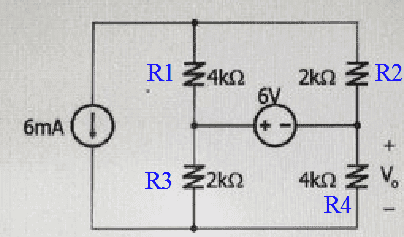
Which resistors are in parallel when the 6 V source is suppressed?
I suspect that you need to work on identifying which components are connected in parallel. Let's number the components:
Which resistors are in parallel when the 6 V source is suppressed?
Attachments

yecko
Gold Member
- 275
- 15
Well... i would short the voltage source first like this:gneill said:Which resistors are in parallel when the 6 V source is suppressed?
i can see the resistors are symmetric yet i still have no idea how’s the current path goes to visualize it as parallel circuit... do u mind telling me where’s the two parallel branches?scottdave said:With the middle linkage, would you agree that the voltage on the left side of the linkage is the same as the voltage on the right? So the voltage difference between the top of the circuit and the linkage are the same in the left branch or the right branch. Do you see how these two branches (top half) are parallel? In the same way, the bottom half 2 branches are parallel.
well...that's where i got stuck... i have got no idea...gneill said:Which resistors are in parallel when the 6 V source is suppressed?
Attachments

gneill
Mentor
- 20,989
- 2,934
So, your first task should be to read up on the characteristics of parallel resistors (or parallel components in general). What makes two components parallel? What does being connected in parallel imply for current and voltage for those components? Can you write a paragraph describing how to recognize when two components are in parallel?yecko said:well...that's where i got stuck... i have got no idea...
yecko
Gold Member
- 275
- 15
the two resistors are having both nodes common at the 2 ends, so they would experience same voltage difference.however, in this case,gneill said:Can you write a paragraph describing how to recognize when two components are in parallel?
parallel circuit pair i can identify: R1//R2, R3//R4, (R1+R3)//(R2+R4)
the 4 resistors are having 3 nodes in between, how can there be a single pair of parallel resistors to obtain the required voltage?
gneill
Mentor
- 20,989
- 2,934
Good!yecko said:the two resistors are having both nodes common at the 2 ends, so they would experience same voltage difference.
I agree with the two parallel pairs: R1 || R2 and R3 || R4. But I disagree with (R1 + R3) || (R2 + R4). Why? Because R1 and R3 are not series-connected, and neither are R2 and R4. Note that for both of these pairs of resistors, where they connect to each other that connection is not exclusive: in both cases the nodes they have in common are shared with other components as well, so the current path is not exclusive to the resistor pair, hence they do not meet the 'single current path' criteria for series connections.however, in this case,
parallel circuit pair i can identify: R1//R2, R3//R4, (R1+R3)//(R2+R4)
the 4 resistors are having 3 nodes in between, how can there be a single pair of parallel resistors to obtain the required voltage?
Now, if you consider your correctly identified parallel pairs, R1 || R2 and R3 || R4, can you re-draw the circuit with those pairs simplified to their equivalent resistance values? Be sure to keep track of which reduced resistor 'contains' R4, since you still need to find the voltage across that component (Vo)!
- 2,009
- 974
Instead of having a linkage joining them, try bringing them so that the nodes joined by the linkage actually touches. Does that help you to visualize the parallel resistors? It is the same exact circuit. There is no voltage drop across the linkage.
- 2,009
- 974
Look at the Wikipedia article about nodes in circuits. https://en.wikipedia.org/wiki/Node_(circuits)yecko said:the two resistors are having both nodes common at the 2 ends, so they would experience same voltage difference.however, in this case,
parallel circuit pair i can identify: R1//R2, R3//R4, (R1+R3)//(R2+R4)
the 4 resistors are having 3 nodes in between, how can there be a single pair of parallel resistors to obtain the required voltage?
Nodes are not just single points.
- 2,009
- 974
Were you able to understand how the nodes work? ... and why the resistors are parallel to each other?

yecko
Gold Member
- 275
- 15
can I also ask about a very similar circuit?
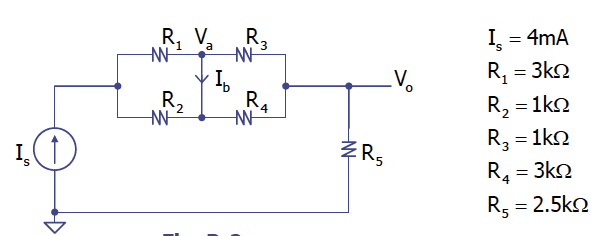
questions:
a) Use nodal analysis or otherwise, compute Va and Vo.
b) Compute Ib.
my attempt:
I2=I3=4mA*3/4=3mA
I1=I4=4mA*1/4=1mA
Ib=1-3=-2mA
Req(R1&R2)=[1+1/3]^-1=0.75k ohm
Req(R1234)=[1+1/3]^-1 *2=1.5k ohm
Req=1.5+2.5k ohm = 4k ohm
V(source)=-4mA*4kΩ=-16V
V(R1)=16*.75/4=3V
Va=16-3=13V
V(R5)=16*2.5/4=10V
Vo=10V
Am I correct in understanding the circuit? Thanks for all your help and patience!
questions:
a) Use nodal analysis or otherwise, compute Va and Vo.
b) Compute Ib.
my attempt:
I2=I3=4mA*3/4=3mA
I1=I4=4mA*1/4=1mA
Ib=1-3=-2mA
Req(R1&R2)=[1+1/3]^-1=0.75k ohm
Req(R1234)=[1+1/3]^-1 *2=1.5k ohm
Req=1.5+2.5k ohm = 4k ohm
V(source)=-4mA*4kΩ=-16V
V(R1)=16*.75/4=3V
Va=16-3=13V
V(R5)=16*2.5/4=10V
Vo=10V
Am I correct in understanding the circuit? Thanks for all your help and patience!
Attachments

The Electrician
Gold Member
- 1,402
- 210
You have the correct answers. For extra practice try this. If the wire carrying the current Ib is replaced with a resistor Rb, does the voltage Vo depend on the value of Rb?
yecko
Gold Member
- 275
- 15
The Electrician said:For extra practice try this. If the wire carrying the current Ib is replaced with a resistor Rb, does the voltage Vo depend on the value of Rb?
Yes, because the Req= R1//R2+R3//R4+Rb, which is of bigger resistance.
The voltage generated by the current source is larger and the Vo=abs(V(source))*(R3//R4)/(R1//R2+R3//R4+Rb), which at current stage there is insufficient information to determine Vo's change.
am i correct?
Last edited:
The Electrician
Gold Member
- 1,402
- 210
This is not correct. Notice that the source is not a voltage source. Why does that make a difference?
yecko
Gold Member
- 275
- 15
the current source give out fixed current while variable voltage; the voltage source give out fixed V while variable I...The Electrician said:This is not correct. Notice that the source is not a voltage source. Why does that make a difference?
the "variable" means it change with respect to resistance in the circuit
yecko said:The voltage generated by the current source is larger
As resistance of the circuit increase, why is it incorrect?The Electrician said:Why does that make a difference?
The Electrician
Gold Member
- 1,402
- 210
The current source puts out a current Is independent of the load on it. The current Is passes through the R1-R2-R3-R4-Rb combination and then into R5. The current in R5 is just Is no matter what the other resistors are. Since the current in R5 is 4 mA, the voltage across R5 is 10 volts no matter what the other resistors are.
If the source had been a voltage source the voltage across R5 would depend on Rb (and the other resistors).
If the source had been a voltage source the voltage across R5 would depend on Rb (and the other resistors).
yecko
Gold Member
- 275
- 15
oh yes! I forgot the R5! Thank you for your help!
Similar threads
Engineering
Open-circuit voltage in Thévenin equivalent
- · Replies 4 ·
- Replies
- 4
- Views
- 2K
- · Replies 1 ·
- Replies
- 1
- Views
- 1K
- · Replies 2 ·
- Replies
- 2
- Views
- 1K
- · Replies 5 ·
- Replies
- 5
- Views
- 3K
- Replies
- 9
- Views
- 2K
- Replies
- 13
- Views
- 3K
- · Replies 5 ·
- Replies
- 5
- Views
- 2K
Engineering
Calculating the voltage at a certain Resistor
- · Replies 3 ·
- Replies
- 3
- Views
- 2K
- · Replies 2 ·
- Replies
- 2
- Views
- 2K
- Replies
- 5
- Views
- 4K