Partition Function for system with 3 energy levels

1 reply · 3K views · last reply
MigMRF
Messages
15
Reaction score
0
Homework Statement
A system contains 3 particles A, B and C. A can have the energies (0, Delta) while B and C can have the energies (0,Delta,6 Delta). Determine the partition function if the particles and distinguisable. Then determine the partition function if the particles are indistinguishable
Relevant Equations
Z=sum(e^(-beta*E))
I determined the partition function of the particle A, B and C.

Partition function equation: Z_A = sum over i of e^(-beta E_i) = e^(-beta*0) + e^(-beta*Delta) = 1 + e^(-beta*Delta).

Handwritten partition function Z_B = sum over i of e^(-beta E_i) = e^(-beta*0) + e^(-6 beta Delta) + e^(-6 beta Delta) = 1 + e^(-beta Delta) + e^(-6 beta Delta).

C should be the same as B.
I then considered the situation, where all particles are in the system at the same time, and drew a diagram of all possible arrangements:
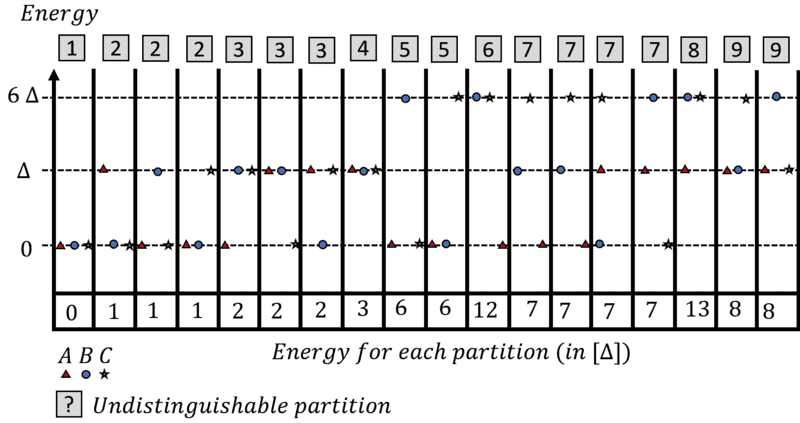
Diagram of 3 particle arrangements across energy levels 0, Δ and 6Δ, with particles A (red triangles), B (blue circles) and C (black stars); grey boxes label undistinguishable partitions and the energy sum is printed under each column.

The grey boxes are the different partitions, given that we can't tell the difference on the particles. The number at the bottom of the table is the sum of all the energies.
From this table i created the two partition functions as shown below:
Distinguishable:

Equation: e^(-β·0) + 3 e^(-βΔ) + 3 e^(-2βΔ) + 3 e^(-3βΔ) + 2 e^(-6βΔ) + e^(-12βΔ) + 4 e^(-7βΔ) + e^(-13βΔ) + 2 e^(-8βΔ)

Indistinguishable:
Partition function sum written as e^(-β·0) + e^(-β·Δ) + e^(-2β·Δ) + e^(-3β·Δ) + e^(-6β·Δ) + e^(-12β·Δ) + e^(-7β·Δ) + e^(-13β·Δ) + e^(-8β·Δ).

The correct answer is the following partition functions:

Partition function sum written as 1 + 2e^(-Δβ) + e^(-2Δβ) + 2e^(-6Δβ) + 2e^(-7Δβ) + e^(-12Δβ), with terms grouped by Boltzmann factors of energy multiples of Δ.

Mathematical expression: 1 + e^(-Δβ) + e^(-2Δβ) + e^(-6Δβ) + e^(-7Δβ) + e^(-12Δβ), with a trailing comma.

So my question is. Why does my method not work?

Kind Regards
 
I agree with your answer for part (a). It looks like the given solution does not include any states where particle A is in the state with energy ##\Delta##.

For part (b), I'm not sure. When the particles are indistinguishable, we can no longer pick out "particle A" and restrict it to the first two energy levels, while allowing the other two particles to be in any of the three levels. This would be treating one of the particles differently than the other two, which doesn't make sense if the particles are indistinguishable. But, maybe they intend for us to interpret the restriction for part (b) as saying that the level with energy ##6 \Delta## is only allowed to hold at most two particles. So, we disallow the state where all three particles occupy this energy level. This appears to be how you interpreted it. If this is what they want, then I agree with your answer for part (b). It looks like their answer leaves out states where there are no particles in the lowest energy level.


