Please explain how the MOSFET and the diode work.

Click For Summary

Discussion Overview

The discussion revolves around the operation of a clipping circuit that utilizes an enhancement mode MOSFET (IRF510) and a germanium diode (1N34) within the context of music electronics, specifically in guitar distortion effects. Participants seek to understand how the MOSFET and diode interact in this circuit, exploring both theoretical and practical aspects of their functionality.

Discussion Character

  • Exploratory
  • Technical explanation
  • Debate/contested
  • Mathematical reasoning

Main Points Raised

  • One participant expresses confusion about how the MOSFET operates in the clipping circuit, questioning its role given the configuration of the diodes.
  • Another participant mentions that the MOSFETs are diode-connected and operate in saturation, implying a specific mode of operation.
  • A participant refers to a source that discusses the use of diodes and MOSFETs in clipping circuits, suggesting that the arrangement can affect the clipping threshold and characteristics.
  • Concerns are raised about the orientation of the diodes and how they affect the conduction of the MOSFET, with one participant arguing that the circuit should not function as expected due to the backward connection of the diode.
  • Another participant highlights the importance of the body diode in the MOSFET, suggesting it plays a critical role in the circuit's operation, akin to a Zener diode under certain conditions.
  • Some participants assert that the circuit may not be functioning as intended, with one stating that the MOSFET is effectively acting as a body diode rather than being utilized for its switching capabilities.
  • There is mention of subjective differences observed in scope readings, with one participant dismissing these as potentially unfounded claims in the audiophile community.
  • Another participant shares their simulation results, indicating that the MOSFET behaves similarly to a body diode in the context of the circuit being discussed.

Areas of Agreement / Disagreement

Participants express differing views on the functionality and purpose of the MOSFET in the clipping circuit. While some acknowledge the role of the body diode, others question the necessity of the MOSFET itself, leading to an unresolved discussion regarding its operational significance.

Contextual Notes

Participants reference specific configurations and behaviors of diodes and MOSFETs, but there are unresolved assumptions regarding the circuit's design and the expected behavior of the components involved. The discussion includes varying interpretations of the role of the body diode and the overall effectiveness of the circuit.

yungman
Messages
5,741
Reaction score
291
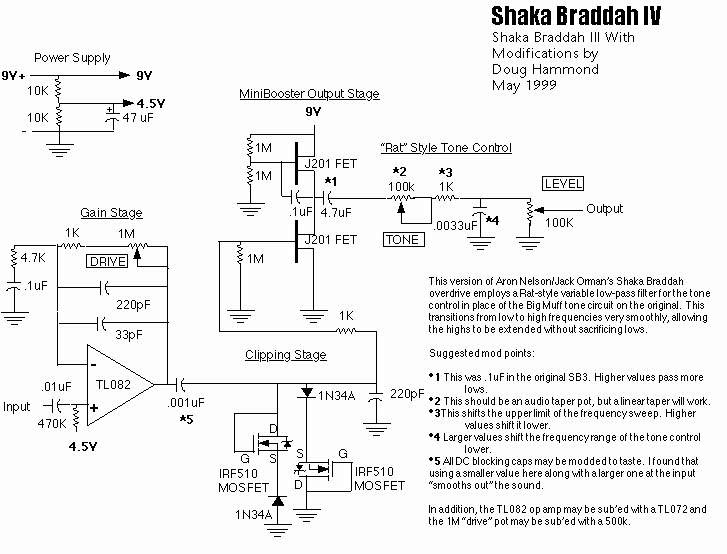
I have been working on some music electronics, I got this on the web and I don't understand how the clipping circuit with germanium diode work.

151334[/ATTACH]"]
108916g.jpg


The part in question is the enhancement mode MOSFET IRF510 with the 1N34 diode. It is a clipping circuit common in distortion box used in guitar effect. Normal it is just two back to back diode for clipping the signal. I would imagine just two back to back germanium diode will work. What is the MOSFET for, I don't even see how the two MOSFET are turn on!

Please explain.

Thanks

Alan
 

Attachments

  • 108916g.jpg
    108916g.jpg
    62.6 KB · Views: 1,877
Engineering news on Phys.org
Those are diode connected mosfet. They work in saturation only.
 
I know about MOSFET rectifier, I read about the MOSFET bridge and understand how it works. Here is the link I read and it should work:

http://www.thetaeng.com/FETBridge.htm

I analyzed the circuit and I cannot see how the two MOSFET even get turn on. I understand the body diode play a role in the ordinary rectifier to turn on the FET, but I don't see how this circuit work.

The reason I put this here because it is published and is used, it must be doing something and I just don't get it.
 
if the diodes were the other way round, the fets would add to the clipping threshold, and probably soften the edges up a bit.

http://www.generalguitargadgets.com/richardo/distortion/index.html

that page has some info, it says
Above you can see special clipping diodes. The first one has one diode on the other side and two on the other. This cuts down the positive or negative peaks (depending on how you connected the diodes) more than the other side. The second one is from Jack A. Orman's and Aaron Nelson's Shaka Braddah III design. It uses a diode and a MOSFET to create clipping. It gives a nice, bluesy, soft clipping. The original diodes were 1N34's and the MOSFETs were IRF520's

edit: ha ha, on closer look, i think that's all the page says.
 
earlofwessex said:
if the diodes were the other way round, the fets would add to the clipping threshold, and probably soften the edges up a bit.

http://www.generalguitargadgets.com/richardo/distortion/index.html

that page has some info, it says

edit: ha ha, on closer look, i think that's all the page says.

Thanks for the reply, that's the Jack A. Orman's and Aaron Nelson's Shaka Braddah III design. My question is how does it work. My confusion is how does the circuit conduct. If you look at the link you provided, the left hand side is the enhancement NMOS with the source connects to the anode of the 1N34.

Let see if top side is positive, the gate of the NMOS is tied to the Drain and when positive, the NMOS is trying to turn on. BUT the diode is connected backward and is OFF. There will be no conduction.

Now if the bottom is positive and top is negative, the diode want to turn on. BUT the NMOS is up side down where the Source is on the positive end and the Gate and Drain is connected to the negative side. Even if you say the S and D is interchangeable, the gate is tide to the D(which is S if you switch S to D) and it is not going to turn on as it is an enhancement mode FET.

This is my confusion. It is obvious the circuit works, but how?
 
It seems that you completely forgot about build-in in every MOSFET parasitic diode (body diode). This diode act just like a Zener diode. The Zener action occurs when Vds > Vds_max. And act like a "normal" diode when Vsd > 0.6V.
 
Jony130 said:
It seems that you completely forgot about build-in in every MOSFET parasitic diode (body diode). This diode act just like a Zener diode. The Zener action occurs when Vds > Vds_max. And act like a "normal" diode when Vsd > 0.6V.

I did not forget the body diode, in fact the body diode is the very thing that make MOSFET as rectifier possible. In fact the body diode is shown in the drawing I posted. It does not make any sense to use the MOSFET just to use the body diode and the MOSFET never get turn on. There got to be a better reason. I designed a lot of MOSFET circuits, just cannot make sense out of this.

It is not used as Zener as the voltage is much higher, this is a clamping circuit for distortion that use 9V battery, never even touch the zener break down voltage.
 
Well, my scope don't see any difference

attachment.php?attachmentid=45855&stc=1&d=1333482952.png


It's looks like another audiophile myth.
 

Attachments

  • NewFile1.PNG
    NewFile1.PNG
    5.2 KB · Views: 2,139
I see a difference in your scope, those peaks are clipped asymetrically.

it should be noted that DIY guitar effects pedals are usually built by random trial and error, by people who haven't studied electronic design.

FETs as diodes

You can connect the Gate and Source to make a FET diode. Connect a FET Gate+Source to ground and the Drain to signal. Then connect another FET Drain to ground and Gate+Source to Signal. Try these where you might have your standard silicon diode clippers.

Buzzwords: "More touch sensitivity", "FET sound", "Tube crunch"
http://www.diystompboxes.com/wiki/index.php?title=Simple_mods
 
  • #10
Yeh, I really think it's those people that really don't know electronics doing something really funny. I did the simulation with LTSpice and see the same thing as your scope trace. The MOSFET is nothing more than a body diode.
 
  • #11
earlofwessex said:
I see a difference in your scope, those peaks are clipped asymetrically.

it should be noted that DIY guitar effects pedals are usually built by random trial and error, by people who haven't studied electronic design.


http://www.diystompboxes.com/wiki/index.php?title=Simple_mods

I think it's due to the Vbe difference. I am busy working on the diode clipping distortion circuit and I can change the duty cycle by introducing offset.
 

Similar threads

  • · Replies 10 ·
Replies
10
Views
2K
  • · Replies 28 ·
Replies
28
Views
6K
  • · Replies 25 ·
Replies
25
Views
6K
  • · Replies 6 ·
Replies
6
Views
3K
Replies
2
Views
2K
  • · Replies 2 ·
Replies
2
Views
2K
  • · Replies 21 ·
Replies
21
Views
3K
  • · Replies 5 ·
Replies
5
Views
1K
  • · Replies 12 ·
Replies
12
Views
2K
Replies
4
Views
3K