PhDeezNutz
- 851
- 561
- Homework Statement
- I want to plot formula 10.119 in Jackson
##\frac{dP}{d \Omega} \approx P_i \frac{\left(ka\right)^2}{4 \pi}\frac{\left(1 + \cos \theta \right)}{2}\left|\frac{J_1 \left( ka \sin \theta \right)}{ka \sin \theta} \right|^2##
(I have let ##\alpha = 0## for normal incidence)
- Relevant Equations
- See above
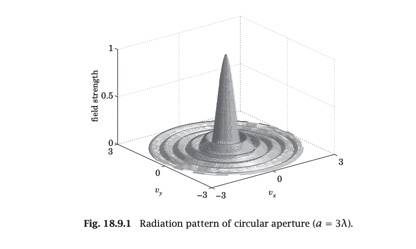
From my understanding of diffraction pattern is supposed to result in something like this
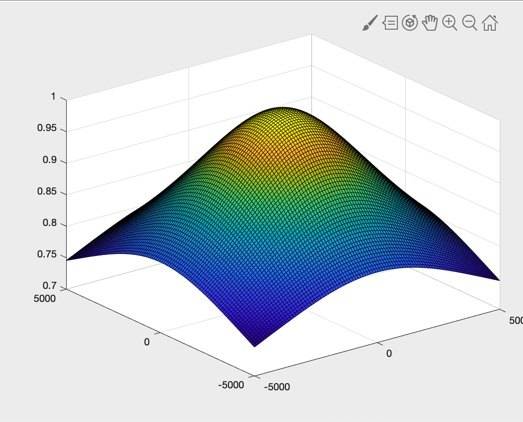
However when I plot it I get the central peak without the ripples (even when broadening the view). My result
My code is as follows
The part of the script that reads
Jfactor(~isfinite(kasinthetaneg1)) = 0.25; is to have a central peak instead of a central 0. It is a pathological case because ##J_1## has a zero at zero but ##\frac{J_1 (x)}{x}## has a peak at zero. Analogous to the sinc function.
Again I am getting a central peak but no ripple (not even tiny ones when I broaden my view).
Thanks for any help in advance. I'll probably have a bunch of follow up questions...fair warning :D
However when I plot it I get the central peak without the ripples (even when broadening the view). My result
My code is as follows
%1) Define the grid. Define vectors so that they include 0, otherwise entire planes are excluded from the picture. We want only to exclude the% origin. Unfortunately there is no mechanism in place to ensure this with arbitrary choices.

n = 100;
rmax = 5000;
x = linspace(-rmax,rmax,n);
y = linspace(-rmax,rmax,n);
z = linspace(-rmax,rmax,n);

%2) Form a meshgrid and the first radial array

[X,Y] = meshgrid(x,y);

r = sqrt(X.^2 + Y.^2 + (z(90)*ones(size(Y))).^2);

rnegative1 = r.^(-1);
rnegative2 = r.^(-2);
rnegative3 = r.^(-3);
rnegative4 = r.^(-4);
rnegative5 = r.^(-5);rnegative1(~isfinite(rnegative1)) = 0;
rnegative2(~isfinite(rnegative2)) = 0;
rnegative3(~isfinite(rnegative3)) = 0;
rnegative4(~isfinite(rnegative4)) = 0;
rnegative5(~isfinite(rnegative5)) = 0;r2 = sqrt(X.^2 + Y.^2);

r2negative1 = r2.^(-1);
r2negative2 = r2.^(-2);
r2negative3 = r2.^(-3);
r2negative4 = r2.^(-4);
r2negative5 = r2.^(-5);
r2negative1(~isfinite(r2negative1)) = 0;
r2negative2(~isfinite(r2negative2)) = 0;
r2negative3(~isfinite(r2negative3)) = 0;
r2negative4(~isfinite(r2negative4)) = 0;
r2negative5(~isfinite(r2negative5)) = 0;%3) Create constants

k = 0.001*5*pi;
epsilon = 8.85*(10^(-12));
c = 3*((10)^(8));
c1 = (4*pi)^(-1);
c2= (4*pi*epsilon)^(-1);mu = (4*pi)*((10)^(-7));
omega = k*sqrt(mu*epsilon);
E0 = 1;
a = 1;%4) The kasintheta function

r2 = sqrt(X.^2 + Y.^2);
r3 = sqrt(X.^2 + Y.^2 + (z(90)*ones(size(Y))).^(2));
r3neg1 = r3.^(-1);
kasintheta = k*a*r2.*((z(90)).^(-1));
kasinthetaneg1 = kasintheta.^(-1);Jfactor = (besselj(1,kasintheta).*kasinthetaneg1).^2;
Jfactor(~isfinite(kasinthetaneg1)) = 0.25;Eratio = 2*((1+ z(90).*r3neg1).^2).*Jfactor;

surf(X,Y,Eratio)
The part of the script that reads
Jfactor(~isfinite(kasinthetaneg1)) = 0.25; is to have a central peak instead of a central 0. It is a pathological case because ##J_1## has a zero at zero but ##\frac{J_1 (x)}{x}## has a peak at zero. Analogous to the sinc function.
Again I am getting a central peak but no ripple (not even tiny ones when I broaden my view).
Thanks for any help in advance. I'll probably have a bunch of follow up questions...fair warning :D