Plotting the Probability Density of the Coulomb Wave Function

7 replies · 2K views · last reply
tomdodd4598
Messages
137
Reaction score
13
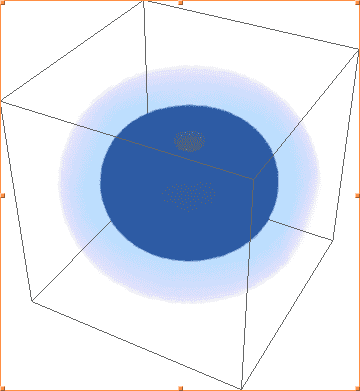
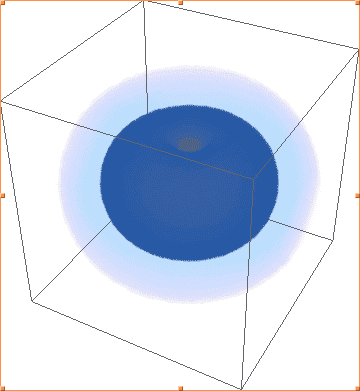
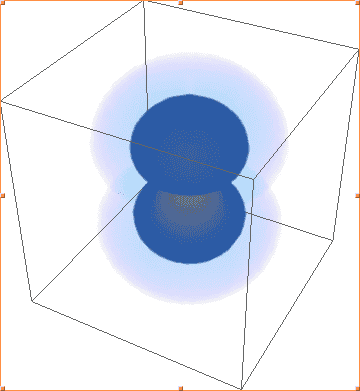
Hey there - I think I have an issue with my 3D density plots of the probability density of the Coulomb wave function. The reason I think something is going wrong is because my plots of |ψ(n=2, l=1, m=-1)|² and |ψ(2, 1, 1)|² are identical, while I would expect them to have the same shape but be rotationally symmetric along different orthogonal axes.
3D density plot inside a wireframe cube: a dark blue, roughly spherical blob with a soft pale blue halo around it, with a small orange marker near its top.
3D density plot inside a wireframe cube of a dark blue two-lobed shape stacked vertically, with a faint blue halo around it, resembling a p orbital along the vertical axis.
3D density plot in a wireframe cube showing a blue spherical region with a lighter blue halo, looks like a rotationally symmetric density cloud.


The above images are Mathematica's plots of |ψ(2, 1, -1)|², |ψ(2, 1, 0)|², |ψ(2, 1, 1)|², respectively. As you can see, the first and third are identical, and not the shape of 2p orbitals, while the second plot actually looks like what I would expect - one of the three 2p orbitals.

Here is my wave function - it's possible that the conversion from spherical to Cartesian coordinates is a problem, but I'm not sure:

Mathematica code defining a hydrogen-like wavefunction using Laguerre and spherical harmonic functions, followed by DensityPlot3D of the squared modulus with axes from -h to h and plot legends enabled.


If the above needs clarifying, do ask. Thanks for any help in advance ;)
 
If you take suitable linear combinations of ##\psi(2,1,-1)## and ##\psi(2,1,+1)##, and then find the probability densities, you do get the ##p_x## and ##p_y## orbitals.
 
jtbell said:
If you take suitable linear combinations of ##\psi(2,1,-1)## and ##\psi(2,1,+1)##, and then find the probability densities, you do get the ##p_x## and ##p_y## orbitals.

Ah, I've managed to make linear combinations which give the x and y-direction p orbitals, but I am still confused - does that mean some orbital wave functions aren't energy energy eigenfunctions? How/why would that be true?
 
tomdodd4598 said:
Ah, I've managed to make linear combinations which give the x and y-direction p orbitals, but I am still confused - does that mean some orbital wave functions aren't energy energy eigenfunctions? How/why would that be true?
They are still energy eigenfunctions. However, ##p_x## and ##p_y## are not eigenfunctions of ##\hat{L}_z##.
 
DrClaude said:
They are still energy eigenfunctions. However, ##p_x## and ##p_y## are not eigenfunctions of ##\hat{L}_z##.

Right, I understand that, but I've now got more questions - what are those donut-shaped probability densities? Why aren't they valid orbitals? Also, is there a systematic way for me to combine these 'base' wave functions to create the correct electron orbitals? I managed to make an intuitive guess with the other two p orbitals, but is there a general set of linear combinations which give all of the orbitals?
 
Last edited:
tomdodd4598 said:
Right, I understand that, but I've now got more questions - what are those donut-shaped probability densities? Why aren't they valid orbitals?
They are completely valid orbitals. But they are complex functions, which can make them more difficult to work with in certain situations. The ##p_x## and ##p_y## orbitals are completely real functions, and their orientation along the Cartesian coordinates makes them useful to understand things like chemical bonding.

tomdodd4598 said:
Also, is there a systematic way for me to combine these 'base' wave functions to create the correct electron orbitals? I managed to make an intuitive guess with the other two p orbitals, but is there a general set of linear combinations which give all of the orbitals?
See https://en.wikipedia.org/wiki/Atomic_orbital#Real_orbitals