Potential difference: positive or negative?

Join the discussion
Registration is free. Ask a follow-up in this thread, or start your own.
9 replies · 8K views
gracy
Messages
2,486
Reaction score
83
Why potential at a point can only be obtained by supposing/assuming a positive test charge there?
For example
There was a question
In figure two points A and B are located in a region of electric field.,The potential difference ##VB##-##VA## is
1-positive
2-Negative
3-zero
4-none of the above
the answer is 2-Negative
Apparently the source charge is positive
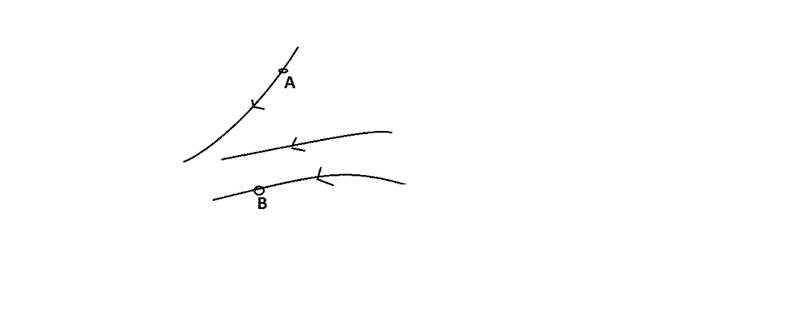
O.png

we will only get the answer to be 2-Negative when we would assume positive test charge but if we assume negative test charge at A &B we are going to get answer 1-positive.So is it like we are bound to assume positive charge at points mentioned in question to get whether potential difference is positive or negative?
 
Physics news on Phys.org
The figure shows the electric field lines.
How is the electric field at a point defined?
 
  • Like
Likes   Reactions: gracy
ehild said:
How is the electric field at a point defined?
Force per unit charge.
The electric field
5eb237ccb8c2716d347ab313cad7918e.png
at a given point is defined as the (vectorial) force
183083a13a40d344ebc290a84579b0c3.png
that would be exerted on a stationary test particle of unit charge by electromagnetic forces
 
Last edited by a moderator:
  • Like
Likes   Reactions: gracy
And we are told to put negative charge there(in electric field ) in that case we can ,right?
 
gracy said:
And we are told to put negative charge there(in electric field ) in that case we can ,right?
You can put a negative charge into any electric field. Do it. And what do you do after?
 
ehild said:
You can put a negative charge into any electric field.
But it can not be called "test charge",right?
 
The potential difference between points A and B (or any two points) does not depend on the test charge used. The relation is standard

V_B - V_A = - \int_A^B \overrightarrow{E}.d\overrightarrow{s}

You can use a negative or positive test charge and multiply both sides of the above relation with the charge. The equation will change to a relation between the difference of potential energies, and the work done by the electrostatic force. In case my Latex is not clear, there is a dot product between the electric field and the infinitesimal displacement in the integral, and the integral is over any path joining points A and B. It does not matter whether you "call" it a test charge or not. The fact is that you can use either positive or negative charges.