PhysicsTest
- 256
- 27
- TL;DR
- I want to calculate the power of general circuit with voltage leading the current by phase difference of Theta
I am trying to calculate the power calculation of a general circuit with voltage leading the current by a phase difference of ##\theta##.
The instantaneous voltage is given by ##v = V_m\sin(\omega t +\theta) ; i = I_m\sin(\omega t) ##. The instantaneous power is then
##p = V_m I_m \sin(\omega t + \theta) * \sin(\omega t) ## ---> 1. The first doubt is if i draw the waveform
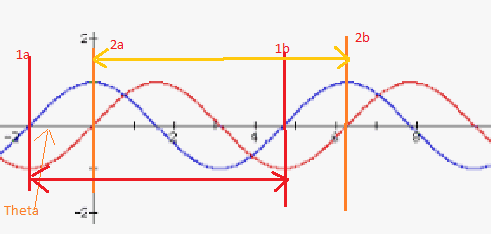
The average power is the power calculated for one cycle ##P_{avg} = \frac {P_{1cycle}} {Duration of 1 Cycle}## where ##P_{1cycle}## is the power for one cycle of the signal. Is my understanding correct? The duration of 1Cycle is ##2\pi##?
2. The 1 cycle can be either from 0 to 2##\pi## represented by 2a to 2b and hence the limits of integration are 0 to 2##\pi## or it can be from 1a to 1b i.e the limits of integration from ##-\theta## to ##2\pi - \theta##?
3. The integral will be
##\int_0^{2\pi} p d\theta ## or ##\int_0^{2\pi} p dt## ? How do i know which one to use? (p is from eq1)
The instantaneous voltage is given by ##v = V_m\sin(\omega t +\theta) ; i = I_m\sin(\omega t) ##. The instantaneous power is then
##p = V_m I_m \sin(\omega t + \theta) * \sin(\omega t) ## ---> 1. The first doubt is if i draw the waveform
The average power is the power calculated for one cycle ##P_{avg} = \frac {P_{1cycle}} {Duration of 1 Cycle}## where ##P_{1cycle}## is the power for one cycle of the signal. Is my understanding correct? The duration of 1Cycle is ##2\pi##?
2. The 1 cycle can be either from 0 to 2##\pi## represented by 2a to 2b and hence the limits of integration are 0 to 2##\pi## or it can be from 1a to 1b i.e the limits of integration from ##-\theta## to ##2\pi - \theta##?
3. The integral will be
##\int_0^{2\pi} p d\theta ## or ##\int_0^{2\pi} p dt## ? How do i know which one to use? (p is from eq1)