Power supplied by capacitor bank

Click For Summary

Discussion Overview

The discussion revolves around the calculation of reactive power supplied by a capacitor bank in an electrical circuit. Participants explore the implications of sign conventions, the nature of admittance versus impedance, and the correct approach to calculating current in relation to the bus voltage.

Discussion Character

  • Technical explanation
  • Debate/contested
  • Mathematical reasoning

Main Points Raised

  • One participant presents a calculation for the reactive power supplied by the capacitor bank, noting a discrepancy in the sign of the result and questioning the assumptions made in the calculation.
  • Another participant questions the definition of the reactance of the capacitor, suggesting that there may be a mistake in the original question regarding the sign of the reactance.
  • Some participants clarify that the value given (j0.25) is admittance, not impedance, and provide a calculation to derive the capacitance from the admittance.
  • Several participants discuss the direction of current flow in relation to the bus, with one participant suggesting that the current should be considered entering the bus when the capacitor bank supplies power.
  • Another participant reflects on their understanding of current direction and its impact on the sign of the calculated reactive power, seeking validation for their reasoning.
  • A later reply suggests reviewing the definition and formula for reactive power for further clarity.

Areas of Agreement / Disagreement

Participants express differing views on the correct interpretation of the capacitor's reactance and the assumptions regarding current direction. There is no consensus on the correct approach to the calculations, and multiple competing views remain present in the discussion.

Contextual Notes

Participants highlight potential confusion regarding the definitions of admittance and impedance, as well as the assumptions made about current flow in the circuit. The discussion reflects a range of interpretations and calculations that have not been resolved.

Who May Find This Useful

This discussion may be useful for individuals studying electrical engineering concepts, particularly those interested in reactive power calculations and the behavior of capacitor banks in circuits.

LagCompensator
Messages
24
Reaction score
1
< Mentor Note -- thread moved to HH from the technical forums, so no HH Template is shown >[/color]

Hi,

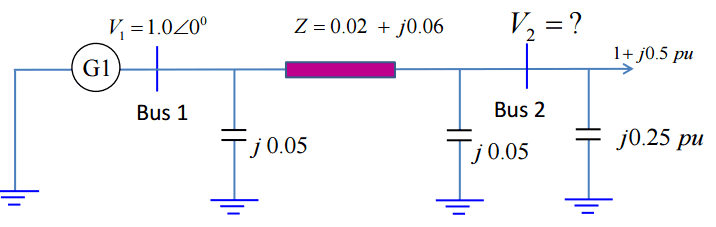
I have the following circuit, where V2 is found to be 0.964∠-3.3 (degrees) p.u.

Then I am to find the reactive power supplied by the capacitor bank (j0.25 p.u, to the right). I got the right number, but with wrong sign, could anyone parhaps tell me if my proposal at the end here is correct?

Calculations:

Current down the capacitor branch:
I_{c} = V_{2} \times Y_{c} = (0.964 \angle-3.3) \times j0.25 = 0.241 \angle 86.7 p.u.\\<br /> S = V \times I^{*} \rightarrow S_{c} = V_{2} \times I_{c}^{*} = 0.964 \angle(-3.3) \times 0.241 \angle(-86.7) = -j0.2323 p.u.<br />

So I get that Q = -0.2323, however it should have been positive since the bank is supplying the bus with power, and since injected power into a bus is defined positive.

So then I guess that current is defined as positive when entering the bus, and negative when leaving, and because of that I_c should be calculated like this instead:

I_{c} = (0 - V_{2}) \times Y_{c}

Thanks for any feedback.

Best regards
test.PNG
 
Last edited by a moderator:
Physics news on Phys.org
Is it really the reactance of capacitor?
I think there is mistake in question
the reactance of capacitor is always given by (-j/wC) where w is angular frequqncy...If we solve the value for C, we get a negative value...
So, I think there is mistake in question
 
Alpharup said:
Is it really the reactance of capacitor?
I think there is mistake in question
the reactance of capacitor is always given by (-j/wC) where w is angular frequqncy...If we solve the value for C, we get a negative value...
So, I think there is mistake in question

j0.25 is the admittance not impedance, so if I solve the value for C, I get a positive value.

Y = \frac{1}{Z} \rightarrow Z = \frac{1}{Y} = \frac{1}{j0.25} = -j4<br /> \\<br /> Z = \frac{1}{j\omega C} = -j4 \rightarrow C = \frac{1}{4 \times \omega}<br />

I did not write that it was the admittance, I just wrote Y instead of Z in the equations, I should have been more clear.
 
When you calculated the current for the capacitor bank, what direction was the assumed current?

If the the bank is supplying power, what direction should the assumed current be?
 
When I calculated and got the wrong sign I did the following:

(V_2-V_{Ground}) \times Y_c
When I do it like this I am assuming the current leaves the bus, which should not be the case, therefore I should do it like this:
(V_{Ground}-V_2) \times Y_c
Doing it this way assumes that current flows into the bus.

Is my way of thinking OK? I'm new to "electrical stuff", and therefore I sometimes fail at stuff like this.
 
LagCompensator said:
When I calculated and got the wrong sign I did the following:

(V_2-V_{Ground}) \times Y_c
When I do it like this I am assuming the current leaves the bus, which should not be the case, therefore I should do it like this:
(V_{Ground}-V_2) \times Y_c
Doing it this way assumes that current flows into the bus.

Is my way of thinking OK? I'm new to "electrical stuff", and therefore I sometimes fail at stuff like this.
Yes, that would be the right way to look at it.
 
I think you should look at the definition and formula of S(reactive power) for clarity.
 

Similar threads

  • · Replies 9 ·
Replies
9
Views
2K
  • · Replies 2 ·
Replies
2
Views
6K
  • · Replies 2 ·
Replies
2
Views
2K
  • · Replies 4 ·
Replies
4
Views
2K
Replies
2
Views
4K
  • · Replies 17 ·
Replies
17
Views
3K
  • · Replies 9 ·
Replies
9
Views
5K
  • · Replies 8 ·
Replies
8
Views
2K
  • · Replies 3 ·
Replies
3
Views
2K
  • · Replies 8 ·
Replies
8
Views
2K