Pressure Gradients along an angle pipe

Click For Summary
SUMMARY

The discussion focuses on the behavior of pressure gradients in an angled pipe connecting high and low pressure volumes. Participants clarify that isobars are influenced by gravity and the pressure difference between reservoirs, with the equation P = hrg (where r is density) being central to understanding pressure distribution. The conversation also explores how the angle of a gimbal in a bottle rocket affects the direction of action and reaction forces, emphasizing that both the thrust line and the resulting torque are impacted by the gimbal's angle. Ultimately, the interaction of pressure gradients and forces in angled systems is complex and requires careful consideration of multiple factors.

PREREQUISITES
  • Understanding of fluid dynamics principles
  • Familiarity with pressure gradient concepts
  • Knowledge of the equation P = hrg (pressure calculation)
  • Basic mechanics of action and reaction forces
NEXT STEPS
  • Research the effects of gravity on fluid pressure in angled pipes
  • Explore Computational Fluid Dynamics (CFD) applications in pressure analysis
  • Study the mechanics of gimbaled systems in rocket propulsion
  • Investigate the relationship between pressure differences and isobar orientation
USEFUL FOR

Engineers, fluid dynamics researchers, and students studying mechanics and pressure systems will benefit from this discussion, particularly those interested in practical applications of pressure gradients in piping and propulsion systems.

Timtam
Messages
40
Reaction score
0
I have a high pressure volume coupled with a low pressure volume by a pipe and valve .
If the pipe was straight I would expect the isobars of the pressure gradient to be parallel to the pressure differences and perpendicular to the pipe , I would expect a reaction force (red arrow) on the wall directly opposite the valve acting perpendicular to the isobars (no shear component)
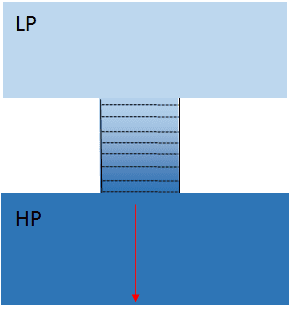
upload_2016-12-20_14-24-16.png

If the pipe was angled I am unsure how the pressure gradients isobars would look ?
Would they still be parallel between the pressure difference
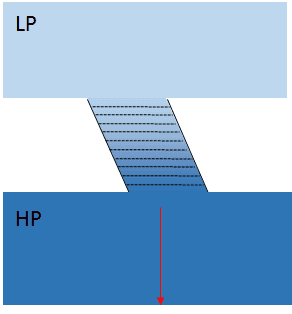
upload_2016-12-20_14-23-1.png

or would they still be perpendicular to the pipe ?
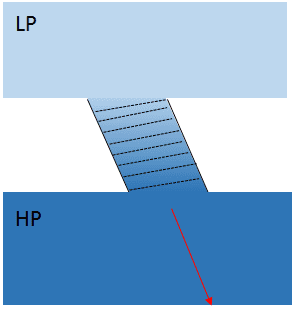
upload_2016-12-20_14-21-58.png

Would the angle of the pipe make a difference to where the reaction force angle on the opposite wall
 
Physics news on Phys.org
The first two diagrams must be correct ...last one incorrect ... theses isobars are the result of gravity , no gravity , no pressure ... It's not true that the opposite wall has a 'reaction force ' depending on the pipe ... the whole of the opposite wall has the same pressure exerted on it , dependent on the height of fluid above it , density of fluid , and gravity. the pressure at any point is ...P =hrg ...(r is dencity)
 
oz93666 said:
The first two diagrams must be correct ...last one incorrect ... theses isobars are the result of gravity , no gravity , no pressure ... It's not true that the opposite wall has a 'reaction force ' depending on the pipe ... the whole of the opposite wall has the same pressure exerted on it , dependent on the height of fluid above it , density of fluid , and gravity. the pressure at any point is ...P =hrg ...(r is dencity)
Hi Oz , sorry i could have been clearer in my diagram, the gravity acts perpendicular to the flow direction between the vessels. The isobars reflect the pressure gradient between the two volumes once the valve is released. I could have probably simplified it by removing the low pressure volume and just said ambient pressure
 
I see ...so we have to rotate the diagrams through 90 degrees to get correct orientation ? and the isobars are not gravity dependent , but due to different pressures in reservoirs?

Then there is no steady state , the situation is very complex depending on the orifice in the valve and other factors ...can you describe the situation in more detail...
 
oz93666 said:
I see ...so we have to rotate the diagrams through 90 degrees to get correct orientation ? and the isobars are not gravity dependent , but due to different pressures in reservoirs?

Then there is no steady state , the situation is very complex depending on the orifice in the valve and other factors ...can you describe the situation in more detail...

Perhaps I could simplify it by asking it another way , in the thrust of a Bottle rocket (aka our high pressure volume ) fitted with a gimble, Does the gimble angle change the direction of the action force at the base , the reaction force in the nose or both

upload_2016-12-21_16-31-36.png

1. Change the direction of the action force - the Gimble angle (deflects momentum at the base of the rocket) causing a torque in the tail but the line of thrust and reaction force still points straight up to the nose of the rocket.

upload_2016-12-22_11-43-50.png


2. Change the direction of the reaction force - an equal and opposite action force the means that is now diametrically opposing the direction of thrust and as it no longer thru the center of gravity causing a torque in the nose

upload_2016-12-22_11-44-23.png


3. Both . The torque in the nose caused by the line of thrust 1. is opposite to the torque in the base by the deflection 2. so would be dampened ? If the gimble angle is severe enough the line of thrust could be below the centre of mass so cause a complimentary torque to the deflection caused by the gimble

upload_2016-12-22_12-10-25.png
 
Last edited:
yes ..with the rocket , if the extended line or reaction force is not exactly going through the CofG it will rotate the rocket .. if there is any gimbal angle at all the rocket will spin , bigger the angle greater the spin.

I'm sure if you could explain what prompted the original question , the answer could be quickly found , does this relate to a practical situation involving real tanks and plumbing , or is it purely theoretical ...
 
The question was prompted by a CFD result i am trying to understand

upload_2016-12-24_13-6-43.png
When a high pressure volume is separated from a lower pressure by an angle surface the isobars behave interestingly

The Isobars suggest that the action reaction / thrust line is (Red line) but the velocity arrows suggests most of the flow comes straight down so the action reaction line would be something like the Black line (straight down and then deflected by the surface )

Intuitively i think it would be a combination of both
 
Last edited:

Similar threads

  • · Replies 15 ·
Replies
15
Views
2K
  • · Replies 28 ·
Replies
28
Views
3K
  • · Replies 20 ·
Replies
20
Views
4K
  • · Replies 2 ·
Replies
2
Views
1K
  • · Replies 20 ·
Replies
20
Views
11K
  • · Replies 11 ·
Replies
11
Views
3K
  • · Replies 13 ·
Replies
13
Views
2K
  • · Replies 31 ·
2
Replies
31
Views
5K
  • · Replies 30 ·
2
Replies
30
Views
4K
  • · Replies 1 ·
Replies
1
Views
3K