Problem resolving forces into components

Click For Summary
The discussion centers on the correct resolution of velocity components into radial (Vr) and angular (Vtheta) forms, with one participant asserting that their calculations (Vr = -V cos theta, Vtheta = V sin theta) differ from the solution manual's answers. They argue that their approach is validated by extreme cases, where changes in r and theta behave predictably. Additionally, there is confusion regarding the solution manual's claim that the total acceleration is zero, leading to the conclusion that radial acceleration equals angular acceleration, which the participant disputes. They emphasize that constant velocity implies zero tangential acceleration but does not eliminate normal acceleration. The conversation highlights potential errors in the solution manual and the importance of understanding the relationships between different types of acceleration.
yugeci
Messages
61
Reaction score
0
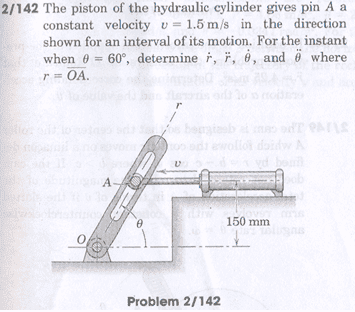
I have problems with this question:

62d306ea7ba4c5d56ff4ab351d23529e.png


This is how I resolved v into its components (Vr and Vtheta):
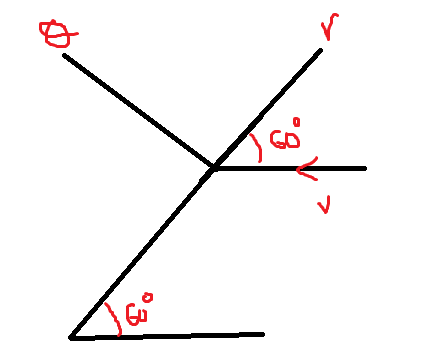
7b408312dc76a0833d3c8c657c5d2659.png


So with this I get
Vr = - V cos theta
Vtheta = V sin theta

However in my solution booklet the components are the other way around (Vr = - V sin theta, Vtheta = V cos theta) and I cannot figure out why. It makes no sense... am I right and the solution wrong?
 
Physics news on Phys.org
The solution manual is wrong.
 
The extreme cases support you. When theta is small, (the piston is in line with the lever) almost all the change is in r and theta is almost constant. Conversely, when the lever arm is straight up (theta=90), r doesn't change and theta is the only thing changing. That puts the cos and sin where you have them.
 
Thought so. Thanks. Another problem I have with the solution manual is that it says the magnitude of the total acceleration is zero and therefore the radial acceleration = angular acceleration (Ar = Atheta). Is this true? Because I thought the constant velocity only meant the tangential acceleration was zero... and there would be still be a normal acceleration equal to v^2 / r.
 
Either the solution manual is wrong again, or you have misread it somehow. ##\ddot r## and ##\ddot theta## have different units, so they can't be equal unless 0.
 
Thread 'Correct statement about size of wire to produce larger extension'
The answer is (B) but I don't really understand why. Based on formula of Young Modulus: $$x=\frac{FL}{AE}$$ The second wire made of the same material so it means they have same Young Modulus. Larger extension means larger value of ##x## so to get larger value of ##x## we can increase ##F## and ##L## and decrease ##A## I am not sure whether there is change in ##F## for first and second wire so I will just assume ##F## does not change. It leaves (B) and (C) as possible options so why is (C)...

Similar threads

  • · Replies 11 ·
Replies
11
Views
1K
  • · Replies 10 ·
Replies
10
Views
2K
Replies
12
Views
3K
  • · Replies 18 ·
Replies
18
Views
2K
  • · Replies 9 ·
Replies
9
Views
711
  • · Replies 6 ·
Replies
6
Views
1K
Replies
46
Views
3K
Replies
3
Views
420
  • · Replies 22 ·
Replies
22
Views
1K
  • · Replies 3 ·
Replies
3
Views
6K