Problem resolving forces into components

Click For Summary

Homework Help Overview

The discussion revolves around resolving a velocity vector into its radial and angular components, specifically addressing discrepancies between a participant's calculations and a solution manual. The subject area includes vector decomposition and dynamics.

Discussion Character

  • Conceptual clarification, Assumption checking

Approaches and Questions Raised

  • The original poster attempts to resolve a velocity vector into components but finds a conflict with the solution manual. Some participants question the validity of the solution manual's components and explore the implications of constant velocity on acceleration.

Discussion Status

Participants are actively discussing the correctness of the component definitions and the interpretation of acceleration in the context of the problem. There is no explicit consensus, but some guidance has been offered regarding the extreme cases supporting the original poster's approach.

Contextual Notes

There are indications of confusion regarding the definitions of radial and angular acceleration, as well as the conditions under which they can be considered equal. The discussion also highlights potential misinterpretations of the solution manual's statements.

yugeci
Messages
61
Reaction score
0
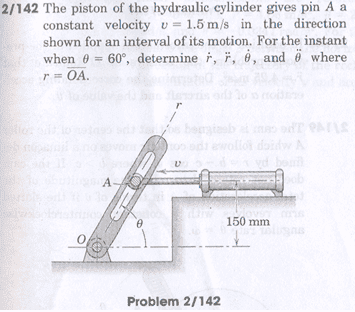
I have problems with this question:

62d306ea7ba4c5d56ff4ab351d23529e.png


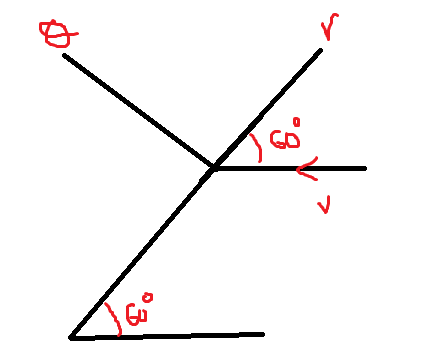
This is how I resolved v into its components (Vr and Vtheta):
7b408312dc76a0833d3c8c657c5d2659.png


So with this I get
Vr = - V cos theta
Vtheta = V sin theta

However in my solution booklet the components are the other way around (Vr = - V sin theta, Vtheta = V cos theta) and I cannot figure out why. It makes no sense... am I right and the solution wrong?
 
Physics news on Phys.org
The solution manual is wrong.
 
The extreme cases support you. When theta is small, (the piston is in line with the lever) almost all the change is in r and theta is almost constant. Conversely, when the lever arm is straight up (theta=90), r doesn't change and theta is the only thing changing. That puts the cos and sin where you have them.
 
Thought so. Thanks. Another problem I have with the solution manual is that it says the magnitude of the total acceleration is zero and therefore the radial acceleration = angular acceleration (Ar = Atheta). Is this true? Because I thought the constant velocity only meant the tangential acceleration was zero... and there would be still be a normal acceleration equal to v^2 / r.
 
Either the solution manual is wrong again, or you have misread it somehow. ##\ddot r## and ##\ddot theta## have different units, so they can't be equal unless 0.
 

Similar threads

  • · Replies 11 ·
Replies
11
Views
2K
  • · Replies 10 ·
Replies
10
Views
2K
Replies
12
Views
3K
  • · Replies 18 ·
Replies
18
Views
2K
  • · Replies 9 ·
Replies
9
Views
2K
  • · Replies 6 ·
Replies
6
Views
1K
Replies
46
Views
7K
Replies
3
Views
1K
  • · Replies 22 ·
Replies
22
Views
1K
Replies
13
Views
2K