Pulleys and Conservation of Energy

Click For Summary
SUMMARY

The discussion focuses on solving a physics problem involving pulleys and the conservation of energy. The participants analyze the motion of two identical hanging masses connected by a movable pulley, applying the conservation of energy principle. The correct formulation of the conservation of energy equation is established as ΔK_total + ΔU_total = 0, which corrects the initial misunderstanding regarding the relationship between kinetic and potential energy. The final conclusion indicates that the upward acceleration of the left mass is (1/3)g, with the clarification that the accelerations of the two masses differ, with one accelerating at twice the rate of the other.

PREREQUISITES
  • Understanding of Newton's laws of motion
  • Familiarity with the concepts of kinetic and potential energy
  • Knowledge of basic pulley systems and their mechanics
  • Ability to apply conservation of energy principles in physics problems
NEXT STEPS
  • Study the derivation of the conservation of energy equation in mechanical systems
  • Explore the dynamics of pulley systems and their acceleration relationships
  • Learn about kinematic equations and their applications in solving motion problems
  • Investigate common mistakes in applying conservation of energy in physics problems
USEFUL FOR

Physics students, educators, and anyone interested in understanding the principles of mechanics and energy conservation in pulley systems.

zx95
Messages
7
Reaction score
0
1. In the system shown in the figure, the pulleys on the left and right are fixed, but the pulley in the center can move left or right. The two hanging masses are identical, and the pulleys and ropes are all massless. Find the upward acceleration of the mass on the left, in terms of g.
2. I have to solve this problem using only Conservation of Energy. The following equations are relevant: K = (1/2)mv^2 and U = mgy
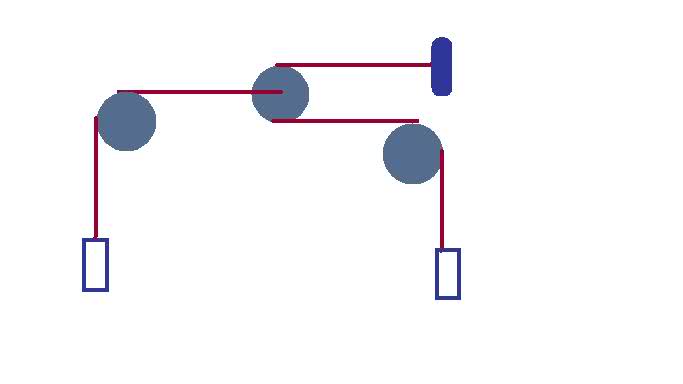
25umnaf.jpg

3. I began by setting up a general Conservation of Energy equation.

I'm calling the left mass m1 and the right mass m2
m1 = m2 = m

ΔU1 + ΔU2 + ΔK2 = ΔK1
mgΔy1 + mgΔy2 + (1/2)mv2^2 = (1/2)m1^2

(( v^2 = 2aΔy)) Substitute kinematic equation for velocity

gΔy1 + gΔy2 + aΔy2 = aΔy1

(( Δy1 = -2Δy2)) Substitute Δy1 in terms of Δy2

-2gΔy2 + gΔy2 + aΔy2 = -2aΔy2
-2g + g = -2a - a
-g = -3a
(1/3)g = a

This however, doesn't seem to be correct. Any hints on where I may have gone wrong? Thanks!
 
Physics news on Phys.org
Looking at this quickly, a couple of points:
(1) the acceleration of the masses, and hence their speeds, are not the same; one of them accelerates at twice the rate of the other.
(2) Your conservation of energy equation is wrong. It's delta K_total plus delta U_total =0. I'm not sure why you have one of the delta K's on the other side of the equation.
 

Similar threads

Replies
28
Views
2K
  • · Replies 5 ·
Replies
5
Views
2K
  • · Replies 15 ·
Replies
15
Views
7K
  • · Replies 17 ·
Replies
17
Views
3K
  • · Replies 5 ·
Replies
5
Views
1K
Replies
25
Views
4K
Replies
24
Views
4K
  • · Replies 33 ·
2
Replies
33
Views
3K
  • · Replies 22 ·
Replies
22
Views
2K
  • · Replies 8 ·
Replies
8
Views
5K