Discussion Overview
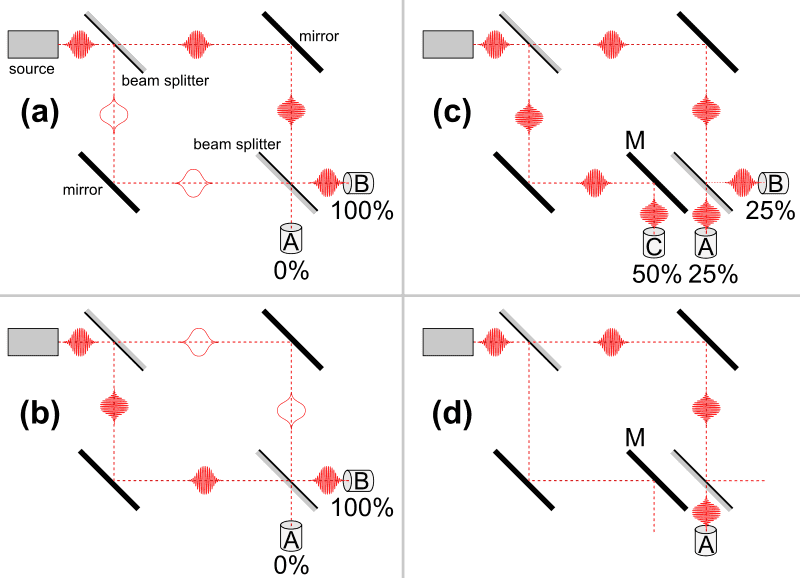
The discussion centers around the outcomes of a Mach-Zehnder interferometer when a mirror is replaced with an additional beam splitter. Participants explore the implications of this modification on photon detection and interference patterns, delving into both theoretical and conceptual aspects of quantum mechanics.
Discussion Character
- Exploratory
- Technical explanation
- Conceptual clarification
- Debate/contested
Main Points Raised
- One participant questions how the outcomes would change with an additional beam splitter instead of a mirror, referring to a diagram for clarity.
- Another participant suggests that the outcomes would yield approximately 25% at the new beam splitter, ~72.9% at detector B, and ~2.1% at detector A, but seeks clarification on the calculations.
- A third participant references a Wikipedia explanation of the Mach-Zehnder interferometer, discussing the interference patterns and the implications of photon behavior in the presence of obstacles.
- There is a discussion about the paradox of photon detection at detector A and the implications of the presence or absence of the mirror M, with differing interpretations of what constitutes "information" about M.
- Some participants express confusion over the nature of the wave function and its role in the interference process, questioning the necessity of the mirror for photon detection at A.
- Several participants engage in a debate about causality and the interpretation of counterfactual statements related to the experiment.
- Questions arise regarding the non-classical nature of the experiment, particularly in relation to single photon detection.
Areas of Agreement / Disagreement
Participants express differing views on the implications of photon detection and the role of the mirror in the interferometer setup. There is no consensus on the interpretations of the paradoxes presented, nor on the calculations of photon distribution among the detectors.
Contextual Notes
Some participants note the dependence of their arguments on specific interpretations of quantum mechanics and the assumptions underlying the behavior of photons in the interferometer. The discussion also highlights unresolved mathematical steps in calculating the outcomes.
Who May Find This Useful
This discussion may be of interest to those studying quantum mechanics, particularly in the context of interferometry and photon behavior, as well as individuals exploring the philosophical implications of quantum measurements.