Discussion Overview
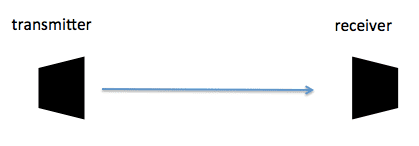
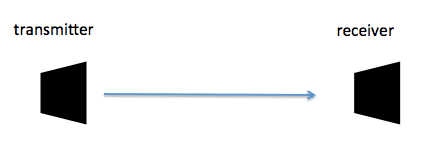
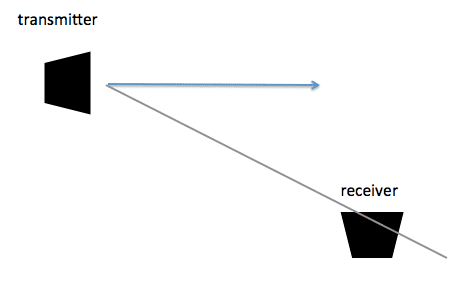
The discussion revolves around the use of ultrasonic transmitters and receivers for determining the position of the transmitter relative to the receivers. Participants explore how the orientation of the receivers affects distance measurements, particularly in a 2D positioning context. The conversation includes considerations of beam angles, reflections, and potential measurement techniques.
Discussion Character
- Exploratory
- Technical explanation
- Debate/contested
Main Points Raised
- One participant questions the existence of omnidirectional ultrasonic transmitters and highlights potential issues with reflections from nearby structures affecting triangulation algorithms.
- Another participant suggests that phase and orientation of the receivers and transmitter are crucial for a 2D positioning system and proposes mounting transducer elements on the same plane with vertical axes.
- A conical reflector is recommended to create phase-independent radiation patterns, with adjustments suggested for better horizontal radiation patterns.
- Participants discuss the importance of measuring the arrival time of pulses from the transmitter and propose using pseudo-random sequences or chirps for more accurate measurements.
- Concerns are raised about potential position errors due to environmental factors like wind speed and the possibility of Doppler effects.
- A later reply references a previous discussion about a 3D motion tracking system, suggesting a connection to the current topic.
Areas of Agreement / Disagreement
Participants express differing views on the feasibility of using omnidirectional transmitters and the impact of receiver orientation on measurements. The discussion remains unresolved regarding the best methods for achieving accurate positioning.
Contextual Notes
Limitations include assumptions about the ideal conditions for measurements, the dependence on specific configurations of the ultrasonic system, and the unresolved nature of environmental influences on accuracy.