Questions about rolling and direction of static friction?

Click For Summary

Homework Help Overview

The discussion revolves around the dynamics of rolling motion, specifically focusing on the effects of applied forces and friction in scenarios involving a plank on cylinders and a disk rolling down an incline. Participants are exploring the relationship between linear and angular accelerations in these contexts.

Discussion Character

  • Exploratory, Conceptual clarification, Assumption checking

Approaches and Questions Raised

  • Participants question how an applied force affects both the angular and linear accelerations of objects in rolling motion. They discuss the role of friction and its direction in relation to motion, particularly in the context of rolling without slipping.

Discussion Status

Some participants have provided insights into the relationship between torque and acceleration, while others are seeking clarification on specific points, such as the effects of friction and the nature of forces acting on the system. The conversation is ongoing, with various interpretations being explored.

Contextual Notes

There is mention of potential confusion regarding terminology, specifically the distinction between "rolling friction" and "rolling resistance." Participants are also considering the implications of removing friction from the ground in their analyses.

Warlic
Messages
32
Reaction score
0
I have spent quite some time trying to get this, can someone please help me understand this?
upload_2015-11-28_19-21-49.png

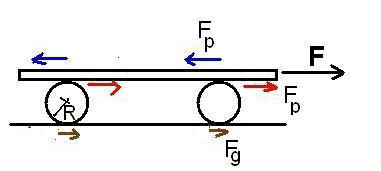
A plank is being pulled by a constant force F, it rests on top of two identitcal sylinders - there is rolling without slipping. What I don't understand is, why does F(p) - red arrow force, affect the acceleration of the center of mass of the cylinder. Isnt the only thing the red arrow F(p) does, to make it rotate - so it only affects its angular acceleration, and not the acceleration of center of mass of cylinders - while F(g) is the only force that affects the acceleration of center of mass.?
And a second question:
upload_2015-11-28_19-35-24.png


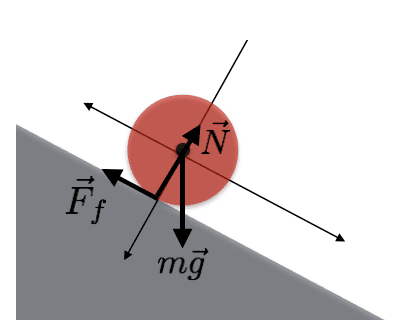
Disk rolls down an incline, here there is also rolling without slipping. But why in the world is the friction force pointing upwards. The disk is rolling clockwise ,shouldn't the friction force be pointing downwards - opposite of what's in the figure? Because on the first picture the cylinder is also rolling clockwise, and the friction force is acting along the same direction as the cylinder is moving - to the right.
 

Attachments

  • upload_2015-11-28_19-27-28.png
    upload_2015-11-28_19-27-28.png
    10.4 KB · Views: 557
  • upload_2015-11-28_19-28-30.png
    upload_2015-11-28_19-28-30.png
    5.3 KB · Views: 1,241
Physics news on Phys.org
Warlic said:
What I don't understand is, why does F(p) - red arrow force, affect the acceleration of the center of mass of the cylinder. Isnt the only thing the red arrow F(p) does, to make it rotate - so it only affects its angular acceleration, and not the acceleration of center of mass of cylinders - while F(g) is the only force that affects the acceleration of center of mass.?
When a force acts on a body it always contributes to the net force, which determines the acceleration of the center of mass. Depending upon its point of application, it may also create a torque. It's not one or the other, but both.

Warlic said:
But why in the world is the friction force pointing upwards. The disk is rolling clockwise ,shouldn't the friction force be pointing downwards - opposite of what's in the figure?
Since the disk rolls without slipping there must be a torque increasing the angular speed to match the increasing linear speed. Friction supplies that torque. Note that friction acts to reduce the acceleration of the center of mass as it rolls down the incline.
 
  • Like
Likes   Reactions: Warlic
Doc Al said:
When a force acts on a body it always contributes to the net force, which determines the acceleration of the center of mass. Depending upon its point of application, it may also create a torque. It's not one or the other, but both.Since the disk rolls without slipping there must be a torque increasing the angular speed to match the increasing linear speed. Friction supplies that torque. Note that friction acts to reduce the acceleration of the center of mass as it rolls down the incline.
So in the first picture F(g) will reduce the angular acceleration but increase acceleration of center of mass? And what if we looked at the wheel of a car - would the motor be providing torque, acceleration of center of mass, or both?
 

Attachments

  • upload_2015-11-28_20-33-35.png
    upload_2015-11-28_20-33-35.png
    18.5 KB · Views: 530
Warlic said:
So in the first picture F(g) will reduce the angular acceleration but increase acceleration of center of mass?
Yes.
It is informative to consider what would happen if you took away the friction from the ground. When you consider the angular and linear accelerations produced by the force applied tangentially at the top, you find that the instantaneous centre of rotation of the cylinders will be above the ground. So although the mass centres move forwards, the part of the cylinder touching the ground moves a bit backwards.
Contrast this with what would happen if the horizontal force were applied at the centre of the cylinder, again with no ground friction. The whole cylinder would move forwards without rotating, so the direction of slip between cylinder and ground has reversed. Thus, allowing ground friction now, the direction of that frictional force has reversed.
In between these cases, there is a point where an applied horizontal force would result in rolling contact yet no frictional force at ground. Finding this point is often set as an exercise.
Warlic said:
And what if we looked at the wheel of a car - would the motor be providing torque, acceleration of center of mass, or both?
What it directly provides is torque. The wheels 'try' to rotate, but friction from the ground acts to oppose that, leading to a forward force on the wheels. The wheels would accelerate forwards, but are somewhat held back by the inertia of the car. The wheels are thus subjected to two opposing torques, one from the axle and one as a result of the opposition between the frictional force at the ground and the inertial force of the car. They don't quite balance, the difference leading to the rotational acceleration of the wheel.

By the way, I don't like the term "rolling friction" used in the problem statement. It isn't friction. They mean rolling resistance, which comes from the imperfect elasticity of the wheels.
 
  • Like
Likes   Reactions: Warlic
Amazing, thank you.
 
Last edited:
Just one thing; "The wheels are thus subjected to two opposing torques, one from the axle" . How can there be a torque from the axle if the axle is right at the center of the wheel - because haven't we chosen the center of the wheel to be the origin point, and torque is T = r x F - isn't our radious going to be zero? Or am I just supposed to look away from the force supplied by the motor, and only think of the motor as providing torque?
 
Warlic said:
Just one thing; "The wheels are thus subjected to two opposing torques, one from the axle" . How can there be a torque from the axle if the axle is right at the center of the wheel - because haven't we chosen the center of the wheel to be the origin point, and torque is T = r x F - isn't our radious going to be zero? Or am I just supposed to look away from the force supplied by the motor, and only think of the motor as providing torque?
As far as the axle is concerned, the motor supplies torque, not force, so there's no need to multiply it by a radius.
 
  • Like
Likes   Reactions: Warlic

Similar threads

  • · Replies 7 ·
Replies
7
Views
2K
  • · Replies 30 ·
2
Replies
30
Views
4K
  • · Replies 42 ·
2
Replies
42
Views
4K
Replies
4
Views
3K
Replies
61
Views
4K
Replies
9
Views
2K
Replies
24
Views
3K
Replies
43
Views
3K
  • · Replies 97 ·
4
Replies
97
Views
6K
  • · Replies 10 ·
Replies
10
Views
2K