Radiant power of a series of light waves

Click For Summary

Discussion Overview

The discussion revolves around calculating the radiant power of an interference pattern formed by a series of light wave reflections. Participants explore the appropriate formulas and units for radiant power, addressing the implications of integrating and squaring values in the context of light wave superposition.

Discussion Character

  • Technical explanation
  • Debate/contested
  • Mathematical reasoning

Main Points Raised

  • One participant proposes a formula for radiant power based on the superposition of light waves evaluated at a specific point, questioning whether squaring the result is necessary.
  • Another participant asks for clarification on the meaning and units of the variable E, suggesting it may represent the electric field rather than radiant power.
  • A participant discusses the need for integrating over a period to obtain average radiant power, emphasizing the theoretical nature of their calculations.
  • Concerns are raised about the dimensional consistency of the proposed formulas, with one participant arguing that E lacks dimensions and cannot yield watts or watts squared without additional context.
  • Participants discuss the relationship between intensity and the square of the amplitude of the electric field, referencing standard equations for average intensity in electromagnetic waves.
  • A later reply introduces a specific quantity, Plaser, related to the radiant power of the input beam, indicating a connection to the overall discussion.

Areas of Agreement / Disagreement

Participants express differing views on the interpretation of the variable E, the necessity of squaring values, and the dimensional analysis of the proposed formulas. No consensus is reached on the correct approach to calculating radiant power in this context.

Contextual Notes

Participants highlight limitations regarding the definitions of variables and the assumptions made about the system, including the nature of reflections and the representation of individual waves in the superposition.

Ngineer
Messages
62
Reaction score
1
Hello everyone,

I need to calculate the radiant power of an interference pattern of a series of light wave reflections. I need a value in Watts that would plug in nicely into a photodetector's responsivity function (given in Amps/Watts) and thus giving me an estimation of the output current.

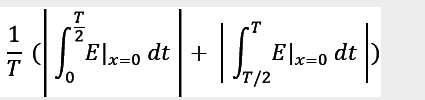
I thought the formula would look something like this:
upload_2016-1-18_15-28-4.png

T is the period (all waves have the same period but are at different phases.)
E|x=0 is the superposition of all the waves (interference pattern) evaluated at x=0

To me, this formula makes the most sense, as it gives a a result in Watts.
However, my supervisor suggests that I square that value. Doesn't this give a result in Watts2?

Thank you for your help!
 
Science news on Phys.org
What is E and what are the units for this quantity?
 
Hi nasu,

E is the sum (superposition) of all the reflections, in other words, it is the interference of multiple light waves having the same frequency/wavelength but differing in phase.

Since it represents the superposition of multiple light waves, my assumption was that it is given in watts (radiant power).
 
If E were indeed the radiant power and you want the radiant power, what is the point of integrating?
Where do you get this E from? You measure it? You calculate it theoretically? How do you represent one of the individual waves in the superposition? What equation?

Usually "E" is used to represent the electric field associated with the wave. I suppose your supervisor assumed that this is the case.
The intensity of the wave is proportional to the square of the amplitude of the wave (electric filed in case of EM wave).
 
Hi nasu,

If E were indeed the radiant power and you want the radiant power, what is the point of integrating?
Integrating over one period and then dividing by the period to get the average radiant power.

Where do you get this E from? You measure it? You calculate it theoretically?
Theoretically.
upload_2016-1-18_18-35-7.png

R1 is the reflection coefficient of a mirror.
ΔΦ is the phase shift corresponding to a distance between two mirrors, given by 2kd.
d1,d2 are phase shifts inherent to the reflection process. I'm assuming them to be zero for now and thus I get:
upload_2016-1-18_18-33-6.png


upload_2016-1-18_18-46-11.png


How do you represent one of the individual waves in the superposition? What equation?
upload_2016-1-18_18-38-10.png


Usually "E" is used to represent the electric field associated with the wave. I suppose your supervisor assumed that this is the case.
The intensity of the wave is proportional to the square of the amplitude of the wave (electric filed in case of EM wave).

That might have been the case. However, when I evaluate my formula (without the square) units check out nicely but I get the answer in a huge square root. With the square,the answer is a nice polynomial of R1, but again units will not checkout.
 
Last edited:
According to your formula, E has no dimensions. The reflection coefficients are just ratios between amplitudes or intensities. This is, unless you use a different definition of these Ri. So you won't get neither watt nor watt^2, no matter what you integrate (E or E^2).
In order to find either amplitude or intensity in absolute values you need to know the amplitude of intensity or the incident wave. What you have there, assuming it is correct, is just a relative quantity, the fraction of the incident wave that is reflected and so on. I am not sure what your system is, it seems that you have multiple reflections.
It looks like the sum of relative amplitudes, in the approximation of plane waves. If you multiply this by the amplitude of the incident wave you will get a total amplitude. To get the intensity you need to take the square of the absolute value and multiply by whatever constant is required by the system of units you are using.

In SI, the average intensity is given by
## I=\frac{\epsilon_0 c E^2}{2 } ##
where E is the amplitude of the wave (maximum electric field)., c is the speed of light and epsilon_0 is permitivity of vacuum. This include the average over a period of the squared amplitude (see the 1/2 factor).This will give you intensity, i.e. watts per unit area. If you want total power you need to multiply by the cross sectional area of the beam. But you assume plane waves, not a finite beam.
 
Last edited:
  • Like
Likes   Reactions: Ngineer
Thank you. I actually forgot to mention that I have a quantity Plaser in mW corresponding to the radiant power of the input beam multiplied by the whole definition.

Thanks again.
 

Similar threads

  • · Replies 17 ·
Replies
17
Views
6K
  • · Replies 14 ·
Replies
14
Views
3K
  • · Replies 10 ·
Replies
10
Views
3K
  • · Replies 7 ·
Replies
7
Views
2K
  • · Replies 56 ·
2
Replies
56
Views
11K
  • · Replies 6 ·
Replies
6
Views
2K
  • · Replies 10 ·
Replies
10
Views
3K
Replies
8
Views
2K
  • · Replies 4 ·
Replies
4
Views
4K
  • · Replies 5 ·
Replies
5
Views
3K