Really on simple energy and spring on incline

AI Thread Summary
The discussion revolves around calculating the elastic potential energy of a compressed spring on a frictionless incline. The spring constant of 19.6 N/cm was incorrectly converted to 0.196 N/m, leading to an erroneous energy calculation. The correct conversion is 19.6 N/cm to 1960 N/m, which is crucial for accurate results. The formula for potential energy, PE = 1/2 K X^2, was applied, but the unit conversion error caused confusion. Proper unit conversion is emphasized as essential for solving physics problems accurately.
B-80
Messages
73
Reaction score
1
A 2.00 kg block is placed against a spring on a frictionless 30.0° incline (Fig. 8-33). (The block is not attached to the spring.) The spring, whose spring constant is 19.6 N/cm, is compressed 16.0 cm and then released.
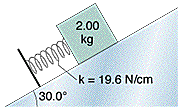
08_37.gif


(a) What is the elastic potential energy of the compressed spring?
So I think of it like this, it wants the answer in joules, so I convert 19.6N/cm to .196N/m, and 16cm to .16m anyway. PE=1/2 K X^2
so
PE=.5(.196)(.16^2) = .0025088J but it's wrong. I know this is very simple, But I don't understand why I am wrong here
 

Attachments

  • 08_37.gif
    08_37.gif
    6.1 KB · Views: 461
Physics news on Phys.org
so I convert 19.6N/cm to .196N/m

This is wrong. Try again, make sure your units work out.
 
I tried leaving them the same, but that didn't work either. The only other thing I can think of is leaving one the same and changing the other, which is mixing units, and that's wrong. What is wrong about it, can you be a little more specific?
 
You just didn't convert it properly. Write it out so you can see how the units need to be:

19.6 N/cm * 100 cm/m = 1960 N/m.
 
Ahh thank you, I swear I lose so many points because of stuff like this
 
I multiplied the values first without the error limit. Got 19.38. rounded it off to 2 significant figures since the given data has 2 significant figures. So = 19. For error I used the above formula. It comes out about 1.48. Now my question is. Should I write the answer as 19±1.5 (rounding 1.48 to 2 significant figures) OR should I write it as 19±1. So in short, should the error have same number of significant figures as the mean value or should it have the same number of decimal places as...
Thread 'Collision of a bullet on a rod-string system: query'
In this question, I have a question. I am NOT trying to solve it, but it is just a conceptual question. Consider the point on the rod, which connects the string and the rod. My question: just before and after the collision, is ANGULAR momentum CONSERVED about this point? Lets call the point which connects the string and rod as P. Why am I asking this? : it is clear from the scenario that the point of concern, which connects the string and the rod, moves in a circular path due to the string...
Thread 'A cylinder connected to a hanging mass'
Let's declare that for the cylinder, mass = M = 10 kg Radius = R = 4 m For the wall and the floor, Friction coeff = ##\mu## = 0.5 For the hanging mass, mass = m = 11 kg First, we divide the force according to their respective plane (x and y thing, correct me if I'm wrong) and according to which, cylinder or the hanging mass, they're working on. Force on the hanging mass $$mg - T = ma$$ Force(Cylinder) on y $$N_f + f_w - Mg = 0$$ Force(Cylinder) on x $$T + f_f - N_w = Ma$$ There's also...
Back
Top