Seeking a cheap wide mouthed jar capable of withstanding a vacuum
- Topic: Wood/Glass/Metal
- Thread starter joniverson
- Start date
-
- Tags
- Vacuum
Join the discussion
Registration is free. Start your own thread to ask a follow-up.
55 replies · 21K views
Physics news on Phys.org
arydberg
- 244
- 31
I have one of these. The wall thickness is between 3/8 and 1/2 inch which makes it possible to drill & tap fro a pipe thread.arydberg said:I suggest you try vacuum food storage containers as in the below link. They are plastic so the risk is smaller. I am assuming they will hold the vacuum.
https://www.houzz.com/photos/contemporary/kitchen-canisters-and-jars/pid=46594324
Science Advisor
2025 Award
- 17,259
- 10,724
What pressure reduction can you achieve with the green button pump built into the lid?arydberg said:I have one of these. The wall thickness is between 3/8 and 1/2 inch which makes it possible to drill & tap fro a pipe thread.
If the pump works, why do you need to drill the plastic container wall?
joniverson
- 44
- 13
Since it will be nearly a month before the insects I desire are collectible, today I ordered some vacuum gauges similar to but less costly like these. I have two options for use: 1) either fashion a quick connect/ disconnect system like used for air compressors to only occasionally check on jar vacuum while in the freezer, or 2) use a 1/4" female threaded "t" adapter and keep the gauges on permanently while frozen. I actually prefer #2. According to specs, they should work at freezer temperatures, but I was hoping to confirm if anyone has done it successfully? Thanks.
Nik_2213
- 1,248
- 499
Slightly off topic, but this may be of interest for preserving super-fine detail...
https://phys.org/news/2018-05-magnetic-fields-disrupt-ice-nucleation.html
https://phys.org/news/2018-05-magnetic-fields-disrupt-ice-nucleation.html
arydberg
- 244
- 31
the green button is not a pump. Unless you release the vacuum the jar is impossible to open. The function of the green button is to release the vacum. My idea is to fit a vacuum hose to a barbed fitting with a pipe thread and thread the fitting on to the vacuum jar as i only have the container and do not have the pump but i have another vacuum pump.Baluncore said:What pressure reduction can you achieve with the green button pump built into the lid?
If the pump works, why do you need to drill the plastic container wall?
Science Advisor
2025 Award
- 17,259
- 10,724
Is the big green lump in the middle a handle for the lid or the vacuum release?arydberg said:The function of the green button is to release the vacum.
What is the much smaller green button in one corner?
Is there a vacuum storage container with an integral pump, or only external?
joniverson
- 44
- 13
Hello everyone,
I wasn't sure whether or not to start a new thread, or continue this one. Please reread my post #4 above to get an idea of what I have been trying to do.
The idea has been to freeze dry soft bodied insects for preservation. This would include caterpillars, spiders, soft beetles and similar. I initially started with basically a homemade vacuum system using heavy walled 8 oz jars fitted with rubber stoppers and the stoppers drilled to accept plumbing valves to allow vacuum to be maintained after the jar is evacuated by single stage pump (post 4). While this system has worked out nicely, I've been needing to go with something larger. My latest experiment was using mason jars. While I can easily seal the jars this way, and they maintain vacuum well, there doesn't seem to be a reliable way to release the vacuum slowly when the time has come to remove the insect (which generally occurs after being under vacuum for two weeks in the freezer).
After careful saving, budget finally allowed me to obtain one of these, which arrived two days ago. To my disappointment however, this device is not holding vacuum. I applied Dow high vacuum grease to all joints and both sides of the rubber ring at the halfway point of the container sections, but after a few hours in the freezer, I am losing vacuum. I will point out that, in the original article, the author says to NOT grease the rubber ring/ gasket. Not sure why. Can anyone shed some light as to why I am losing vacuum? Is there any way to tell where exactly the leaks are occurring?
I wasn't sure whether or not to start a new thread, or continue this one. Please reread my post #4 above to get an idea of what I have been trying to do.
The idea has been to freeze dry soft bodied insects for preservation. This would include caterpillars, spiders, soft beetles and similar. I initially started with basically a homemade vacuum system using heavy walled 8 oz jars fitted with rubber stoppers and the stoppers drilled to accept plumbing valves to allow vacuum to be maintained after the jar is evacuated by single stage pump (post 4). While this system has worked out nicely, I've been needing to go with something larger. My latest experiment was using mason jars. While I can easily seal the jars this way, and they maintain vacuum well, there doesn't seem to be a reliable way to release the vacuum slowly when the time has come to remove the insect (which generally occurs after being under vacuum for two weeks in the freezer).
After careful saving, budget finally allowed me to obtain one of these, which arrived two days ago. To my disappointment however, this device is not holding vacuum. I applied Dow high vacuum grease to all joints and both sides of the rubber ring at the halfway point of the container sections, but after a few hours in the freezer, I am losing vacuum. I will point out that, in the original article, the author says to NOT grease the rubber ring/ gasket. Not sure why. Can anyone shed some light as to why I am losing vacuum? Is there any way to tell where exactly the leaks are occurring?
Science Advisor
Gold Member
- 2,858
- 12,734
The original article is old. Your device is new.
I would see what the manufacturer of the desiccator you bought says about the issue.
They may also have something like a FAQ or help line where you might get some idea about why it isn't working.
If not the seals, it may have something to do with the valve.
If the manufacturers help doesn't help, there might be appropriate to return it for a replacement.
I would see what the manufacturer of the desiccator you bought says about the issue.
They may also have something like a FAQ or help line where you might get some idea about why it isn't working.
If not the seals, it may have something to do with the valve.
If the manufacturers help doesn't help, there might be appropriate to return it for a replacement.
joniverson
- 44
- 13
BillTre said:I would see what the manufacturer of the desiccator you bought says about the issue.
They may also have something like a FAQ or help line where you might get some idea about why it isn't working.
If not the seals, it may have something to do with the valve.
Here is what the manufacturer says, so I am right in using the grease. I also swapped out valves for a different one, still getting loss. Any way to tell where the leak may be coming from? Can I take the unit from the freezer and tip it in a tub of water?
Science Advisor
Gold Member
- 2,858
- 12,734
I could not find any directly useful information on the manufacturer's site, but I did see a different view of the desiccator.
The valve is on slip fitting with the dome. It should slip on and off. It could be leaking and should be greased up (unless you already did).
If that doesn't work, I would disassemble the valve, grease the contacting surfaces, and reassemble.
Sometimes just taking something apart and putting it back together can fix it (dust falls out or ring sits properly).
If that doesn't work go to the company you bought it from and tell they you are disgruntled and want some decent information on a product you bought from them. But do it in a friendly way.
They might be able to provide a useful contact at the manufacturer.
The valve is on slip fitting with the dome. It should slip on and off. It could be leaking and should be greased up (unless you already did).
If that doesn't work, I would disassemble the valve, grease the contacting surfaces, and reassemble.
Sometimes just taking something apart and putting it back together can fix it (dust falls out or ring sits properly).
If that doesn't work go to the company you bought it from and tell they you are disgruntled and want some decent information on a product you bought from them. But do it in a friendly way.
They might be able to provide a useful contact at the manufacturer.
Science Advisor
Gold Member
- 2,858
- 12,734
They have a tech manual here. Its mostly about properties of the materials their various products are made of.
Not useful for advice, but among many other things, it will list the resistances to solvents of different plastics. Figure out what your item is made of, look it up, and know what not to expose it to.
It is also a good way to know what products to look for if you want to use particular chemicals.
According to the items webpage it is made of PP/PC; probably polypropylene and polycarbonate parts. These are plastics that can take temperatures high enough to autoclave them (common lab sterilization method (you can do it in a pressure cooker!)). However, they might warp, making them more difficult to use.
Not useful for advice, but among many other things, it will list the resistances to solvents of different plastics. Figure out what your item is made of, look it up, and know what not to expose it to.
It is also a good way to know what products to look for if you want to use particular chemicals.
According to the items webpage it is made of PP/PC; probably polypropylene and polycarbonate parts. These are plastics that can take temperatures high enough to autoclave them (common lab sterilization method (you can do it in a pressure cooker!)). However, they might warp, making them more difficult to use.
joniverson
- 44
- 13
Thanks, BillTre, but all may not be lost yet. I just made one discovery which could be causing reading errors. When I placed the desiccator in the freezer after vacuuming, I also placed a simple oil-filled gauge in on top of the removable tray. This internal gauge began to register vacuum drop from about 28 down to 22" Hg over the course of three hours while in the freezer. However, a separate gauge at room temperature coupled to the desiccator valve shows the original 28" Hg. Therefore, the internal gauge might be in error from the cold. Perhaps the oil contracted or even started solidifying thereby affecting the needle. When I bought the gauge, the ambient temp was supposed to be down to -4 F (according to the specs listed at that website). With my freezer bottoming out at around 1 F, it should work but maybe not. I'm going to let the desiccator continue undisturbed in the freezer until tomorrow and see if vacuum changed any on the external gauge before I go any further.
Last edited:
Science Advisor
Gold Member
- 5,661
- 4,509
Their tech manual shows the minimum temperature for PP (polypropylene) as -10°C (14°F).
Also check the chemical compatibility table.
But I agree that the oil filled gauge is most likely the problem of the moment.
Edit 1: You might want to check the temperature rating of the guage.
Edit 2: A gauge is oil filled to increase mechanical damping of the needle. Not needed here as the measurand (chamber pressure) is essentially static. Try a gauge based on an Aneroid Barometer:
https://www.britannica.com/science/atmospheric-pressure#ref128230
http://marinegyaan.com/what-is-aneroid-barometer-its-principle-and-correction/
Cheers,
Tom
Also check the chemical compatibility table.
But I agree that the oil filled gauge is most likely the problem of the moment.
Edit 1: You might want to check the temperature rating of the guage.
Edit 2: A gauge is oil filled to increase mechanical damping of the needle. Not needed here as the measurand (chamber pressure) is essentially static. Try a gauge based on an Aneroid Barometer:
https://www.britannica.com/science/atmospheric-pressure#ref128230
http://marinegyaan.com/what-is-aneroid-barometer-its-principle-and-correction/
Cheers,
Tom
Last edited:
joniverson
- 44
- 13
Thanks for the replies, guys. BillTre and Tom G, you both seem pretty thorough, something I should have been before using the device as intended. However, after roughly 64 hours in the freezer under vacuum, I tested it today using the external gauge and the good news is that there has been very little, if any, change in vacuum (perhaps 0.5" Hg change but not even sure of that). When I was having vacuum retention problems (or just thought I was), one of the first things I did was change out the original flimsy and press-to-fit valve for one of my copper ones I use for my thick walled jars. I had to epoxy a copper tube in place and then coupled the new valve to the tubing with lab vacuum tubing. I was a bit worried about outgassing from the epoxy (JB Weld), but I read it wasn't an issue unless much greater vacuums were used. The plumbing valves can sometimes leak, so I wanted to be sure it was easily replaceable.
This new chamber with valve seems to be holding vacuum better than my thick walled jars with stoppers. I usually have to re-evacuate the latter once or twice a week due to some vacuum loss, but the chamber would not have needed an additional vacuuming so far. So, for now, I consider it ready for use and next week it will have some matter placed within it.
Thanks again for the help and suggestions. Oh, I will be removing the gauge I dropped in there as it will not register properly, but it will be no issue coupling a room temperature gauge as I do with my jars.
This new chamber with valve seems to be holding vacuum better than my thick walled jars with stoppers. I usually have to re-evacuate the latter once or twice a week due to some vacuum loss, but the chamber would not have needed an additional vacuuming so far. So, for now, I consider it ready for use and next week it will have some matter placed within it.
Thanks again for the help and suggestions. Oh, I will be removing the gauge I dropped in there as it will not register properly, but it will be no issue coupling a room temperature gauge as I do with my jars.
joniverson
- 44
- 13
After nearly two weeks in the freezer, the vacuum in the chamber has not changed. I now feel confident using it for future projects. I did remove it from the freezer a day ago and the vacuum gauge I placed within it read correct levels once it warmed up. Apparently, the gauges are affected by the cold, so I'll know not to place it within the chamber in the future.
Thanks again for all those helpful suggestions and comments.
Thanks again for all those helpful suggestions and comments.
mp3car
- 82
- 7
jim mcnamara said:It is still done often on smaller specimens and food products:
https://www.cuddonfreezedry.com/applications/
Although people have their deceased pets freeze dried, there is a limit to the size of pet.
http://abcnews.go.com/US/grieving-pet-owners-opt-stuffing-freezing-drying-deceased/story?id=16022869
So, you should probably restrict your dreams to large bugs and centipedes
I believe this was performed on people by a group of scientists in China, they did it to humans and it became a museum exhibit that toured around the US under a cloud of suspicion that the subjects used were tortured/executed political prisoners…. Anyone else remember that, or get a chance to see the exhibit? P.s. Sorry for resurrecting an old thread….
Admin
- 69,798
- 25,658
I saw that exhibition about 15 years ago when it came to San Jose here in Silicon Valley. Pretty weird stuff. It looks like it may have had a couple different names:mp3car said:I believe this was performed on people by a group of scientists in China, they did it to humans and it became a museum exhibit that toured around the US under a cloud of suspicion that the subjects used were tortured/executed political prisoners…. Anyone else remember that, or get a chance to see the exhibit? P.s. Sorry for resurrecting an old thread….
Real Bodies: The Exhibition https://www.dailymail.co.uk/news/ar...adavers-come-Chinese-political-prisoners.html
BODY WORLDS https://www.google.com/url?sa=t&rct...usg=AOvVaw3qNe09vA4FDobD7CEY8wPe&opi=89978449
Ducatidragon916
- 21
- 4
I used a cookie jar purchased from target. I used progressive grades of sandpaper and water and ground the lip of the jar using circular orbiting motions on the sandpaper to even out the surface so to establish a tight seal for a good vacuum. The photo shows the setup I am still working on to do Vacuum deposition experiments etc. When I am ready I will build a protective screen shroud around the glass in case of implosion protection. Will be interesting to see how much vacuum a glass cookie jar can withstand.
The images show the lip of the jar with a 1/4inch surface ground flat and the overall size over the nickel plated steel plate. Height of the jar is about 10 1/2inches and the diameter is about 9 inches in diameter.
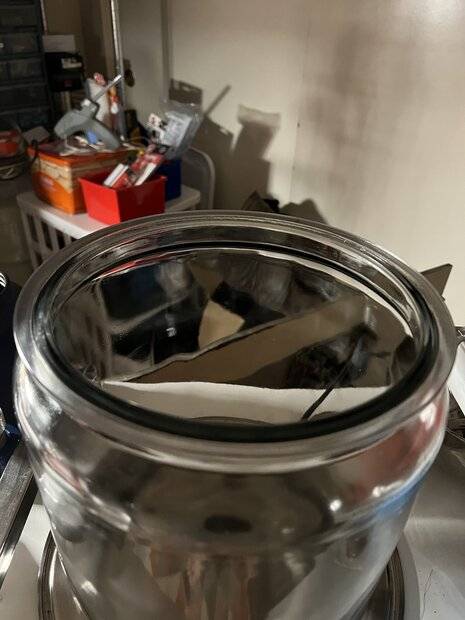
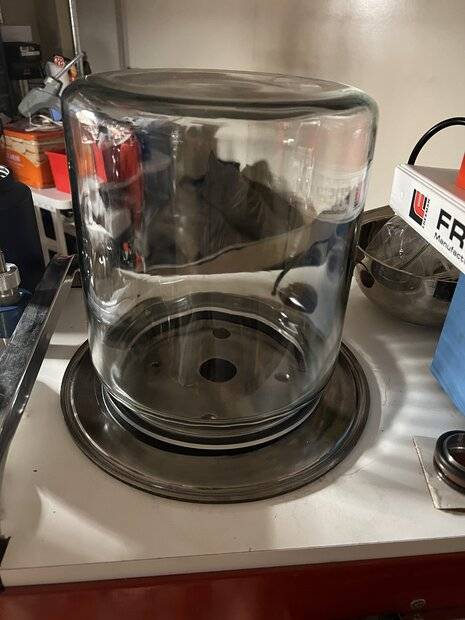
The images show the lip of the jar with a 1/4inch surface ground flat and the overall size over the nickel plated steel plate. Height of the jar is about 10 1/2inches and the diameter is about 9 inches in diameter.
Science Advisor
2025 Award
- 17,259
- 10,724
A glass jar will be structurally stronger under a positive external pressure, than it is under internal positive pressure. An internal vacuum is equivalent to an external positive pressure, and is limited to atmospheric pressure of about 14.7 psi.Ducatidragon916 said:When I am ready I will build a protective screen shroud around the glass in case of implosion protection. Will be interesting to see how much vacuum a glass cookie jar can withstand.
A normal vacuum is as dangerous as a high vacuum, the high vacuum just has less contamination.
The danger of a vacuum is primarily for things inside the chamber, things that will be cut or crushed, by the imploding walls, or the incoming atmosphere.
The external danger of an internal vacuum is the projectile fragments that accelerate through the container, bounce off the contents, or pass through the opposite wall. One lethal example is the electron-gun in the neck of a cathode ray tube, that was aimed at the operator's head, who was watching the screen.
Science Advisor
Homework Helper
- 30,596
- 7,548
But not just any old bell jar!!!! A Google search produces many bell shaped display jars : not what you want. They are just a few quid. I couldn't find anything sold as a vacuum jar for less than £100. There may well be polycarbonate jars that would be strong enough and not lethal. Small is cheaper of course but if you want to do experiments then one that's too small soon becomes useless for you.Tom.G said:STRONG RECOMMENDATION:
BUY A BELL JAR!
Nik_2213
- 1,248
- 499
Again, may I mention the stretchy plastic safety mesh which we used on eg rotary evaporators ??
Yes, yes, have a safety enclosure too, to be sure, to be sure...
Yes, yes, have a safety enclosure too, to be sure, to be sure...
Admin
- 69,798
- 25,658
Okie dokie, this thread is now closed again for good. To anybody reading this thread in the future, it's best to buy a purpose-built Bell jar as mentioned early in this thread, and the latest suggestion by Ducati to build a safety enclosure is good as well. (I've used 1" think Lexan at work in the past)
berkeman said:Thread reopened provisionally.
Welcome to the PF, Jon.
We just need to be careful not to allow dangerous discussions here at the PF. We'll see how this discussion goes, and hopefully you can get some good suggestions. Whatever you end up with, it will be important to have a protective barrier around the jar to contain any implosion/explosion fragments if there is a problem. I (unfortunately) have some experience with an exploding glass jar, and it was just pure luck that my roommate and I were not in front of the jar when it exploded.
And even though you are on a budget, for less than $120 you could get a standard Bell Jar that would probably be a lot safer for your experiments...
https://www.zoro.com/sp-scienceware...MI9b-rsrDi2gIVA9bACh2T9A-9EAQYAiABEgJODvD_BwE
View attachment 224937