Shaft Encoder with Pulleys/spring/spool

  • Thread starter Thread starter elixirnova
  • Start date Start date
  • Tags Tags
    Encoder Shaft
Click For Summary
SUMMARY

This discussion focuses on designing a system to measure the instantaneous velocity of a swimmer using a shaft encoder and pulleys. The proposed setup includes a nylon rope, a spool, and a constant force spring to maintain consistent tension in the line, ideally around 1 lbf. The swimmer's velocity fluctuates between 0 m/s and 3 m/s, with expected fluctuations up to 10 Hz. The user considers using a baitcasting fishing reel as a spooling mechanism, leveraging its drag system to manage line tension effectively.

PREREQUISITES
  • Understanding of shaft encoders and their application in velocity measurement.
  • Knowledge of pulley systems and their mechanical advantages.
  • Familiarity with constant force springs and their tension characteristics.
  • Basic principles of fishing reels, particularly baitcasting reels and their drag mechanisms.
NEXT STEPS
  • Research the mechanics of shaft encoders and their integration with pulleys.
  • Explore designs for constant force spring applications in tension maintenance.
  • Investigate the functionality and specifications of baitcasting fishing reels for optimal tension control.
  • Examine the principles of belt tensioners and their potential application in this setup.
USEFUL FOR

Engineers, hobbyists, and researchers interested in mechanical design, particularly in applications involving velocity measurement and tension management systems.

elixirnova
Messages
12
Reaction score
0
Alright I am trying to measure the "instantaneous" velocity of a swimmer at around 400Hz.

I plan on attaching the swimmer to some nylon rope or something similar and having the rope go into a "box" that will use pulleys, a wheel mounted to a shaft and shaft encoder that will rotate freely between two bearings, and a spool that will feed the line.

My big problem is maintaining tension in the line that is fairly constant and negligible (probably 1lbf or less would be nice), but consistency is most important for testing.

I have found out there are constant force springs out there. So I figure I could attach a pulley to one of those to maintain tension on the line, but with constant tension on the line(which is needed) the line will always be unspooling from the spool faster than it needs to be...

The swimmer's velocity will fluctuate between around 3m/s and 0m/s at the most extreme situation and velocity fluctuations can be expected up to around 10Hz.

Any ideas on how I can make this work?

Here is what I have so far
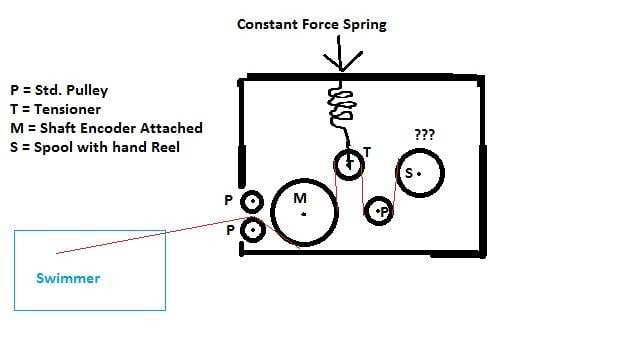
Velocity_Measurement_System.jpg


Also, I tried looking up belt tensioners for car but couldn't find anything to show how they work. Could a belt tensioner help me?
 
Engineering news on Phys.org
Just searching around google, would a fishing reel work as my spooling mechanism? It has a reel already attached and perhaps the drag can be used to maintain tension and once the tension is achieved it let's out line and if too much tension persists to build up perhaps the constant force spring could be used to prevent excess tension while the line unspools from the fishing reel.

So maybe the combination of a fishing wheel w/drag and a constant force spring?

Edit:
So here is a reel that looks good. It seems like a baitcasting reel would be best and here is a cheap one I found http://www.kmart.com/shc/s/p_10151_...003a&ci_src=14110944&ci_sku=089V002609844000P

Not sure about the open faced and closed faced reels though. I suppose I ought to set up the measurement wheel/shaft and see how the fishing reel works in the device and I can always add constant force spring(s) to help keep the tension constant.

The only possible problem I can see is the fishing reel requiring too much tension or providing inconsistent tension with it's drag setting.
 
Last edited by a moderator:
I have encountered a vertically oriented hydraulic cylinder that is designed to actuate and slice heavy cabling into sections with a blade. The cylinder is quite small (around 1.5 inches in diameter) and has an equally small stroke. The cylinder is single acting (i.e. it is pressurized from the bottom, and vented to atmosphere with a spring return, roughly 200lbs of force on the spring). The system operates at roughly 2500 psi. Interestingly, the cylinder has a pin that passes through its...

Similar threads

  • · Replies 5 ·
Replies
5
Views
5K
  • · Replies 16 ·
Replies
16
Views
11K
  • · Replies 13 ·
Replies
13
Views
15K
  • · Replies 27 ·
Replies
27
Views
3K
  • · Replies 3 ·
Replies
3
Views
2K
Replies
13
Views
4K
  • · Replies 11 ·
Replies
11
Views
3K
  • · Replies 22 ·
Replies
22
Views
6K
Replies
52
Views
13K
  • · Replies 23 ·
Replies
23
Views
2K