Shear Force/Bending Moments Equation

  • Thread starter Thread starter smr101
  • Start date Start date
  • Tags Tags
    Moments Shear
Click For Summary

Discussion Overview

The discussion revolves around the conversion of shear force equations to bending moment equations in structural analysis, specifically addressing the calculation of constants of integration and the application of boundary conditions. Participants explore various examples and seek clarification on inconsistencies in their results.

Discussion Character

  • Technical explanation
  • Mathematical reasoning
  • Debate/contested

Main Points Raised

  • One participant questions how the constant '-1562.5N' is derived in the bending moment equation.
  • Another participant suggests that the first and second bending moment equations should equal each other at the same point Q.
  • There is a discussion about the integral of shear force being the bending moment, with a focus on the constant of integration.
  • Participants express confusion over why the constant is not present in some bending moment equations but is in others.
  • One participant illustrates examples where they find inconsistencies in the application of constants of integration across different equations.
  • There is mention of using free body diagrams to determine bending moments and constants of integration.

Areas of Agreement / Disagreement

Participants express confusion and uncertainty regarding the calculation of constants of integration and the application of boundary conditions. There is no consensus on the correct approach to these issues, and multiple competing views remain on how to handle the bending moment equations.

Contextual Notes

Participants highlight limitations in their understanding of when to apply constants of integration and how to derive them based on boundary conditions. There are unresolved mathematical steps and dependencies on specific examples that contribute to the confusion.

smr101
Messages
72
Reaction score
0
Hi, question and solution attached.

I'm having trouble converting the second equation in 2 (b) to the corresponding bending moment equation. I have worked out everything else, I'm just unsure how the '-1562.5N' part is calculated.

http://snag.gy/Uqrel.jpg
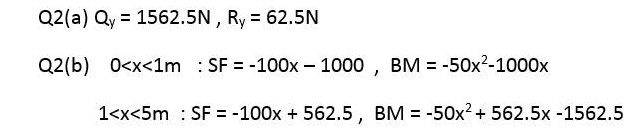
WFzmZ.jpg


Help is much appreciated, thanks!
 
Physics news on Phys.org
Doesn't the first equation for BM have to equal the second equation BM at the same point Q?
 
paisiello2 said:
Doesn't the first equation for BM have to equal the second equation BM at the same point Q?

So because Q is 1562.5 it is taken away from the second BM equation?
 
The integral of the shear force is the bending moment. -1562.5 is the constant of integration. Why?
 
PhanthomJay said:
The integral of the shear force is the bending moment. -1562.5 is the constant of integration. Why?

I'm not understanding how that constant is reached in this instance.
 
smr101 said:
I'm not understanding how that constant is reached in this instance.
WFzmZ.jpg


between x =1 and x=5, if you are good with the SF, then the BM equation is the integral of it, that is,
BM = -50x^2 + 562.5x + constant

(you're ok with that?)

To solve for the constant, see paisiello2 hint in post 2. Or note that the bending moment is ? at x=5.
 
PhanthomJay said:
WFzmZ.jpg


between x =1 and x=5, if you are good with the SF, then the BM equation is the integral of it, that is,
BM = -50x^2 + 562.5x + constant

(you're ok with that?)

To solve for the constant, see paisiello2 hint in post 2. Or note that the bending moment is ? at x=5.

Yeah I get that.

Ok, so you just sub 5 into x. Why is the constant not present in the first bending moment equation though?
 
Also, in terms of this example here, just looking at the second equation in 2. (b), why is the constant not applied in the same way when integrating the second SF equation? It is in the 3rd, but not the second.

kdSkR.jpg

xteWS.jpg


Sorry for the amount of questions, but I'm quite confused by this...
 
smr101 said:
Yeah I get that.

Ok, so you just sub 5 into x.
yes sub the 5 into x and set the bending moment equal to __?__ to solve for the constant.
Why is the constant not present in the first bending moment equation though?
It is, but it happens to be zero
 
  • #10
smr101 said:
Also, in terms of this example here, just looking at the second equation in 2. (b), why is the constant not applied in the same way when integrating the second SF equation? It is in the 3rd, but not the second.

kdSkR.jpg

xteWS.jpg


Sorry for the amount of questions, but I'm quite confused by this...
If you are having trouble determining the constant of integration, it is probably best to draw free body diagrams at a cut in the sections to determine the BM in that section, using the equilibrium equations. For better assistance, please show your workings in determining the shear force and moment equations in one of the sections.
 
  • #11
PhanthomJay said:
If you are having trouble determining the constant of integration, it is probably best to draw free body diagrams at a cut in the sections to determine the BM in that section, using the equilibrium equations. For better assistance, please show your workings in determining the shear force and moment equations in one of the sections.

Ok, I'll give you two examples to illustrate where I'm seeing a lack of consistency.

In the second BM equation in the first example I provided after integrating the SF equation you get this...

-50x^2 + 562.5x + C
C = 50 x 5^2 - 562.5 x 5
= - 1562.5
BM = -50x^2 + 562.5x - 1562.5

That's the correct solution as shown in the answers provided and as you've explained.

Now again looking at the second BM but this time in the second example provided after SF is integrated you get...

-8x + C
C = 8x
= 8 x 5
= 40

That's incorrect, as shown in the solution C = 90.

So what am I missing out here?

I notice that if I carry out the same method on the third equation it does again provide the correct answer, it's just that last example I'm not understanding. I could do something with the 50 at 4m that would get an answer of 90 but that wasn't necessary in the other two equations.
 
  • #12
smr101 said:
Ok, I'll give you two examples to illustrate where I'm seeing a lack of consistency.

In the second BM equation in the first example I provided after integrating the SF equation you get this...

-50x^2 + 562.5x + C
you mean BM = -50x^2 + 562.5x + C , then set BM = 0 at x =5 (pinned support), to solve for C.
C = 50 x 5^2 - 562.5 x 5
= - 1562.5
BM = -50x^2 + 562.5x - 1562.5
ok
That's the correct solution as shown in the answers provided and as you've explained.

Now again looking at the second BM but this time in the second example provided after SF is integrated you get...

-8x + C
C = 8x
= 8 x 5
= 40

That's incorrect, as shown in the solution C = 90.

So what am I missing out here?
The BM is -8x +C between x =3 and x=4, so you can't solve for the constant at x =5. You would have to determine the BM at x=4 from the third equation, then use that value (BM = 58) when writing -8X + C = 58 at x = 4, solve for C.
I notice that if I carry out the same method on the third equation it does again provide the correct answer, it's just that last example I'm not understanding. I could do something with the 50 at 4m that would get an answer of 90 but that wasn't necessary in the other two equations.
Again, using Free Body Diagrams to determine the BM equations is an alternate method.
 

Similar threads

  • · Replies 2 ·
Replies
2
Views
3K
  • · Replies 2 ·
Replies
2
Views
2K
  • · Replies 2 ·
Replies
2
Views
3K
  • · Replies 12 ·
Replies
12
Views
2K
  • · Replies 4 ·
Replies
4
Views
2K
  • · Replies 3 ·
Replies
3
Views
2K
  • · Replies 10 ·
Replies
10
Views
3K
  • · Replies 16 ·
Replies
16
Views
4K
  • · Replies 2 ·
Replies
2
Views
5K
Replies
9
Views
3K