High School Shifting of a Cosine Curve with negative phase angle values

Click For Summary
The discussion centers on the behavior of cosine waves with different phase angles, specifically how negative and positive phase angles affect their positions on a graph. A negative phase angle, such as -Pi/4, results in a rightward shift of the cosine curve, while a positive phase angle, like Pi/4, causes a leftward shift. The confusion arises from the misconception that the maximum value of the cosine function influences its displacement direction; however, the critical factor is when the maximum occurs. The relationship between phase angles and wave shifts is clarified by noting that a negative phase indicates a delay, while a positive phase indicates an advance. Understanding these shifts is essential for accurately interpreting wave behavior in oscillations.
warhammer
Messages
164
Reaction score
33
TL;DR
I was reading Halliday-Resnick on Oscillations. It says that 2 curves having same amplitude and period will be shifted differently to each other depending upon the sign of their phase angle.
Continuing on from the summary, the chapter has given a graphed example. We are shown a regular cosine wave with phase angle 0 and another with phase angle (-Pi/4) in order to illustrate that the second curve is shifted rightward to the regular cosine curve because of the negative value. Now, my question is even if we took a positive value of phase angle (supposedly Pi/4) even then the second curve would have been rightward relative to the regular curve or for that matter any other angle as the max value of a cosine function is 1? What am I not understanding or missing here? (Attaching an image of the example for better understanding of the prospective responders).
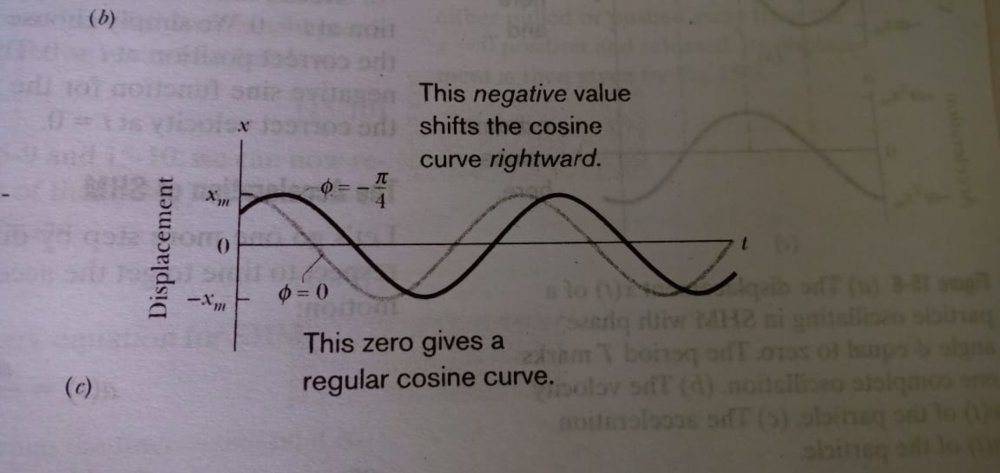
[pic.jpeg
 
Physics news on Phys.org
If the phase angle is ##+\pi/4##, then that shifts the cosine curve leftwards. But, that is equivalent to a phase angle of ##-7\pi/4## and a rightward shift of that amount .
 
  • Like
Likes warhammer
A negative phase angle means that the wave is delayed, so it appears to the right of the curve with no phase offset. It may be intuitive to think that it would be to the left; I think I had that problem too when I started on waves and oscillations.
 
PeroK said:
If the phase angle is ##+\pi/4##, then that shifts the cosine curve leftwards. But, that is equivalent to a phase angle of ##-7\pi/4## and a rightward shift of that amount .
Thank you for your response. I'm not sure if I grasped your explanation and would want to either correct my understanding or my mathematical knowledge. Elucidating further, the regular cosine graph has a phase angle of 0. My intuition was that with negative phase angle (Say -Pi/4) the value of its cosine would anyway be lesser than 1 and it would remain rightwards relative to the original curve; thus satisfying the general result. However if one inputs a value of Pi/4, even then its value would be lesser than 1 and it would remain rightward to the curve thereby contradicting the generic result. This is the point I find contentious because if it is a general result it must satisfy this as well.
 
sophiecentaur said:
A negative phase angle means that the wave is delayed, so it appears to the right of the curve with no phase offset. It may be intuitive to think that it would be to the left; I think I had that problem too when I started on waves and oscillations.
Do you mean to say one could visualize it physically that the wave with a negative phase angle is somewhat "running late" and thus shifted to the right relative to the original while the wave with a positive phase angle is "forward" and appears upward/leftward to the original wave?
 
warhammer said:
Do you mean to say one could visualize it physically that the wave with a negative phase angle is somewhat "running late" and thus shifted to the right relative to the original while the wave with a positive phase angle is "forward" and appears upward/leftward to the original wave?

You could try plotting the functions on graph paper and see where the curves actually turn up along the t axis.
There is a similar potential misconception about the Earth's rotation, the time zones and what it means to someone who wants to ring their family in the US at a convenient time. Six hours too early may not be appreciated too much. Their time is later so we are early for them.
 
warhammer said:
Thank you for your response. I'm not sure if I grasped your explanation and would want to either correct my understanding or my mathematical knowledge. Elucidating further, the regular cosine graph has a phase angle of 0. My intuition was that with negative phase angle (Say -Pi/4) the value of its cosine would anyway be lesser than 1 and it would remain rightwards relative to the original curve; thus satisfying the general result. However if one inputs a value of Pi/4, even then its value would be lesser than 1 and it would remain rightward to the curve thereby contradicting the generic result. This is the point I find contentious because if it is a general result it must satisfy this as well.
The cosine function has a maximum at 0. It reduces whichever way you go. Thus does not, therefore, determine the direction of the displacement.

For example, by your logic both positive and negative phase angles should displace the function leftwards equally well as forwards.
 
warhammer said:
However if one inputs a value of Pi/4, even then its value would be lesser than 1 and it would remain rightward to the curve thereby contradicting the generic result.
This is not relevant. The generic result is correct. The question about shifting left or right has nothing to do with the value of the maximum. It is about when the maximum occurs. That is given by the generic result.
 
  • Like
Likes sophiecentaur
warhammer said:
Thank you for your response. I'm not sure if I grasped your explanation and would want to either correct my understanding or my mathematical knowledge. Elucidating further, the regular cosine graph has a phase angle of 0. My intuition was that with negative phase angle (Say -Pi/4) the value of its cosine would anyway be lesser than 1 and it would remain rightwards relative to the original curve; thus satisfying the general result. However if one inputs a value of Pi/4, even then its value would be lesser than 1 and it would remain rightward to the curve thereby contradicting the generic result. This is the point I find contentious because if it is a general result it must satisfy this as well.
I think it's easy to see, if you rewrite the phase shift in a very simple way. Say the phase shift is ##\phi##, i.e., you general solution of the undamped harmonic oscillator reads
$$x(t)=x_m \cos(\omega t+ \phi)=x_m \cos [\omega (t+\phi/\omega)].$$
This shows that for ##\phi<0##, the phase is delayed relative to the case ##\phi=0##; as you see in the plot from the book, the first maximum after ##t=0## occurs at ##t=-\phi/\omega>0##, i.e., later than at ##t=0## for the unshifted case. This is, why for negative phase shift the entire graph of you cosine function is shifted to the right in this case.

For ##\phi>0## you argue easily in the same way that the graph mustbe shifted to the left.
 
  • #10
The problem with using a cos or sin wave for this argument is that it ends up implying that it's all to do with specific trig functions. Precisely the same arguments apply to any function for the wave shape. @Dale made part of the argument in his earlier post but the point needs to be made that the time (/phase) reference point can be anywhere along the wave; zero crossing or a small wiggly bit between large amplitude portions; it's all the same.
Fourier is a red herring, not because it's wrong (of course) but because it is not an explanation. In fact it makes things worse when you need to modify the phase shift according to the particular harmonic component. The sign of the phases and the resulting wave shape at a distance only needs sorting out once in your head. Thereafter, you can rely on what the sums tell you.
 
  • Like
Likes vanhees71

Similar threads

  • · Replies 12 ·
Replies
12
Views
10K
Replies
5
Views
3K
  • · Replies 3 ·
Replies
3
Views
7K
  • · Replies 7 ·
Replies
7
Views
7K
  • · Replies 1 ·
Replies
1
Views
7K
  • · Replies 1 ·
Replies
1
Views
2K
Replies
3
Views
3K
  • · Replies 1 ·
Replies
1
Views
2K
  • · Replies 0 ·
Replies
0
Views
5K
  • Poll Poll
  • · Replies 3 ·
Replies
3
Views
6K