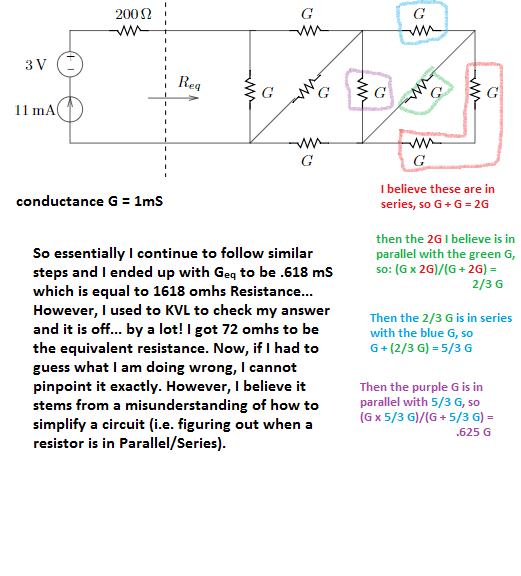
A good way to approach this is to rearrange the diagram so that current only flows from left to right or vertically, never right to left (which includes diagonals that flow right & down or right & up).
Start by labeling all six junctions in the original diagram as A,B,...,F, starting at top left and going around clockwise. Then start a new left-to-right (l2r) diagram by putting A (top-left junction on initial diagram) at the far left and F (bottom-left junction in original) at the far right. Remember that shape and geometry are irrelevant. Only connections and resistances between connections matter.
Now work through the circuit, one junction at a time, transposing it to your l2r diagram. At each junction, say it is an n-way junction and you have m wires entering it from the left. n will be at least 3, otherwise it is not a junction. Then draw n-m wires going out to the right. For each wire, if the downstream junction is already drawn on the l2r diagram, connect it to that, approaching from the left (redraw the diagram if necessary, lengthening some wires, to make that possible). Otherwise, mark the downstream junction on your l2r diagram and draw the connection to that, again approaching it from the left.
Do this until all wires and junctions have been marked on the l2r diagram.
Then check that , in the l2r diagram:
1. the number of wires at each of your junctions matches that on the original diagram; and
2. The resistors on each wire between junctions match those on the original diagram.
Make corrections as necessary, based on any errors revealed by the check.
You now have the circuit drawn in a fashion in which it is straightforward to work out resistances. Use the parallel and series laws repeatedly to collapse the diagram until there remains only one equivalent wire between A and F. The resistance of that is the resistance of your circuit.
Good luck!
PS I get the same answer as you. ##0.6\dot1\dot8## mS. Perhaps there is an error in your KVL check. Can you post your work on that?