luiseduardo
- 29
- 0
Thread moved from the technical forums, so no Homework Template is shown
Question
Consider a heating system with strongly inductive characteristic and with an electronic control of temperature performed by varying the firing angle of a single-phase controlled bridge.
a) Determine the value of resistance to to ensure a maximum power of 7500W if this system is powered with 220V (effective).
b) Determine the fire angle to a power of 3000W.
My attempt of solution:
a)
If the system is strongly inductive so the current is constant, then we should use average voltage. So, maximum power is when the average voltage is maximum and this is possible when fire angle = 0 degree. Then:
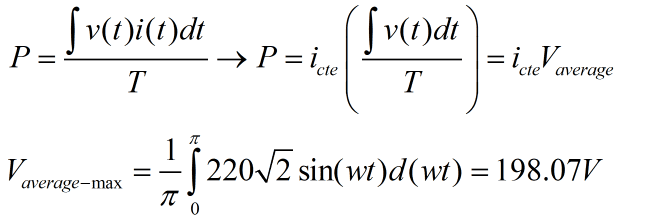
And the resistance is:

b) Using the same idea:
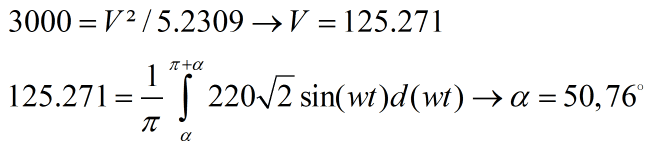
The problem is:
Many friends (and maybe the professor) solved this problem on a exam using 220 V as voltage to find the resistance when maximum power, but I don't think this is totally correct because the problem tells us that the system is strongly inductive, so Irms = Iaverage = I constant, then, to find the voltage we should use average voltage and not effective as many other did. So, What do you think ? If I'm incorrect, why ? I'm a bit upset because I studied a lot for this exam and I was confident that the correct was average voltage when constant current.
Consider a heating system with strongly inductive characteristic and with an electronic control of temperature performed by varying the firing angle of a single-phase controlled bridge.
a) Determine the value of resistance to to ensure a maximum power of 7500W if this system is powered with 220V (effective).
b) Determine the fire angle to a power of 3000W.
My attempt of solution:
a)
If the system is strongly inductive so the current is constant, then we should use average voltage. So, maximum power is when the average voltage is maximum and this is possible when fire angle = 0 degree. Then:
And the resistance is:
b) Using the same idea:
The problem is:
Many friends (and maybe the professor) solved this problem on a exam using 220 V as voltage to find the resistance when maximum power, but I don't think this is totally correct because the problem tells us that the system is strongly inductive, so Irms = Iaverage = I constant, then, to find the voltage we should use average voltage and not effective as many other did. So, What do you think ? If I'm incorrect, why ? I'm a bit upset because I studied a lot for this exam and I was confident that the correct was average voltage when constant current.


