Slip Conditions for flow between Parallel Plates

Click For Summary
SUMMARY

The discussion focuses on the analysis of slip conditions for fluid flow between two parallel plates, where the top plate moves with velocity V and the bottom plate remains stationary. The participants clarify that under slip conditions, the velocities at the plates differ from the no-slip condition, leading to a modified shear rate equation. The final shear rate is derived as $$\gamma=\frac{V/h}{\left(1+2\frac{l}{h}\right)}$$, indicating the impact of slip on the flow characteristics. The analysis emphasizes the importance of correctly accounting for the effective height and velocity differences in the shear rate calculation.

PREREQUISITES
  • Understanding of fluid dynamics principles, particularly shear stress and shear rate.
  • Familiarity with the no-slip and slip boundary conditions in fluid mechanics.
  • Knowledge of differential calculus as it applies to fluid velocity profiles.
  • Experience with mathematical modeling of fluid flow between surfaces.
NEXT STEPS
  • Study the derivation of shear stress in fluid mechanics, focusing on the impact of boundary conditions.
  • Learn about the implications of slip conditions in various fluid flow scenarios.
  • Explore computational fluid dynamics (CFD) tools to simulate flow between parallel plates.
  • Investigate the effects of varying plate velocities on shear rates in different fluids.
USEFUL FOR

Fluid mechanics students, researchers in material science, and engineers involved in designing systems with fluid flow between surfaces will benefit from this discussion.

SebastianRM
Messages
39
Reaction score
4
Homework Statement
A) Analyze velocity profile
B) Determine shear stress at both walls
Relevant Equations
Fluid flow between two parallel plates with slip of,
$$ \delta u \approx l (du/dy)$$
The problem states:

Two parallel plates separated by distance h, the plate at the top moves with velocity V, while the one at the bottom remains stationary.

My initial approach was:

I considered, ##du/dy = V/h## and for the shear stress ##\tau = \mu \frac{\partial u}{\partial y}##

For $$\frac{\partial u}{\partial y} = \frac{U_{top}-U_{bottom}}{h}$$

Where I considered the fluid's velocity at the top plate to be, ##U_{top} = V - \delta u## , and at the bottom, ##U_{bot} = 0 + \delta u##.

In order to improve my understanding, I searched for a diagram that illustrated the phenomena, which shows (apologies for the low quality) :
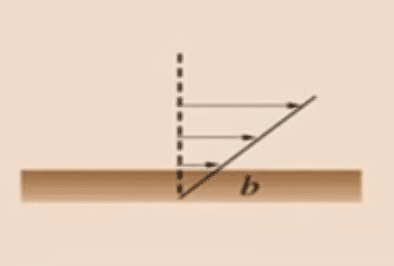
Screen Shot 2021-01-19 at 7.05.36 PM.png


This ##b## distance in the diagram is the ##l## of my equation at the top. So I am wondering if it should be included as part of the ##dy## term, as ##dy = h - l## or should it be part of the ##\partial y = h - l ## or if my original analysis was correct?

Thanks a lot guys, your time and help are very appreciated.
 
Physics news on Phys.org
The velocity at the top is V and the velocity at the base is 0. Forget the diagram. The shear rate is V/h.
 
  • Like
Likes BvU
Chestermiller said:
The velocity at the top is V and the velocity at the base is 0. Forget the diagram. The shear rate is V/h.

That is for no-slip condition, this is Slip condition. The velocity at the top is not V, because there is slip. Same at the bottom, the fluid is not attached to the plate, as there is slip.
 
Can you render the actual problem statement in full?:
 
BvU said:
Can you render the actual problem statement in full?:
The diagram says *No-slip* but that is a typo (the teacher said so).
Screen Shot 2021-01-20 at 4.53.13 PM.png
 
  • Like
Likes Delta2
I see. In that case your picture is sensible and something similar occurs at the top plate.

Effectively ##h## is increased by ##2b##. Arguing that ##\tau## is a one-side derivative is thin ice, but I suppose that's what is meant.
 
  • Like
Likes SebastianRM
BvU said:
I see. In that case your picture is sensible and something similar occurs at the top plate.

Effectively ##h## is increased by ##2b##. Arguing that ##\tau## is a one-side derivative is thin ice, but I suppose that's what is meant.
I see, that makes sense. Would you say du/dy is the usual slope V/h ? While ##\partial u / \partial y ## accounts for the velocity V affected by slip and the "new" height, such that ## (V - 2\delta u)/(h + 2b) ## ?
 
Not both.
 
I get a fluid velocity at y = 0 of ##u(0)=l\gamma##, where ##\gamma## is the shear rate. And, at y = h, I get a fluid velocity of ##u(h)=V-l\gamma##. So, for the shear rate, I get $$\gamma=\frac{u(h)-u(0)}{h}=\frac{(V-l\gamma)-l\gamma}{h}=\frac{V-2l\gamma}{h}$$Solving for ##\gamma## gives:$$\gamma=\frac{V/h}{\left(1+2\frac{l}{h}\right)}$$
What do you guys think?
 
  • Informative
Likes SebastianRM
  • #10
Chestermiller said:
I get a fluid velocity at y = 0 of ##u(0)=l\gamma##, where ##\gamma## is the shear rate. And, at y = h, I get a fluid velocity of ##u(h)=V-l\gamma##. So, for the shear rate, I get $$\gamma=\frac{u(h)-u(0)}{h}=\frac{(V-l\gamma)-l\gamma}{h}=\frac{V-2l\gamma}{h}$$Solving for ##\gamma## gives:$$\gamma=\frac{V/h}{\left(1+2\frac{l}{h}\right)}$$
What do you guys think?
That is correct Sir, I think. By doing ##\delta u = \ell du/dy = \ell V/(h+2l) ## we can arrive to the same form.
Thank you!
 

Similar threads

Replies
13
Views
3K
  • · Replies 15 ·
Replies
15
Views
4K
  • · Replies 19 ·
Replies
19
Views
3K
  • · Replies 5 ·
Replies
5
Views
2K
  • · Replies 4 ·
Replies
4
Views
2K
  • · Replies 1 ·
Replies
1
Views
2K
  • · Replies 1 ·
Replies
1
Views
2K
  • · Replies 4 ·
Replies
4
Views
2K
  • · Replies 4 ·
Replies
4
Views
2K
  • · Replies 1 ·
Replies
1
Views
1K