Solve for Tension in 3-Cable System on 120 ft Tower Using Trigonometry

  • Thread starter Thread starter r34racer01
  • Start date Start date
  • Tags Tags
    Static Tension
Click For Summary
SUMMARY

The discussion focuses on solving for the tension in a three-cable system supporting a 120 ft tower, with Cable AO under 1000 lb of tension. Participants detail their use of trigonometry to calculate angles and forces but express confusion regarding the application of unit vectors and coordinate labeling for points A, B, and C. The conversation emphasizes the importance of listing relevant equations and calculations to facilitate peer assistance in homework problem-solving.

PREREQUISITES
  • Understanding of trigonometry, specifically in three-dimensional space.
  • Familiarity with vector analysis and unit vectors.
  • Knowledge of static equilibrium principles in physics.
  • Ability to apply coordinate systems in problem-solving.
NEXT STEPS
  • Study the application of unit vectors in three-dimensional force analysis.
  • Learn how to derive tension forces in static equilibrium scenarios.
  • Explore coordinate geometry and its use in physics problems.
  • Review examples of similar cable tension problems for practical insights.
USEFUL FOR

Students in physics or engineering courses, particularly those studying statics and mechanics, as well as anyone involved in structural analysis or cable system design.

r34racer01
Messages
62
Reaction score
0
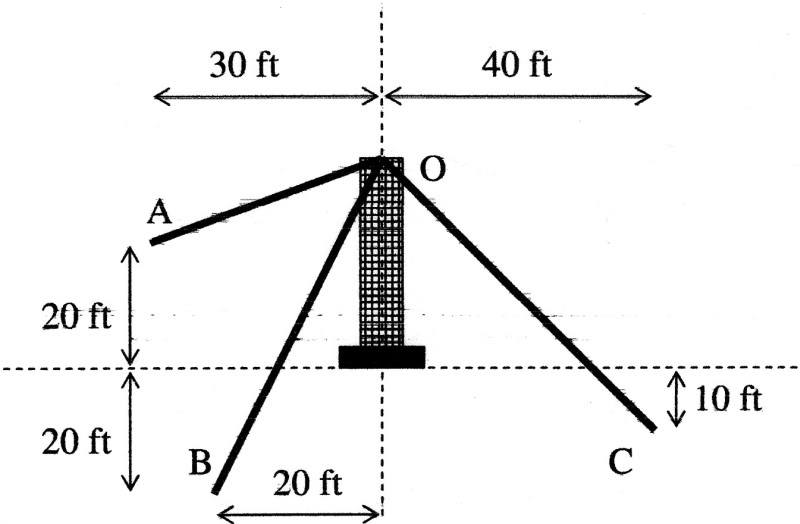
1. A 120 ft tower is being held by three cables in tension. Cable AO is in 1000
lb of tension. Find the tension in the other cables and the vertical force from
the tower if the whole system is at rest.
statics_0002b.jpg


tension-a.jpg


tension-b.jpg


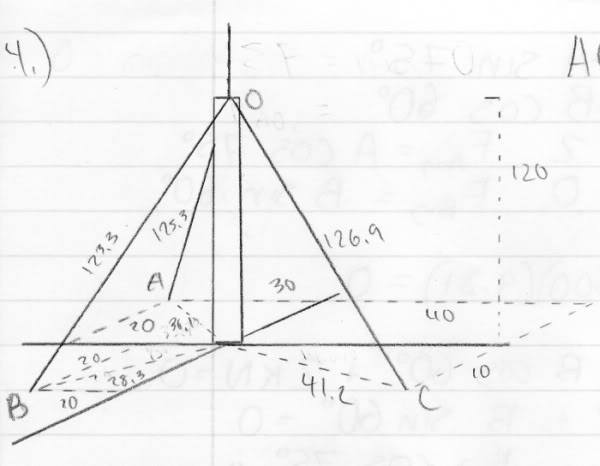
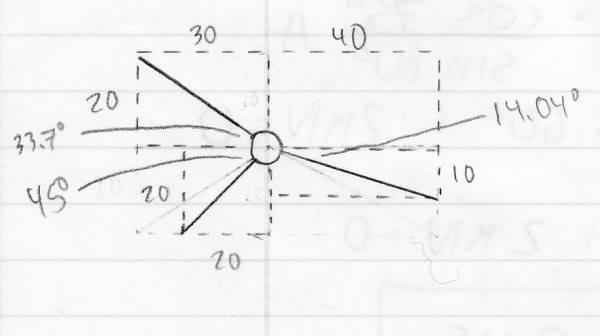
3. So using lots and lots of trig I was able to find most of the magnitudes, thetas, and phi's as you can see from the last 2 images. But now I'm lost from there. During office hrs. my prof. mentioned something about using unit vectors and then labeling the pts. A, B & C as coordinates A(-30,0,-20), b(-20,0,20), & c(40,0,10), but I don't see how those can help me. Any suggestions?
 
Physics news on Phys.org
Hi, r34racer01. The PF rules state we are not allowed to tell you how to approach or solve your homework problem. You must list relevant equations yourself, and show your calculations to determine the forces; and then someone might check your math.
 

Similar threads

  • · Replies 3 ·
Replies
3
Views
3K
  • · Replies 2 ·
Replies
2
Views
2K
Replies
8
Views
5K
  • · Replies 33 ·
2
Replies
33
Views
8K
Replies
1
Views
4K
Replies
1
Views
6K
  • · Replies 1 ·
Replies
1
Views
11K
  • · Replies 3 ·
Replies
3
Views
3K
  • · Replies 1 ·
Replies
1
Views
2K
  • · Replies 1 ·
Replies
1
Views
11K