Solving for the impulse response of a discrete time system?

Click For Summary

Discussion Overview

The discussion revolves around understanding the coefficients a_0 and b_0 in the context of solving for the impulse response of a discrete time system, particularly as presented in a textbook example related to IIR filters. Participants seek clarification on how these coefficients are derived and their significance in the equations provided.

Discussion Character

  • Technical explanation
  • Conceptual clarification
  • Debate/contested

Main Points Raised

  • One participant expresses confusion about the origin of b_0, noting that while a_0 is determined by the characteristic modes, b_0's derivation is unclear.
  • Another participant suggests that a complete statement of the problem is necessary for others to provide effective assistance, indicating that context is crucial for understanding.
  • It is mentioned that b_0 is the coefficient in the b_0f[k] term on the right-hand side of a specific equation (9.36), and in the current case, it is stated that b_0 equals 0.
  • There is a correction regarding the coefficients, with one participant acknowledging a mistake in their previous post about the coefficients and confirming that a_0 is also 0 in this context.
  • Another participant references an external example to clarify the typical values of a_0 and b_0 in IIR filters, asserting that a_0 is -0.16 and b_0 is 0, which contradicts earlier claims.
  • Participants engage in back-and-forth corrections regarding the coefficients, indicating a lack of clarity and consensus on their values.

Areas of Agreement / Disagreement

Participants do not reach a consensus on the values of a_0 and b_0, with multiple competing views presented regarding their derivation and significance. The discussion remains unresolved as participants continue to clarify their positions and correct previous statements.

Contextual Notes

There are references to specific equations and examples in the textbook that may not be fully explained in the discussion, leading to potential misunderstandings about the coefficients. The context of the problem is crucial for accurate interpretation.

Jayalk97
Messages
45
Reaction score
5
Hey guys I was just studying for finals and I came across something in my textbook that either wasn't explained properly or something I just don't get.
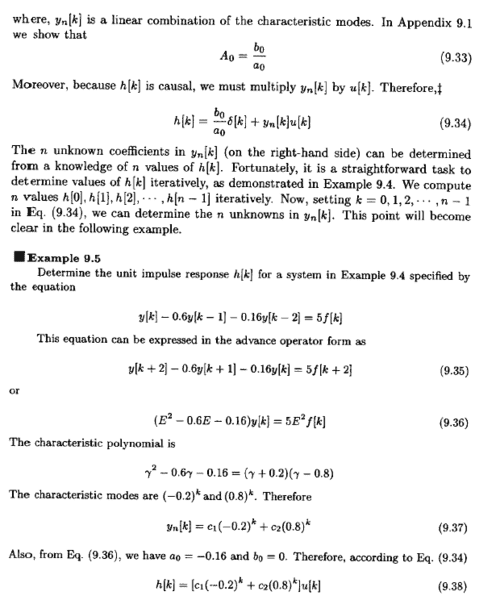
upload_2017-12-9_22-48-42.png

So this page explains that the coefficient of y_n[k] is A_0, which is represented by b_0/a_0, I can see that a_0 is determined by multiplying the characteristic modes of the equation, but I'm not sure where b_0 comes from. Thanks for any clarification.
 

Attachments

  • upload_2017-12-9_22-48-42.png
    upload_2017-12-9_22-48-42.png
    30.4 KB · Views: 1,428
Engineering news on Phys.org
Bump. I just need a little clarification on how to find a_0 and b_0, I have a pretty good grasp on the concepts.
 
If want help from the general mathematical population, you should give a complete statement of the problem. A communications engineer might be able to infer what is in Appendix 9.1, what is in example 3.4, and how ##a_0## and ##b_0## are defined. However, the typical helpful mathematician won't know what you are asking.
 
b0 is the coefficient in the b0f[k] term on the right hand side of 9.36. You can trace where it comes from and goes to from there. In this case, there is no such term, so b0 = 0.

EDIT: This post originally had a0s where it should have been b0s. It has been corrected.
 
Last edited:
FactChecker said:
a0 is the coefficient in the a0f[k] term on the right hand side of 9.36. You can trace where it comes from and goes to from there. In this case, there is no such term, so a0 = 0.
Ohhhhh thank you so much! I would have picked up on it if they used an example that had a nonzero b_0 haha.
 
Typically a_0 and b_0 would be t=0 coefficient of a typical IIR filter. See the below example

http://123.physics.ucdavis.edu/week_5_files/filters/digital_filter.pdf

FactChecker said:
a0 is the coefficient in the a0f[k] term on the right hand side of 9.36. You can trace where it comes from and goes to from there. In this case, there is no such term, so a0 = 0.

I disagree... look at 9.35 (or 9.36) and reference page 10 of my above link.
a_0=-0.16
b_0=0
 
Sorry, my post #4 should have been saying b0, not a0. I will edit it.
 
FactChecker said:
Sorry, my post #4 should have been saying b0, not a0. I will edit it.
I picked up on that, I probably should have mentioned it but I was just excited it clicked and just went back to studying haha. Thanks regardless.
 

Similar threads

  • · Replies 5 ·
Replies
5
Views
5K
  • · Replies 9 ·
Replies
9
Views
2K
  • · Replies 2 ·
Replies
2
Views
5K
  • · Replies 2 ·
Replies
2
Views
2K
Replies
2
Views
5K
  • · Replies 4 ·
Replies
4
Views
2K
  • · Replies 4 ·
Replies
4
Views
4K
  • · Replies 5 ·
Replies
5
Views
6K
  • · Replies 1 ·
Replies
1
Views
2K
  • · Replies 6 ·
Replies
6
Views
2K