Spectral Intensity as a Function of Wavelength in Blackbody Radiation

Click For Summary

Discussion Overview

The discussion revolves around the spectral intensity of blackbody radiation as a function of wavelength. Participants explore the implications of measuring intensity across different wavelengths, the mathematical treatment of these measurements, and the physical interpretations of intensity in relation to blackbody radiation and monochromatic light.

Discussion Character

  • Exploratory
  • Technical explanation
  • Conceptual clarification
  • Debate/contested
  • Mathematical reasoning

Main Points Raised

  • Some participants assert that a blackbody emits radiation at all frequencies, questioning how intensity can be finite for each wavelength when there are infinitely many wavelengths in any interval.
  • Others argue that the concept of integration resolves this issue, as the intervals shrink to infinitesimal sizes, keeping the total intensity finite.
  • A participant expresses confusion about how to relate the intensity of neighboring wavelengths and the concept of integration to physical measurements.
  • One participant provides the formula for spectral intensity and emphasizes the need to multiply by the differential wavelength to obtain total flux.
  • Another participant notes that practical measurements cannot isolate a single wavelength, leading to a decrease in measured intensity as the wavelength range narrows.
  • Some participants compare the situation to probability density functions, suggesting that the probability of measuring a specific wavelength is zero.
  • There is a discussion about whether monochromatic light has zero intensity, with some suggesting that intensity at a single frequency should be considered zero.
  • One participant proposes an analogy involving counting students' weights to illustrate the concept of intensity at a specific wavelength versus the total measured intensity.
  • Participants discuss the idea of counting photons and how the number of photons in a narrow wavelength band approaches zero as the band width decreases.
  • There is mention of the complexity in describing light measurements and the various units used in radiometry, which adds to the confusion in understanding the physics involved.

Areas of Agreement / Disagreement

Participants express multiple competing views regarding the nature of intensity at specific wavelengths, the implications of integration, and the physical interpretation of measurements. The discussion remains unresolved with no consensus reached on several key points.

Contextual Notes

Some participants highlight limitations in understanding due to the dependence on definitions and the complexity of integrating over continuous spectra. The discussion reflects a range of interpretations and assumptions that have not been fully reconciled.

Samama Fahim
Messages
52
Reaction score
4
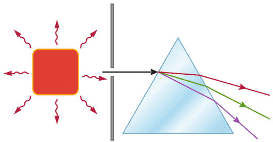
A blackbody is also a perfect emitter giving off electromagnetic waves at all frequencies. A detector could measure the intensity of the radiation it receives through the prism. By moving the detector to different positions, you could measure the intensity of light as a function of color or wavelength. (https://goo.gl/bqwl7K)

So each wavelength has a finite (not an infinitesimal) intensity? If we consider wavelengths in the interval [λ, λ + dλ] and each wavelength in this interval has a finite intensity, then the total intensity for this interval would be infinite because this interval has infinitely many wavelengths. Where am I going wrong? Are there not infinitely many wavelengths within this interval?
kw7II.png

Between the red and green beams there are infinitely many beams with a finite intensity, so the total for this interval would be infinite?
 
  • Like
Likes   Reactions: OmCheeto
Science news on Phys.org
You need to review the concept of integration. By your argument, any integral would be infinite. The point you are missing is that as the number of intervals [λ,λ+dλ] increases to infinity, the size of the interval dλ decreases to become infinitesimally small in such a way that the total sum remains finite.
 
  • Like
Likes   Reactions: Samama Fahim
I don't get it. For example the intensity of a red beam is x units. The neighboring beams would have an intensity between x + dx. If you add all the intensities and each of them has an x in them since they are greater than x, then for all the beams the sum of x's is infinite. How is it similar to finding distance which is an integral?
 
I think I see what you are missing. The spectral intensity at a given wavelength is given by:
B(\lambda, T) = \frac{2 h c^2}{\lambda^5}\frac{1}{e^{\frac{h c}{\lambda k T}-1}} ,
but if you want to know the total flux between λ and λ+dλ, you need to multiply this expression by dλ, giving:
B(\lambda, T) d \lambda = \frac{2 h c^2}{\lambda^5}\frac{1}{e^{\frac{h c}{\lambda k T}-1}} d \lambda
 
Intensity or intensity per wavelength band? I don't know why it is so confusing. I know how integral works, I don't understand the physics.
 
From a practical point of view, we can never measure the intensity of a single wavelength. Any measuring device has a wavelength range Δλ that it measures. Let's say we measure the intensity at λ0 with one instrument having a range Δλ1 and get a value of I1. Next we measure the intensity at λ0 with another instrument that has a smaller range, Δλ2, and get I2, where I2<I1. If we continue doing this with more and more accurate instruments, the resultant intensity measurement would continue to get smaller and smaller. In the limit as Δλ → 0, the measured intensity also → 0.

An analogy would be a probability density function, P(x). The probability of a value of region dx about x is given by P(x)dx. The probability of one specific value of x is 0 (dx = 0).
 
  • Like
Likes   Reactions: Samama Fahim
According to the Wikipedia article on Black-body radiation, the first equation in phyzguy's post is (noting that c = ν λ):

the power (the energy per unit time) of frequency ν radiation emitted per unit area of emitting surface in the normal direction per unit solid angle per unit frequency by a black body at temperature T

Note all the instances of "per." It is not power, but rather a power density type of function, similar to the probability density function.
 
So the measured intensity will go to zero as we shrink the wavelength interval? Is this like at any instant the distance traveled in that instant is zero? Δs → 0, as Δt → 0?
 
Samama Fahim said:
So the measured intensity will go to zero as we shrink the wavelength interval? Is this like at any instant the distance traveled in that instant is zero? Δs → 0, as Δt → 0?

I would say yes. Δs = v Δt (for constant velocity). I wouldn't make sense to ask how far a particle travels at a specific, single time t, but rather how far it moves in a time interval Δt.
 
  • Like
Likes   Reactions: Samama Fahim
  • #10
Apart from blackbody radiation case, any monochromatic light wave should have a zero intensity? Is that true?
 
  • #11
The intensity corresponding to anyone wavelength or frequency should then be zero. Like some wave EM wave with a single frequency has zero intensity?
 
  • #12
Samama Fahim said:
The intensity corresponding to anyone wavelength or frequency should then be zero. Like some wave EM wave with a single frequency has zero intensity?
I think you can say " The intensity of a single frequency in a blackbody radiation is zero" but I would like to talk about an example.
Consider a class of students. We can then plot a histograms of weights. That means we are distributing the total number into spectrum of the students' individual weights. You can say that the number of student with exactly 50kg = 0. However if we do the sum/ integral we can get the number of students to be some number.
We need to keep in mind that the y-axis on the histogram does not really mean number of students, but specific number of students. Just like the case in blackbody radiation we talked about specific intensity at a particular wavelength.
 
  • Like
Likes   Reactions: Samama Fahim
  • #13
Maybe it would be easier to think of it as counting photons. In your drawing in post #1, the red emitter is emitting a certain (finite) number of photons per second. The prism is splitting them up into wavelength bands, As you make the wavelength band dλ narrow and narrower, the number of photons per second arriving in that band gets smaller and smaller. In the limit of dλ=0, the number of photons per second arriving in that bandwidth goes to zero.
 
  • Like
Likes   Reactions: Samama Fahim
  • #14
Samama Fahim said:
The intensity corresponding to anyone wavelength or frequency should then be zero. Like some wave EM wave with a single frequency has zero intensity?

A plane wave, with a single frequency, is an idealization since it would have to fill all space.
 
  • #15
phyzguy said:
Maybe it would be easier to think of it as counting photons. In your drawing in post #1, the red emitter is emitting a certain (finite) number of photons per second. The prism is splitting them up into wavelength bands, As you make the wavelength band dλ narrow and narrower, the number of photons per second arriving in that band gets smaller and smaller. In the limit of dλ=0, the number of photons per second arriving in that bandwidth goes to zero.

What's the frequency/wavelength of these photons?
 
  • #16
Samama Fahim said:
What's the frequency/wavelength of these photons?

The source is emitting a large number of photons, each with a different wavelength, distributed according to the Planck law. Is that your question?
 
  • #17
Samama Fahim said:
Intensity or intensity per wavelength band? I don't know why it is so confusing. I know how integral works, I don't understand the physics.

I think I found it so confusing, as there are WAY TOO MANY WAYS to describe the measurement of light, IMHO.

per wiki: SI radiometry units
36, by my count.

It took me a weeks worth of googling, a lot of studying, and one nap, before I finally figured out why the y-axis on the "Planck's Law" graph was labeled in so many different ways.

wiki: kW/sr/m^2/nm
my first spreadsheet: W/m^2/sr/m
my current spreadsheet: W/m^2/sr/nm

ps. I think it was just last week that I solved this.
 

Similar threads

  • · Replies 29 ·
Replies
29
Views
5K
  • · Replies 1 ·
Replies
1
Views
2K
  • · Replies 15 ·
Replies
15
Views
1K
  • · Replies 3 ·
Replies
3
Views
2K
  • · Replies 3 ·
Replies
3
Views
2K
Replies
8
Views
5K
  • · Replies 56 ·
2
Replies
56
Views
13K
  • · Replies 23 ·
Replies
23
Views
3K
  • · Replies 4 ·
Replies
4
Views
3K
  • · Replies 17 ·
Replies
17
Views
3K