Static equilibrium: Placing a fulcrum

Click For Summary

Homework Help Overview

The discussion revolves around a problem related to static equilibrium, specifically focusing on the placement of a fulcrum under a bar with weights at either end. Participants are attempting to understand how to determine the position of the fulcrum based on the weights and the center of gravity.

Discussion Character

  • Exploratory, Conceptual clarification, Mathematical reasoning

Approaches and Questions Raised

  • Participants are discussing the relationship between the weights at either end of the bar and the position of the fulcrum. There are questions about the assumptions regarding the center of gravity and how to approach the problem systematically. Some participants are exploring the implications of torque and equilibrium conditions.

Discussion Status

There is an ongoing exploration of different methods to analyze the problem. Some participants have shared their initial thoughts and calculations, while others are questioning the assumptions and approaches taken. Guidance has been offered regarding the selection of points for torque calculations, indicating a productive direction in the discussion.

Contextual Notes

Participants are navigating the constraints of the problem, including the requirement to find the fulcrum's position and the implications of the weights' distribution. There is a mention of the need for clarity on the systematic approach to solving such problems in engineering contexts.

archaic
Messages
688
Reaction score
214
Homework Statement
A 0.140-kg, 45.4-cm-long uniform bar has a small 0.050-kg mass glued to its left end and a small 0.100-kg mass glued to the other end. You want to balance this system horizontally on a fulcrum placed just under its center of gravity.
How far from the left end should the fulcrum be placed?
Relevant Equations
##\sum\tau=0##
I don't understand the question; they're telling me that the fulcrum is just under the center of gravity of the bar, but that I also need to find its position.
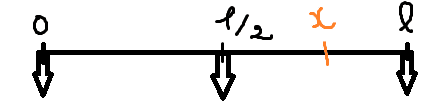
In any case, I suppose that the fulcrum's position is ##x##.
Untitled.png

Let the weight at the left end be ##w_1##, at the right end be ##w_2##, and of the center of gravity be ##w##.
Since ##w_2>w_1##, I'm going to suppose that ##x>\frac l2##.
$$w(x-\frac l2)+w_1x=w_2(l-x)\\x=l\frac{w_2+\frac w2}{w+w_1+w_2}=45.4\times\frac{0.100+\frac{0.140}{2}}{0.140+0.100+0.050}$$
 
Physics news on Phys.org
Ok, this is correct. I have first mindlessly put ##x## randomly less than ##l/2## and worked that way.
 
Generally, do engineers balancing such systems check from which side of the center of gravity the sum of the forces' component contributing to rotation is greater before setting up the equation? Or there is a systematic way?
 
If it isn’t moving the sum of the torques about any point must be zero. Pick a point, pick a sign convention for the torques, and the answer will come out right no matter what point you pick. Engineers don’t generally try to guess the right point. Instead they generally pick a point to make the math easy. For example, if there’s a force you don’t know use it’s location as the center of rotation and it’s torque is zero no matter what the magnitude. It drops out of the calculation. Similarly pick a place where several forces act to get them all out. Perhaps most the forces are perpendicular but one is at an unknown angle and you don’t want to have to figure out the components. Choose that as the origin. Etc.
 
  • Like
Likes   Reactions: Lnewqban

Similar threads

Replies
4
Views
2K
  • · Replies 4 ·
Replies
4
Views
9K
  • · Replies 1 ·
Replies
1
Views
2K
  • · Replies 2 ·
Replies
2
Views
8K
  • · Replies 5 ·
Replies
5
Views
2K
  • · Replies 1 ·
Replies
1
Views
2K
  • · Replies 15 ·
Replies
15
Views
3K
Replies
7
Views
1K
  • · Replies 2 ·
Replies
2
Views
3K
  • · Replies 5 ·
Replies
5
Views
2K