The fastest route between two points

  • Context: Undergrad 
  • Thread starter Thread starter ddddd28
  • Start date Start date
  • Tags Tags
    Points
Click For Summary

Discussion Overview

The discussion revolves around the problem of finding the fastest route between two points, considering different velocities before and after a border. Participants explore the implications of varying speeds and the complexity of minimizing travel time while accounting for distance and path selection.

Discussion Character

  • Exploratory
  • Technical explanation
  • Debate/contested
  • Mathematical reasoning

Main Points Raised

  • One participant describes the scenario of traveling from point a to point b with different velocities v1 and v2, noting the challenge of determining the optimal crossing point at the border.
  • Another participant suggests that the solution should be general and applicable to both cases of v1 being greater than v2 and vice versa, emphasizing that the problem should inherently resolve the path length issue.
  • A participant references standard calculus problems involving minimizing time rather than distance, drawing parallels to similar scenarios in textbooks.
  • One participant presents a mathematical expression related to the problem, indicating an attempt to derive a solution based on the parameters involved.
  • Another participant connects the discussion to principles of refraction and the least time path for light, suggesting a conceptual link to the original problem.

Areas of Agreement / Disagreement

Participants express differing views on how to approach the problem, with some emphasizing the need for a general solution while others focus on specific scenarios. The discussion remains unresolved, with no consensus on the optimal method or solution.

Contextual Notes

Participants note that the problem's complexity arises from the interplay between distance and velocity, and there are unresolved mathematical steps in deriving a solution. The discussion also highlights the dependence on the specifics of the velocities involved.

ddddd28
Messages
73
Reaction score
4
Hello,
Consider the next scenario:
I wish to travel from point a to point b as fast as possible. Between the points there is a border. In the region from a to the border, I can move only with velocity v1, and after the border, I am allowed to move only with velocity v2. All the additional details are given in the sketch:
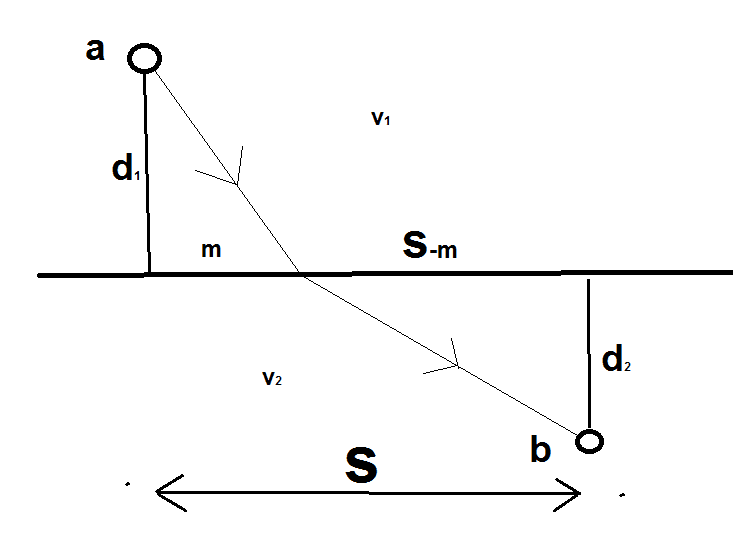
1564235532763.png

As it turns out, the problem is not as easy as it appears to be because it is not clear where I should pass the border. If v1 is bigger than v2 then I should consider taking a longer route in the first section to compensate on the time spent in the second section. However, a longer route in the first section adds up to the overall distance.
My attempt to solve it was to express the overall duration of the route as a function of m and minimize it. To my dismay, I ended up with a fourth-degree equation that didn't want to crack...
 
Physics news on Phys.org
ddddd28 said:
Hello,
Consider the next scenario:
I wish to travel from point a to point b as fast as possible. Between the points there is a border. In the region from a to the border, I can move only with velocity v1, and after the border, I am allowed to move only with velocity v2. All the additional details are given in the sketch:
View attachment 247182
As it turns out, the problem is not as easy as it appears to be because it is not clear where I should pass the border. If v1 is bigger than v2 then I should consider taking a longer route in the first section to compensate on the time spent in the second section. However, a longer route in the first section adds up to the overall distance.
My attempt to solve it was to express the overall duration of the route as a function of m and minimize it. To my dismay, I ended up with a fourth-degree equation that didn't want to crack...
No replies as yet so I will ask a question.
There will be different answers on this depending on which v is faster and by how much. Have you given all the details on this?
Some trig scenarios in there to play with.
I'm not a maths guy but I like the subject. @fresh_42 and @Mark44 will probably have 2 or 3 steps to solve!
 
ddddd28 said:
If v1 is bigger than v2 then I should consider taking a longer route in the first section to compensate on the time spent in the second section.
I don't get at all why that should be an issue. The solution needs to be general and has to encompass both situations automatically. I agree that it's a nasty problem but not because you can't decide in advance which path should be longer. That's what you are supposed to be SOLVING for, really.
 
This is a standard problem in calculus textbooks, where the goal is to minimize the time rather than the distance covered. Typical problems include scenarios in which you need to get to a point on the other side of a river, and your velocity while swimming or boating is different from your velocity on foot, as well as finding the path of least time for light passing through two different media.
 
  • Like
Likes   Reactions: pinball1970, SSequence, fresh_42 and 1 other person
I get : m = v1 √(d1^2+m^2) / ( v2 √(d2^2+(S-m)^2) + v1 √(d1^2 + m^2) )
 
Mark44 said:
Typical problems include scenarios in which you need to get to a point on the other side of a river, and your velocity while swimming or boating is different from your velocity on foot, as well as finding the path of least time for light passing through two different media.
Yes, refraction and the principle of least time was the first thing that came to my mind (since the kind of diagram, as in OP, is often associated with it).
 

Similar threads

Replies
0
Views
2K
  • · Replies 10 ·
Replies
10
Views
2K
Replies
14
Views
2K
  • · Replies 2 ·
Replies
2
Views
3K
  • · Replies 16 ·
Replies
16
Views
3K
  • · Replies 20 ·
Replies
20
Views
2K
  • · Replies 8 ·
Replies
8
Views
1K
  • · Replies 12 ·
Replies
12
Views
7K
  • · Replies 17 ·
Replies
17
Views
4K
  • · Replies 7 ·
Replies
7
Views
2K