The Set of Positive Integers - a Copy of the Natural Numbers

Click For Summary
SUMMARY

The discussion centers on Ethan D. Bloch's book, "The Real Numbers and Real Analysis," specifically Chapter 1 regarding the construction of real numbers and Theorem 1.3.7. Participants clarify that Bloch defines natural numbers as starting from 1, excluding 0, and debate the implications of the Peano Postulates, particularly the assertion that ##p \ne 1##. The consensus suggests a potential error in the text, proposing that it should state ##p+1 \ne 1## instead. Additionally, the conversation touches on the effectiveness of Bloch's presentation style, with some participants recommending alternative texts for clearer understanding.

PREREQUISITES
  • Understanding of Peano Postulates and their implications
  • Familiarity with the definitions of natural numbers in mathematical literature
  • Basic knowledge of mathematical proofs and theorem construction
  • Awareness of alternative mathematical texts and their presentation styles
NEXT STEPS
  • Review the Peano Postulates and their applications in number theory
  • Study alternative definitions of natural numbers in various mathematical texts
  • Explore the construction of integers as equivalence classes of natural numbers
  • Read A.G. Kurosh's "Theory of Groups" for a different perspective on group theory
USEFUL FOR

Mathematics students, educators, and anyone interested in foundational concepts of number theory and the construction of real numbers will benefit from this discussion.

Math Amateur
Gold Member
MHB
Messages
3,920
Reaction score
48
I am reading Ethan D. Bloch's book: The Real Numbers and Real Analysis ...

I am currently focused on Chapter 1: Construction of the Real Numbers ...

I need help/clarification with an aspect of Theorem 1.3.7 ...

Theorem 1.3.7 and the start of the proof reads as follows:
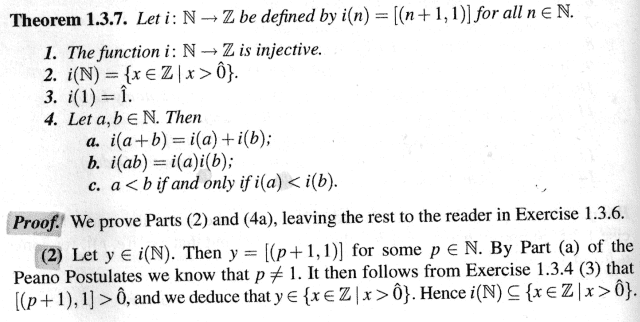
?temp_hash=eef1873f98a47f5c694b92208af85698.png

n the above proof we read the following:" ... ... By Part (a) of the Peano Postulates we know that ##p \ne 1##. ... ... "Can someone please explain exactly how the Peano Postulate (a) implies that ##p \ne 1## ... ?
Help will be much appreciated ...

Peter
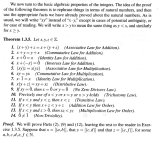
Readers of the above question may well be helped by access to Bloch's definition of the integers as well as Bloch's theorem on the algebraic properties of the integers ... so I am providing both as follows:
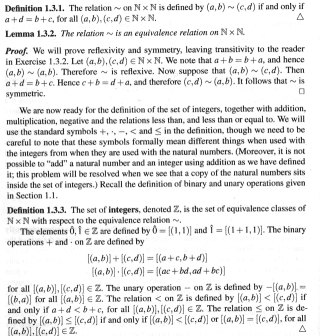
?temp_hash=eef1873f98a47f5c694b92208af85698.png

?temp_hash=eef1873f98a47f5c694b92208af85698.png
 

Attachments

  • Bloch - 1 - Theorem 1.3.7 - PART 1 ... ....png
    Bloch - 1 - Theorem 1.3.7 - PART 1 ... ....png
    37 KB · Views: 1,499
  • Bloch - Defintion of Integers ... ....png
    Bloch - Defintion of Integers ... ....png
    35.3 KB · Views: 574
  • Bloch - Algebraic Properties of Integers ... Theorem 1.3.5 ....png
    Bloch - Algebraic Properties of Integers ... Theorem 1.3.5 ....png
    5.7 KB · Views: 538
Physics news on Phys.org
Hi Peter.

Two more things are needed in order to understand and respond to this problem.

(1) Under Bloch's definition, is 0 included in the natural numbers?

(2) Which Peano postulate does he label as (a)? So far as I can see, your attachments do not show Bloch's labelling of the postulates. My guess is that it is postulate (9) in this wiki formulation, since that is the only one that makes a 'is not equal to' assertion. But I can't be sure and also, this issue is tangled up with the question of whether 0 is a natural number in Bloch's set-up.

Andrew
 
  • Like
Likes   Reactions: Math Amateur
andrewkirk said:
Hi Peter.

Two more things are needed in order to understand and respond to this problem.

(1) Under Bloch's definition, is 0 included in the natural numbers?

(2) Which Peano postulate does he label as (a)? So far as I can see, your attachments do not show Bloch's labelling of the postulates. My guess is that it is postulate (9) in this wiki formulation, since that is the only one that makes a 'is not equal to' assertion. But I can't be sure and also, this issue is tangled up with the question of whether 0 is a natural number in Bloch's set-up.

Andrew
In answer to your Question 1 ... Bloch regards the natural numbers, ##\mathbb{N}## as ##1,2,3, ... ... ## ... , that is not including 0 ...

In answer to your Question 2 ... I should have included the Peano Postulates or Axioms ... so here they are ... ...
?temp_hash=fa5a74c242e885d6d2af2fc6fdeda236.png


Apologies for omitting this information ... ...

Peter
 

Attachments

  • Bloch - 1 - Peano Postulates ... . ....png
    Bloch - 1 - Peano Postulates ... . ....png
    17.6 KB · Views: 564
Thanks. Based on that it looks like the author has made a mistake. He should have written ##p+1\neq 1## rather than ##p\neq 1## (since ##p+1=s(p)##).

Based on this and the previous example from Bloch you posted, I am tending towards mathwonk's view that this may not be a very good textbook, that is going to cause unnecessary grief by the obscurity of its presentation, not to mention mistakes like this.
 
  • Like
Likes   Reactions: jim mcnamara and Math Amateur
andrewkirk said:
Thanks. Based on that it looks like the author has made a mistake. He should have written ##p+1\neq 1## rather than ##p\neq 1## (since ##p+1=s(p)##).

Based on this and the previous example from Bloch you posted, I am tending towards mathwonk's view that this may not be a very good textbook, that is going to cause unnecessary grief by the obscurity of its presentation, not to mention mistakes like this.
Thanks Andrew ...

Regarding the text ... I will certainly take account of your (and others) warning about the text ... will however persevere a bit further ...

Thanks again ...

Peter
 
Hi Peter,

may I ask you, why you want to go through these very fundamental constructions? In my opinion this doesn't provide real insights. At best it's a training ground for basic reasoning, e.g. by the introduction of integers as equivalences classes of pairs of natural numbers. This is a bit unusual and in my view, not really of value. However, if you do want to tackle these topics in such a basic manner, I think you should try to prove those theorems on your own, and only take Bloch's proofs as an outline what to do and along which ways the arguments evolve. You're always welcome here to check, whether your proofs are correct (... if you'll use less empty lines in your posts ... the scrolling drives me crazy :wink: ...)

I have a really beautiful book about group theory, which is written almost entirely without formulas, o.k. very few formulas. It isn't an easy read, as I have been taught in a more formal, Bourbaki stylish way. The book provides really interesting perspectives and it's somehow entertaining to read about group theory like a novel. But this is by no means a short way to learn the topic and I never made it cover to cover.

Those presentations above remind me on this book: nice and entertaining but not suited to study the topic. It distracts by its methods whereas it should present the concepts and ideas instead.
 
Thanks fresh_42 ...

Reflecting on your viewpoint ...

Peter
 
@fresh_42 Surely you won't tease us by telling us about such a great group theory book without naming it?
 
Infrared said:
@fresh_42 Surely you won't tease us by telling us about such a great group theory book without naming it?
It's A.G. Kurosh: Theory of Groups: Volumes One & Two, at least I hope this English version is identical to mine. I wasn't sure, if I really should mention it, as the way the results are presented is a bit old fashioned.

Edit: B.L. van der Waerden's Algebra books (https://www.amazon.com/dp/0387406247/?tag=pfamazon01-20) are also a bit old fashioned with much text, but easier to read (IMO) and most of all: significantly cheaper.
 
Last edited:
  • Like
Likes   Reactions: Fervent Freyja

Similar threads

  • · Replies 3 ·
Replies
3
Views
2K
  • · Replies 7 ·
Replies
7
Views
2K
  • · Replies 3 ·
Replies
3
Views
4K
  • · Replies 2 ·
Replies
2
Views
2K
Replies
4
Views
2K
  • · Replies 4 ·
Replies
4
Views
2K
Replies
4
Views
2K
  • · Replies 4 ·
Replies
4
Views
3K
  • · Replies 3 ·
Replies
3
Views
2K
  • · Replies 7 ·
Replies
7
Views
3K