Thermochromatic liquid crystals, how do they change color?

Click For Summary

Discussion Overview

The discussion centers on the color-changing properties of thermochromatic liquid crystals, particularly in applications like mood rings and liquid crystal thermometers. Participants explore the underlying mechanisms of color change related to the cholesteric liquid crystal phase and the interaction of light with these materials.

Discussion Character

  • Exploratory, Technical explanation, Debate/contested

Main Points Raised

  • One participant describes the cholesteric liquid crystal phase and how the alignment of layers affects color change, mentioning the concept of "pitch" related to light wavelength.
  • Another participant notes that light passes through the liquid crystal dye twice, involving reflections that contribute to the observed color change.
  • Some participants express uncertainty about the role of the backing layer, suggesting it may absorb light rather than reflect it, leading to questions about how specific wavelengths, like red light, are reflected while others are transmitted.
  • A later reply clarifies that the polarizer does not cancel out all light but instead modifies it, yet questions remain about the selective reflection of red light based on the pitch length.

Areas of Agreement / Disagreement

Participants do not reach a consensus on the mechanisms behind the selective reflection of red light versus other wavelengths, indicating ongoing uncertainty and debate regarding the underlying physics.

Contextual Notes

Participants acknowledge limitations in their understanding of how the liquid crystal structure interacts with light, particularly regarding the assumptions about the backing layer's properties and the specific conditions under which color changes occur.

Coolcrab
Messages
11
Reaction score
0
If you look at liquid crystals in things like moodrings and LCthermometers then you will notice that they can change color when heated.

Now I have looked on the internet and found that it has to do with the The cholesteric (or chiral nematic) liquid crystal phase, where they align with each other in layers but are slightly tilted across layers. Example:
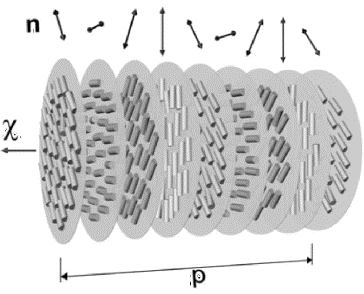
image006.gif


I also know that they reflect the light which has the wavelength of a full rotation of the crystals, this being called the "pitch". (see pic)

So if they rotate at such an angle that they make a full rotation in P = lambda Red, then it will look red.

But I do not know why. If I look at this picture, then it looks like a polariser that goes in all directions:
http://plc.cwru.edu/tutorial/enhanced/files/lc/phase/Graphics%5Cschem.BMP Which would cansel out all the light, and not reflect any.

So can anyone tell me what's going on here?
 
Last edited by a moderator:
Science news on Phys.org
I don't think that it has to do with reflection of the back, as they say that that's often black to absorb everything that comes trough.
So it has to reflect all red light, while letting trough all the other light. But I don't see why or how.

And yea I, saw that source :P
 
I now know that the poleriser would not cansel out all the light, but rather repolerise/absorb a bit.
But I still don't get why red light would be reflected, while the rest is let trough.

Edit: red light in the case the the pitch has the length of red light's wavelength
 

Similar threads

  • · Replies 7 ·
Replies
7
Views
2K
  • · Replies 1 ·
Replies
1
Views
1K
  • · Replies 6 ·
Replies
6
Views
20K
  • · Replies 21 ·
Replies
21
Views
6K
  • · Replies 5 ·
Replies
5
Views
3K
  • · Replies 5 ·
Replies
5
Views
3K
  • · Replies 19 ·
Replies
19
Views
19K