Thevenin and Norton equivalent circuits

Click For Summary

Discussion Overview

The discussion revolves around the process of finding the Thevenin and Norton equivalent circuits, focusing on the combination of resistors in a specific circuit configuration. Participants explore methods for calculating equivalent resistance and voltage, as well as the implications of these calculations for circuit analysis.

Discussion Character

  • Homework-related
  • Technical explanation
  • Exploratory

Main Points Raised

  • One participant expresses difficulty in grouping resistors for Thevenin and Norton equivalents and presents their calculations for equivalent resistances.
  • Another participant suggests redrawing the circuit with load nodes clearly defined to simplify the analysis.
  • A different participant advises omitting the load when determining the Thevenin equivalent and suggests calculating the Thevenin voltage first.
  • One participant acknowledges a misunderstanding and proposes sharing links to resources that explain the process of solving such problems.
  • Another participant proposes a method of checking the Thevenin equivalent by calculating the short-circuit current and comparing it to the derived values.
  • A participant provides detailed calculations for the short-circuit current and the current through each resistor, showing their reasoning and results.

Areas of Agreement / Disagreement

Participants do not reach a consensus on the best approach to calculate the Thevenin and Norton equivalents, with multiple methods and perspectives presented. Some participants agree on the importance of redrawing the circuit, while others focus on specific calculations.

Contextual Notes

The discussion includes various assumptions about circuit configurations and the treatment of loads, which may affect the calculations and interpretations of the Thevenin and Norton equivalents.

TwinCamGTS
Messages
18
Reaction score
0
Hi guys,
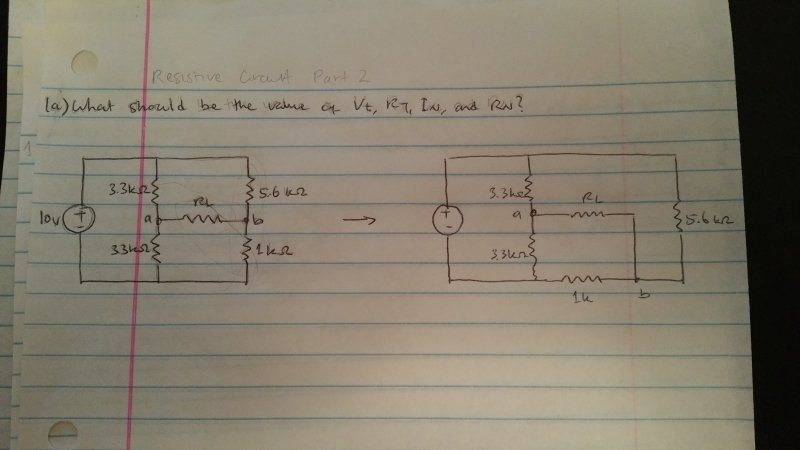
Sorry if all you guys think this question is too easy. But I have a hard time to understand how to group the resistor. I suppose to find the the thevenin and Norton equivalent circuit. This is what i think about the combination of resistor.

Req1= RL+1k
Req2= Req1 ll 3.3k (3.3k after node a)
Req3= Req2 + 3.3k (3.3k before node a)
Req4= Req3 ll 5.6k

Is my prediction correct?
20150209_033447.jpg
 
Engineering news on Phys.org
I have no idea what you mean. I always find it best to redraw the circuit with the load nodes A and B shown on the right, one above the other, with the rest of the circuit redrawn as simply as possible to accommodate that and THEN worry about series/parallel reductions.
 
When you redraw the circuit, omit the load. The load is not part of the Thèvenin equivalent of the source.

You might understand things better if you first work out the Thèvenin voltage, and leave the resistance calculation until last.

 
:blushing:
First of all I have to apologize for my mistake!
I thought it was a very simple question and
it was only an example how to proceed generally.
I think it was better to recommend a link how to solve this kind of problems. There are a lot of links on the web treating specifically this.

For instance: http://www.calvin.edu/~svleest/circuitExamples/TheveninNorton/
 
As a check, you could imagine a short-circuit wire between a and b, and calculate how much current would flow. Does your Thévenin equivalent suggest that same value?
 
Last edited:
Babadag said:
:blushing:
First of all I have to apologize for my mistake!
I thought it was a very simple question and
it was only an example how to proceed generally.
I think it was better to recommend a link how to solve this kind of problems. There are a lot of links on the web treating specifically this.

For instance: http://www.calvin.edu/~svleest/circuitExamples/TheveninNorton/
Yes, and people with initiative will generally look for such solutions online but some just come here, which is fine, and we try to help them HERE rather than just doing the online search that they could have done for themselves.
 
Thank you NascentOxygen .The short-circuit current according to Thevenin rule V=I*Rth+Vth

If V=0 then Isc=-Vth/Rth Isc=-3.485/2.4985=-1.39484 mA.

If we shall short-circuit point a and b the total current will be 10/(3.3*5.6/(3.3+5.6)+3.3*1/(3.3+1))=3.51636 mA.

The current flowing in each resistance will be:

for 3.3k 3.51636*5.6/(3.3+5.6)=2.2125 mA.

for 5.6k 1.3038 mA.

for second 3.3k -0.81776 [it leaves the point a].

and for 1k -2.6986mA[it leaves the point b].

The sum of currents in point a will be:

Isca+2.2125-0.81776=0 Isca= -1.3948 mA.

-Iscb+1.3038-2.6986=0 Iscb=-1.3948
 

Attachments

  • upload_2015-2-19_12-33-45.png
    upload_2015-2-19_12-33-45.png
    2.5 KB · Views: 569

Similar threads

Replies
12
Views
2K
  • · Replies 9 ·
Replies
9
Views
6K
  • · Replies 5 ·
Replies
5
Views
2K
  • · Replies 9 ·
Replies
9
Views
3K
  • · Replies 1 ·
Replies
1
Views
2K
Replies
10
Views
3K
  • · Replies 2 ·
Replies
2
Views
5K
  • · Replies 2 ·
Replies
2
Views
8K
Replies
3
Views
2K
  • · Replies 4 ·
Replies
4
Views
2K